A looooong Investigation in Collin County

The Collin County Observer first broke the story of the looooong investigation of one of the sitting judges in Collin County.  (The other judge investigation was already dismissed).

For most news stories, the story would be about the wrongdoing of the judges being investigated.  But once again, for Collin County, the focus seems to be on the accusers -- the Collin County District Attorney's office. 

You see, the CCO and I have chronicled the empty prosecutions and misguided policies of the DA's office in the past:

- Targeting Judges?
- Collin County DA Denies Citizen From Pleading Guilty
- DMN -Collin drug defendant wants to plead guilty to judge, but DA won't let him
- Court releases Willis Grand Jury report
- Arguing against a new trial in case where judge and (FORMER) District Attorney that they had previously been in an adulterous affair.
- Courthouse commandos receive order: "Return to Barracks"
- Allegations of fraud between Dallas County Sheriff Bowles and jail contractor Jack Madera. All indictments were later tossed out because the charges in the indictment were not criminal offenses
- Indictment of two Defense Attorneys - later dismissed.
 

The CCO's story, "The DA vs. the Judge" or "In re: Grand Jury Proceedings" was followed up today by an article by Ed Housewright in the Dallas Morning news.  Ed's article, "Collin County DA's investigation of judge taking too long, ex-prosecutors say" details the yearlong investigation which has so far culminated in nothing.

The article quotes myself and two other former prosecutors who were all critical of the happenings and investigations by the office.

Unfortunately it would seem we are faced with the DA who cried wolf.  The accusations seem to come so often, that when real corruption does actually come up, I'm afraid no one will notice.

Targeting Judges?

Yesterday, our firm found ourselves in an odd position.  A case of ours was set for trial, and we were ready to go. (That's not the odd part).  The odd part is that although we were willing to waive the jury and allow the judge to make the determination of guilt, the state wouldn't allow it.

In general, the only reason the state would oppose this is because  they think they would have a better chance of a guilty verdict with a jury rather than the judge.  Conversely, a defense attorney would do this if they think they have a better (or equal) chance with the judge.  In this case, we knew the facts of the case, and were very confident of a not guilty no matter who was looking at it.

So we attempted to save our citizens some time, and let the judge decide.  But as has recently been pointed out by the front page article in the Dallas Morning News (just one day earlier), the State has a right to a jury trial.

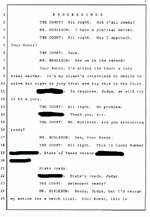
A quote from the article was running through my mind when the prosecutor said that they wouldn't waive a jury.  Although we asked why, they refused to say why, except to proclaim "we have a right to a jury." Transcript Page I, Transcript Page II.  (Sound like a recent appellate attorney for the State?)

From the DMN article:

Roach said his office does not target specific judges as some allege. "That's an ignorant statement," he said. The law says prosecutors are entitled to demand a jury trial "and it doesn't make any difference what our motives are."

Yet avoiding specific judges seemed to be exactly what was going on in our case.

It needs to be pointed out, that this specific case, the issue was not about who was going to be doing the punishing in the case (as the DMN article was about).  This case was about having a judge or a jury decide the verdict of guilty or not guilty.  So although the quote is telling about the mindset of the District Attorney's office -- it's not directly on point.

So, instead of having the one judge decide, the State insisted on the jury.  About 25 jurors were brought in for the day.  Of those 25 jurors, 6 were selected for the jury and sat through a day and a half of trial.

Oh yeah, the verdict? Not Guilty. I'm sure the jurors were glad to have to take off work.


DMN -Collin drug defendant wants to plead guilty to judge, but DA won't let him

Always nice to see the Dallas Morning News reporting on Collin County justice issues.  (Even nicer when they quote me). 

This case was first reported by the CCO, and then a lengthy response and explanation of the law was made by me

Basically, the guy wanted to plea guilty and let the judge punish him.  The DA refused to allow that, which left him but one option.  Plea Not Guilty, and elect the judge to sentence him. At that point, there is a sham trial, which involves about 60 citizens (in this case, possibly 240 citizens, because there were 4 charges), a judge, bailiff, prosecutor, and defense attorney who could all be doing better things with their time.  After the sham trial, the judge sentences the defendant, just like he was asking for in the first place!

Unfortunately, this concept does not seem to bother the District Attorney.  That or we are both arguing different issues.  I say we are arguing different issues, because in the article, the response doesn't seem to address the issue/point the article and I sought to make:


Roach stands by his policy to adhere to the law that allows him to refuse to let judges accept pleas without his consent. Even though the law allows Blackburn to be sentenced by a judge after a jury trial.

"I don't think it's a waste of taxpayer money for fellow citizens to make a determination about whether a person is guilty of a criminal offense."

The point the article and I sought to make is that the DA cant stop a judge from sentencing a person.  They jury serves no purpose, and is not needed to make a determination of guilt -- because the defendant conceded to his guilt.  


Below is the entire text of the article:
____________________________________________________


Collin drug defendant wants to plead guilty to judge, but DA won't let him

06:37 AM CDT on Monday, March 22, 2010
By DIANE JENNINGS / The Dallas Morning News
djennings@dallasnews.com

Robert Blackburn wants to tell a judge that he's guilty. But the people charged with punishing him – the prosecution – won't let him.

When visiting Judge John McCraw tried to allow Blackburn to plead guilty to drug possession charges, saying taxpayers should not have to pay for unnecessary trials, the ruling set off a flurry of legal maneuvers in which the Collin County district attorney's office asserted its right to demand that a jury hear the case rather than let him plead guilty to the judge.

"We're not up here just going through the motions," District Attorney John Roach said. "We have reasons for everything we do – our reason has to do with the promotion of justice."

The spat between judge and district attorney has created a stir in legal circles and the blogosphere. But Roach says the brouhaha over forced jury trials in Collin County, which has arisen occasionally in other counties, is due to "defense lawyers that don't like being made to go to trial."

Roach declined to discuss the Blackburn case, citing pending litigation. But in a peculiar twist due to Texas law, if Blackburn goes to trial, he can demand to be sentenced by the judge, putting the case back where it started after considerable taxpayer expense. Blackburn's attorney is promising to take the issue to the Supreme Court to allow his client to plead guilty to a judge.

Roach said his office doesn't think it is an "honest process" to accept open pleas in which the accused pleads guilty to the judge and the judge decides the punishment without approval by the prosecution.

"A lot of time the defendant and the state, it's just a wink and nod and forcing the judge to decide what the punishment should be," said Roach, who also is a former judge.

Few cases go to jury

Despite the hallowed American right of defendants to face a jury of their peers, 99 percent of criminal cases in Texas never go to trial. Guilty pleas are the grease that keeps the system moving, because it would break down if everyone entitled to a jury trial demanded one.

Texas is one of a handful of states that allow jury sentencing; most leave that task to a judge. But in the few states that do, if you demand a jury trial, you get jury sentencing. Texas is the only state that allows the defendant to choose who sentences the guilty – judge or jury. Only if a Texas defendant pleads guilty to a jury must he or she be sentenced by the jury.

Juries generally are considered less predictable than judges when it comes to punishment.

And in Texas, like many other states, prosecutors must agree to a defendant's decision to waive a jury trial and go before a judge.

Though it is unusual for prosecutors to demand trial when the defendant wants to plead guilty, it's not unheard of.

"It's costly, but it might serve some educational purpose for the public to air the facts," said Nancy King, law professor at Vanderbilt University. "It's a way to test the proof, if there's some doubt about whether the offense actually occurred."

Shannon Edmonds, government liaison for the Texas District and County Attorneys Association, said a trial also might \enable the judge to "learn something new in that trial he wouldn't have learned otherwise," and give the victim "their day in court, which they don't get to do if there's a plea."

But judge shopping – by the defense or the prosecution – is always a possibility.

In Blackburn's case, McCraw thought he saw just that. In his December ruling, McCraw accused the district attorney's office of "forum shopping for a particular judge to fix the punishment."

Assistant District Attorney John Rolater, who is handling the Blackburn case, denied it in court.

Attorneys cannot request that a case be assigned to a specific judge, but they can try to gauge a judge's calendar to see when he or she will be presiding.

Hunter Biederman, a Collin County defense attorney who was in court the day McCraw accepted Blackburn's plea, said efforts by prosecutors to avoid certain judges are outrageous.

"If we're going to elect our judges, who are supposed to be neutral magistrates, why are we going to take that [sentencing] power away from them?"

Roach said his office does not target specific judges as some allege. "That's an ignorant statement," he said. The law says prosecutors are entitled to demand a jury trial "and it doesn't make any difference what our motives are."

Rolater also pointed out in court that without a trial, a judge could give Blackburn deferred adjudication in which the accused's record is wiped clean if he or she completes this special probation. Authorities said Blackburn, 27, tried to swallow the evidence and scuffled with an officer. He faces four felony counts.

Prosecutors opposed deferred adjudication in Blackburn's case. But McCraw called that argument a "straw man" because Blackburn did not request deferred adjudication.

"The state wants to control who sets the punishment hearing," McCraw said. "Is that what the fight is about here?"

DA's reasons debated

Biederman, who wrote about the twists and turns of the Blackburn case extensively on his blog, mentioned other reasons the district attorney's office might insist on trials in cases in which defendants want to plead guilty, including giving rookie prosecutors courtroom experience or inflating the district attorney's conviction rate for political purposes.

Roach dismissed those ideas as well, pointing out that young attorneys cut their teeth in misdemeanor court, not felony court, and saying his office doesn't need to "pump up" its conviction rate.

"I'm hired by the people of Texas to try criminal trials – that's what we do," he said. "Who wants an idiot for the district attorney who won't work to try a case?"

When McCraw allowed Blackburn to plead guilty over prosecutor's objections, he said, "I would submit the United States Constitution allows a defendant the right to enter a plea based on the court's request."

McCraw cited "judicial economy" in his ruling, saying the county should not have to pay for up to four jury trials at a cost of about $5,000 per trial when the defendant is willing to plead guilty.

Other costs related to any trial – attorney fees, costs to jurors' time – also would be incurred.

An appellate court overruled McCraw, citing the state law that says the case must go to trial because the prosecutor and judge must consent to the waiver of a jury trial and saying Blackburn failed to "specifically raise a constitutional argument for this court to address."

Blackburn's attorney, Michael Curran, said he is filing a motion asking the appellate court to rehear the issue. If he loses in state courts, as others challenging the law have done, "This thing can go all the way to the U.S. Supreme Court," he said. "I intend to take this as far as I can."

Roach stands by his policy to adhere to the law that allows him to refuse to let judges accept pleas without his consent. Even though the law allows Blackburn to be sentenced by a judge after a jury trial.

"I don't think it's a waste of taxpayer money for fellow citizens to make a determination about whether a person is guilty of a criminal offense."


Collin County District Attorney Race - Videos

Recently, several candidates for the Republican primary came to the Allen Area Patriots club to discuss the race for Collin County District Attorney.  Videos of the candidates were uploaded to youtube, and I have added them here to the blog.  A big thank you to "mopenshaw" whoever you are.You can read bios of the candidates on my previous post HERE.

JEFF BRAY

GREG WILLIS


JAMES ANGELINO


PAST ARTICLES ON COUNTY RACES

 Hunter Biederman is a DWI / Criminal Defense Attorney in Collin County. He publishes his blog (www.friscodwilawyer.com) which focuses on the Collin County and Texas legal system. He can be reached at friscolaw@gmail.com or (888) DWI-FRISCO.

Collin County DA Denies Citizen From Pleading Guilty

A couple of weeks ago, I happened to be present in the 429th District Court and saw an individual, Mr. Robert Blackburn trying to plea guilty, but was barred in doing so by the Assistant District Attorney.  I didn't think too much of it at the time, because I have seen the DA do this many times -- including to my clients.

What happened differently on this occasion, is that the (visiting) Judge John McCraw stood up to this ridiculous practice. I was pleased to read a great article by the Collin County Observer reporting the incident and subsequent appeal by the DA.

The Law

First, lets go through how a criminal case is disposed.

A person accused of a crime may either plea guilty or plea not guilty regarding criminal charges against them.

Plea Not Guilty

Texas has a bifurcated trial system, meaning "two parts."  The first phase is to determine whether or not a person is guilty, the second phase is to determine punishment (if found guilty).  Obviously if found not guilty, there is no punishment phase.  As far as the second phase goes, one must choose before the trial begins as to whether or not to have the judge or jury handle sentencing if found guilty.

1. Plea Not Guilty, Judge Punishment:  A citizen requests a jury to determine if they are guilty or not guilty, and if  found guilty, elect the judge to impose punishment.  This is the most common, as most attorneys know that judges get to see lots of cases and can understand the seriousness/non-seriousness of the particular crime.  Additionally, it is easier for an attorney to advise a client on the likely punishment if you know who will be doing the sentencing opposed to jurors you have never met.

2. Plea Not Guilty, Jury Punishment: A citizen requests a jury to determine if they are guilty or not guilty, and if found guilty, elect the jury to impose punishment.  If in front of a tough, unreasonable, or unknown judge, one might elect a jury of their peers to decide their fate. 

Plea Guilty

1. Negotiated Plea:  This is the most common plea.  The DA and the citizen (often with the help of their attorney), negotiate a punishment, and they plea and receive punishment.

2. Non-Negotiated "Slow" Plea: If a citizen accused wants to plea, but cannot agree with the DA on punishment, they can enter a "slow plea."  This means the accused will plea guilty, but allow the jury to assess the punishment.

2. Non-Negotiated "Open" Plea: If a citizen accused wants to plea, but cannot agree with the DA on punishment, they can enter an "open plea."  This means the accused will plea guilty, but allow the judge to asses the punishment.

The Case

In this case, the defendant, Robert Lee Blackburn was charged with 4 felonies after he bit a Plano Police officer while being arrested for possession of cocaine. It seemed that everyone agreed as to his guilt, but there was no agreement on what the punishment would be.

Mr. Blackburn and his attorney agreed he should plea guilty, and wanted the presiding Judge (in this case, Judge Jill Willis) to assess punishment.  Mr. Blackburn wanted to plea guilty in an "open plea," but the District Attorney refused to allow him to do so.  They did this by invoking the State's right to a Jury Trial. 

In Texas, the State has a right to a jury trial.  It's a bit silly in my opinion, but too complicated to debate in this article the legality of the whole issue.  I'll save that for another article.

By invoking the right to a jury trial, it means that a defendant CANNOT enter an "open plea."  This means that if Mr. Blackburn wants a judge to assess his punishment, he must plea not guilty, go through the farce of a jury trial, and elect the judge to impose the sentence. 

That is exactly what the Assistant District Attorney, Gary Knapp forced upon Mr. Blackburn's.  I do not know if this was his personal decision, or if someone higher up in the office instructed him to do this. (The Observer reported and provided a transcript showing Appellate Chief John Rolater who was arguing the case -- which is accurate at the second hearing.  Originally it was Knapp barring the plea of guilty, and calling  the Appellate department for assistance).  In this case, the Judge did not allow the State to invoke their right to a jury trial, and ordered the plea be accepted.  The State has since appealed, and the case is in limbo until the appellate court reaches a decision.

Why would the DA force a "sham" trial on a defendant when everyone agrees on their guilt?

There can be several possible reasons, none of which seem justified to me:

1. Forum Shopping - Forum shopping is an attorney (on either side of the case) attempting to pick what judge is going to hear a case.  Defendant's cases are randomly assigned to courts, so one cannot pick a judge.  However, visiting judges are often called in when judges are out of town, or want to run a "double-docket," to help clear out some cases. 

I am almost positive I heard the DA that if Mr. Blackburn wanted to plea to a visiting judge, they would allow it, but not to the presiding judge.  I cannot remember for sure, and am not willing to make this claim positively.  I wish that a transcript available of the hearing that took place before the appellate department got involved.  That is where the true hearing took place.  I personally believe forum shopping was part of the reason why the DA did not allow the plea.

2. Padding Statistics - This is political gamesmanship. If a DA wants to boast about their conviction rate, they can pad the stats.  I have seen Collin County DA literature boasting about conviction rates in the past. Additionally, if a prosecutor wants to look good to their superiors, they will try to win as many cases as possible.

The DA can offer really tough plea bargains to a defendant.  This will bar someone from pleading guilty in a negotiated plea.  In a court where the defendant chooses to allow the judge to accept punishment, this will force a trial if the state invokes their right to a jury trial.  The DA will have a slam dunk case of guilt, and get to put it down as a win.

They will additionally get to put it up on the "Board" which is at the DA's office.  The "Board" is where attorneys write down their trials they are having that week, along with the results.  It was there when I was an assistant district attorney, and assume it is still there.

3. Practice for young prosecutors:  I guess if someone wants some experience in a trial, they could force a sham trial just to get some experience.  This is not what happened in this case, because these are felony prosecutors with plenty of trials under their belts already. 

4. Manipulating the Punishment Range: The entire range of punishment is available to either a judge or a jury.  With one exception: Deferred Adjudication.  A citizen accused can only get deferred adjudication from a judge after a guilty plea (negotiated, or not negotiated).  By barring a person from pleading guilty, the DA is barring the possibility of them getting Deferred Adjudication.  Basically usurping the elected Judge's powers.  The DA in this case says this is the reason for their behavior, however I have personally seen them do this in cases where the client is not even deferred eligible.  I don't see why the DA would stop an elected presiding Judge (or in this case, a judge appointed by Governor Rick Perry) from doing the job they were put there to do.

My hope is that with this article, one of the new candidates for District Attorney will stop this archaic practice of barring a person from pleading guilty to an elected Judge thus forcing a sham trial.  In the end, it is about the difference of what should be done, versus what can be done.  After about seven years of the same elected District Attorney, I think a new DA will be the only factor that change this practice.

DOCUMENTS


Petition for Writ of Mandamus, In re John Roach, Fifth COA case number 05-09-01451-cv

Reporters Record, December 3, 2009 Texas vs Robert Lee Blackburn

Order granting Emergency Motion for Temporary Relief, In re John Roach, Court of Appeals, Fifth District.

Link to Court of Appeals case 05-09-014510-CV, In re John Roach

Link to Collin County cases 199-80283-08, 199-80284-08, 199-80285-08, 199-80286-08, State vs. Robert Lee Blackburn

Hunter Biederman is a DWI / Criminal Defense Attorney in Collin County. He publishes his blog (www.friscodwilawyer.com) which focuses on the Collin County and Texas legal system. He can be reached at friscolaw@gmail.com or (888) DWI-FRISCO

The Race for Collin County District Attorney

Collin County's District Attorney will have a new face at the helm beginning January 2011.  Two term District Attorney John Roach has announced that he will not be seeking re-election.  Following that announcement, several candidates have announced their intentions to run for the position.  The Collin County District Attorney is charged with prosecuting all Felonies and Misdemeanors within the County.  There are about 60 attorneys that work for the elected District Attorney, along with support staff and investigators.  All candidates are running in the Republican primary, with the exception of Rafael De La Garza, who is running as a Democrat.

The Candidates:

GREG WILLIS

Greg Willis recently resigned as the judge of Collin County Court Six in order to run for District Attorney.  Mr. Willis served as a judge for the court after being appointed in 2006 until his recent resignation.  Prior to being a judge, Mr. Willis opened his own law firm in Plano, and his wife Jill (now a district judge) joined him at the firm. The Willis Law Firm was a general law practice, handling primarily criminal, employment and family matters. During this time, Mr. Willis served as President of the Collin County Bar Association and was twice named a SuperLawyer® by Texas Monthly. Mr. Willis also previously worked as a prosecutor at the Collin County District Attorney's office, and at the law firms, Haynes & Boone, LLP and Jones Day LLP.

A fifth generation Texan, Mr. Willis has stated that "[m]y experience as a judge, prosecutor, and attorney will enable me to serve in an effective manner from day one.  As your District Attorney, I vow to aggressively prosecute crimes against children, sexual and domestic assaults, and drunk driving.  Together we can keep Collin County safe, secure, and prosperous."

More about Greg Wills can be found on his campaign website, www.gregwillis.org.

K. JEFFERSON  BRAY (JEFF BRAY)

Jeff Bray currently serves as the Senior Legal Advisor to the Plano Police Department.  He has 11 years experience as a prosecutor, and is Board-certified in Criminal Law by the Texas Board of Legal Specialization.  Mr. Bray is a fifth generation Texan and graduate of Texas A&M.

Mr. Bray has vowed to use smart prosecutions and his relations with local law enforcement to make the office more efficient.  He has also taken aim at  white collar crime, and especially identity thieves, vowing mandatory jail time for those offenders. 

"I love my job at the Plano Police Department, but I am a prosecutor at heart. A man is lucky indeed if he can find a job that he loves and that also allows him to give back to his community. For me, that job is Collin County Criminal District Attorney."

More about Jeff Bray and his plans for the office can be found at www.brayforda.com.


JAMES "JIMMY" ANGELINO

James Angelino is an attorney currently in private practice, but spent much of his career in law enforcement.  Mr. Angelino was an Assistant District Attorney in Denton for 11 years, and personally prosecuted more than 190 criminal cases to a verdict. He created and oversaw a DWI Prosecution Unit and personally provided hundreds of hours of advanced training to prosecutors and police officers around the state. Mr. Angelino was also a Dallas Police officer prior to his career as an attorney.  He was decorated twice for saving lives as a police officer, and he was awarded the Bronze Star, among other commendations, for his service in Iraq as a U.S. Army officer following the attacks of September 11, 2001.

""The D.A.'s office is no place for on the job training. Never before have the challenges to public safety and our quality of life been greater. My experiences as a police officer, a soldier and prosecutor have given me a unique perspective about what it takes to protect the public from crime."

More about Mr. Angelino can be found on his campaign website at www.angelino4da.com.

JOHN ERIC REED

John Eric Reed is an attorney in private practice, and small local Business Owner since 1996.  He has practiced criminal defense (Trial and Appellate), white collar crime, organized crime, DWI and general criminal defense and constitutional rights law.  Mr. Reed is also a former Dallas Assistant District Attorney and former Special Assistant US Attorney.

More about Mr. Reed can be found on his facebook campaign page which can be found under, "John Eric Reed for Collin County District Attorney."


RAFAEL DE LA GARZA (D)

Rafael De La Garza is an attorney in private practice and Board Certified in Criminal Law by the Texas Board of Legal Specialization.  Previously, Mr. De La Garza became a prosecutor with the Dallas County District Attorney’s Office under the tenure of John Vance. 

After his tenure at the Dallas District Attorney's office, De La Garza was named Assistant United States Attorney for the Western District where he was recognized for handling tough drug and gang prosecutions and for his leadership and keen ability in coordinating multi-agency federal investigations.

"I plan to apply what I’ve learned both at the federal and state level to prosecuting cases and seeking justice as the Collin County District Attorney"

More about Rafael De La Garza can be found on his campaign website www.delagarzaforda.com.

PAST ARTICLES ON COUNTY RACES

Hunter Biederman is a DWI / Criminal Defense Attorney in Collin County. He publishes his blog (www.friscodwilawyer.com) which focuses on the Collin County and Texas legal system. He can be reached at friscolaw@gmail.com or (888) DWI-FRISCO

And Now For the Rest of the Story. . .

I have not written about a recent DWI incident because I didn’t want to soil the names of  prosecutors accused of wrongdoing.  Those accused have now found their names in print and put on TV.  I have chosen not to add their names to this article.

WFAA & the Collin County Observer have published stories, so I guess on a small scale, the cat is now out of the bag about the “story.”  Which in my opinion is not much of a story at all.

The truth is, if these reporters personally knew the stellar reputations of the two prosecutors accused and the great reputation of the defense attorney accused versus the young prosecutor accuser, they wouldn’t have been so quick to believe what they heard from the accuser.

The 30 second recap of the story is that an “iron-clad” DWI case was effectively dismissed by a Collin County prosecutor by holding a trial and not putting on any evidence.

Brett Shipp from WFAA and the Collin County Observer got this one way wrong.  At the very least, they made a premature jump to conclusions:

The first conclusions asserted are that the citizen accused is definitely guilty and there would be plenty of evidence to prove his guilt in court.

The second conclusion was that the actions of the prosecutor was motivated by some ulterior motive.

Assuming the citizen is guilty and there is enough evidence to prove his guilt can often be a big leap in a DWI case.  I do not know the facts of the case.  But from courthouse talk, I am told that the citizen burped seconds before the breath test.  Anyone who regularly practices in the area knows that this would invalidate the breath test.  Additionally, the state’s own experts who are required to certify the test will not do so if someone burps within the required 15 minute observation period.  This is because the machine would be testing the mouth alcohol instead of the alcohol from the lungs.  No jury would ever hear the results of the test. 

If a prosecutor has this knowledge, they may a) try to put on the evidence anyway, knowing it is no good, or b) self-regulate and not offer the breath test evidence.  Apparently the prosecutor chose the latter.  So then, what is left is the facts of the case without the breath test.

Without going into too much detail, often young, just out of school prosecutors think cases are “iron-clad” when they are anything but that.  As a DWI attorney, I could give a list of DWI not guilty verdicts in cases with seemingly significantly worse facts where prosecutors thought the case was a slam dunk.  Especially in cases where there are no chemical tests.  There is a reason why the State is pushing so hard for blood tests when people refuse breath tests – because it is difficult to obtain convictions on opinion testimony alone of some police officers.

I have heard that the citizen accused in this case looked stellar on the tape.  Just because a person is weaving and cant stand on one leg doesn’t mean they are guilty of DWI.  So again, the prosecutor may have had doubts about the guilt of the person, who is by law required to "seek justice" can then either, a) put on the evidence anyway, or b) do what apparently was done in this case – not put on the shaky evidence.

I believe the WFAA report deceives the audience in what I gather is an attempt to shield the true source of his story – a young prosecutor accuser.  The report purports to display two citizen callers as the people who are upset about the trial results.  And they very well may be upset, but certainly they did not bring this story to the attention of the reporter.  You see, this “story” was known for a while by many local attorneys.  The young prosecutor accuser sent a long email to a law professor about his views on the indigent’s representation in local courts.  In the email, he blasts his fellow prosecutors for effectively dumping the DWI case for their own personal gain.  His email did not mention the names of the prosecutors, but gave enough personal information about them to make them easily identifiable to anyone in the tight knit Collin County legal community.

WFAA’s story relates and shows that the “incident report spells out what happened next.” Smelling of alcohol and stepping off line during a walk and turn test.  So the reporter has the incident report of the event.  Where did the reporter get it?  Witnesses aren’t given police reports and never went to court.  The case is expunged and you cannot get the paperwork from the court or from open records.  So it would seem that maybe young prosecutor gave it to the reporter?  This prosecutor proclaimed in his email to the professor that he “got the file from the ‘disposed’ files and made sure that none of it was attributed to me.  I made copies of the file.”

Under the law, the reporter of the story didn’t do anything wrong, but our hero young prosecutor accuser might want to study up on expunction laws:

55.04. Violation of Expunction Order

1. A person who acquires knowledge of an arrest while an officer or employee of the state or of any agency or other entity of the state or any political subdivision of the state and who knows of an order expunging the records and files relating to that arrest commits an offense if he knowingly releases, disseminates, or otherwise uses the records or files.

2. A person who knowingly fails to return or to obliterate identifying portions of a record or file ordered expunged under this chapter commits an offense.

Violation of an Expunction order is a Class B misdemeanor.  Ironically enough, it the same level crime as the DWI in question.  It would appear likely that the accusing young prosecutor may have committed the same level crime that he is complaining was not effectively prosecuted.  I wonder if he would object if someone prosecuting him were to drop the case if they felt the evidence against him was shaky?

Hunter Biederman is a DWI / Criminal Defense Attorney in Collin County. He publishes his blog (www.friscodwilawyer.com) which focuses on the Collin County and Texas legal system. He can be reached at friscolaw@gmail.com or (888) DWI-FRISCO.

A Prosecutors Job Should Be To Seek Justice

(Below is a revised version of a past article.)

Recently I had an experience with the Collin County District Attorney's office that gives some great insight into the minds of some (certainly not all) prosecutors.  I refer to it as the "Win At All Costs" mindset.

I have seen this mindset from prosecutors locally and in articles around the country.  The Win At All Costs mindset can often rear its ugly head in the appellate process. Prosecutors who handle the appeals of cases are often far removed from the courtroom. Book law vs. Practical law. Can we make an argument vs. should we make an argument.

The Win At All Costs arguments get away from why we have the judicial system in place.

Consider cases around the country where inmates request DNA to prove their innocence.  A Win At All Costs prosecutor would argue not about whether or not that person is guilty, but whether or not he should be allowed to test the DNA sample.  This moves away from the primary concern - is he innocent or guilty? 

Collin County prosecutors have gotten caught up in this mindset as well. Recently, death row inmate Charles Hood requested a hearing to have a new trial alleging the then elected District Attorney was having an affair with the Judge. He wasn’t asking for a new trial yet, but rather a hearing to determine if he should get one. The court ruled against holding the hearing, and Collin County’s Appellate Chief John Rolater proclaimed it was “a significant procedural victory.”    Nothing about if the affair resulted in an unfair trial, but rather pleasure in blocking a court from even hearing if Dean got a fair trial in the first place.

The illogical Win At All costs mindset is what I too saw first hand from our local prosecutors, and it was shameful.

A while back we requested a hearing for a new trial for a client.  He had a different attorney who told him he couldn’t lose (always a bad sign). He relied on this poor advice and never got a jury trial because of it. He was convicted and felt like he didn't get a fair shake at things.  We agreed and offered to represent him.  We requested, and were granted a hearing on a motion for a new trial.  At this hearing, the judge would decide for himself whether or not the client gets a new trial. Maybe the judge would agree, maybe not. But we felt the judge deserved to hear the evidence.

We prepared for the hearing and headed into court. The judge asked if we were ready, we said "yes," but the prosecutors said "we just have a quick issue to take up first."

Instead of having the hearing and deciding whether or not the client got a fair trial, the prosecutors decided to argue procedural issues.  Their arguments were not whether or not the client got a fair trial, but whether or not he should even get a hearing to determine if he got a fair trial.

They proceeded to argue for quite some time that we were not entitled to even have a hearing to determine if the client had a fair trial. (The judge eventually ruled against the prosecutors and allowed the hearing)

The Code of Criminal Procedure states that "It shall be the primary duty of all prosecuting attorneys . . . . not to convict, but to see that justice is done."

Can the argument of whether or not to even have a hearing be done?  Sure.  Does it seem to me like this is a way to see that justice is done?  Not by a long shot.

Hunter Biederman is a DWI / Criminal Defense Attorney in Collin County.  He publishes his blog (www.friscodwilawyer.com) which focuses on the Collin County and Texas legal system.  He can be reached at friscolaw@gmail.com or (888) DWI-FRISCO.