Personal Experiences Show Lawmakers the Results of Their Actions

Thanks to Scott over at Grits for Breakfast for bringing us some quotes from lawmakers about .  In his article, Bill author says "overly punitive" Driver Responsibility surcharge a "mistake", he tells of of a quote from Former state Rep. Mike Krusee, R-Round Rock, who authored the omnibus transportation law that led to the program's approval.

“My feeling right now is we definitely made a mistake — that it's overly punitive,” Krusee said. “I think it's past time to either revise or repeal the program. It is inequitable in its enforcement because it doesn't take into account to a just degree people's incomes and their ability to pay, because the fines, I mean, they're huge.”

I'd like to commend him on his comments. . . it is not often we see a lawmaker (even former lawmaker) admit mistakes.

I think Grits forgot one big point, though.  Perhaps it was Rep. Krusee's recent arrest and facing of the surcharge that showed him how punitive the surcharge was.  Naturally, he refused to provide a breath test -- the only way that would help him avoid a 3,000 additional penalty.  But I guess he made out O.K., considering his case was dismissed.

Federal Ignition Interlock Requirement on all DWIs?

It seems as if the Federal Government is now getting into the mix of deciding what the individual states should and should not be allowed to do to punish first time DWI / DUI offenders.

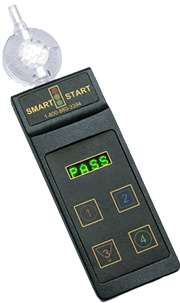
Today, an article in the USA today explained that the Federal Government has a pending bill that would tie in government funding for roads to the conditions of probation on a  DWI first.  According to the article, if States do not make Ignition Interlock devices a requirement as a condition of probation for DWI 1st. 

I've always heard that this is how the Government got Louisiana to up their drinking age to 21 . . by tying road funding to it.  But I don't know if that is true. 

So if this passed, what would this mean for DWI first offenders?  In my opinion, this just gives everyone even MORE of a reason to fight and go to trial.  If the only way to keep people from losing their jobs by keeping this device off, then a trial by jury is the only way to go.  We have had so many people tell us that they would lose their jobs if they have one of these installed.  Realtors, those in sales,  or any business people that have clients in their car.  What about a mom who does carpool, and the other children see mom blowing into a device to start the car?

Yet another not well thought out plan spearheaded by our friends at MADD.

Substance Abuse Evaluations (SASSI) in DWI cases

I have always been bothered by one of the ramifications of a DWI conviction:  The Substance Abuse Evaluation.

I am all for the premise and theory behind it.

If you are place on probation following a conviction for DWI, you are required by law to take a substance abuse evaluation, and perform any conditions imposed.  This can be something as small as "no alcohol while on probation," or larger (very time consuming) things like attending AA several times per week, or going to an intensive inpatient or outpatient program.

The point of requiring counseling for DWI offenders is obvious.  I have no problem with that.  Also, the premise that a counselor makes the decisions instead of a judge or prosecutor makes sense as well.  Us lawyers (or "law talking guys") do not necessarily know what the best treatment plan.

Here is the problem:  The offender is usually simply given a short, one page "SASSI - Substance Abuse Subtle Screening Inventory."  It is described by the maker as "A one-page paper and pencil test that identifies people who suffer from substance dependence."  This simple quiz, magically can tell what a person's substance problems are, and how to fix them.  Oh yeah, even according to SASSI information, training required for administration, is checked off "No."

The reason this came up to me, was a client of mine that was placed on probation took this quiz.  Then, after about a 10 minute multiple choice quiz, he was ordered by the court to attend an intensive outpatient substance abuse treatment program.  This was way more than he bargained for.  Oh yeah, he is required to pay for it as well (the SASSI and the treatment program).

I couldn't help but feel that it was unjust that this occurred after his negotiated plea.  Not only that, I was troubled by how a one page multiple choice quiz could so vastly affect someones life time wise and monetarily.

When I spoke to the counselor about my client's recommended treatment, I asked him if I could take a look at one of the blank tests.  I really just wanted to see it so I could prepare my clients for what they are in for if they are convicted. I  was told, that I was not allowed to see one.

Funny thing is, I went online, and found several places to order the SASSI forms from.  I have contemplated ordering a some, along with posting the "good answers."  I was actually pretty surprised I couldn't find anything about suggested (or not suggested) answers online.  Maybe I wasn't looking hard enough.

I'm curious if any other attorneys have  run into major problems with the SASSI quiz.

Prison starts new DWI rehab program

I read an article today about a prison that started a new DWI rehab program within the prison.  In "Area prison implements DWI rehab program," it details the new program.  It is a "six-month initiative that teaches life skill lessons, alternatives to drinking and driving and the medical, lifestyle and stress effects of alcohol."

This should not be confused with the DWI Court program for misdemeanor DWI's (usually DWI 2nds).
Anyone in this program has already been sent to prison.  Keep in mind, in order to go to prison, your sentence has to be over 2 years long -- so this would be for DWI 3rd+, or Intoxication Assaults or Intoxication Manslaughter.  You can see the punishment ranges for DWI Felonies here.

The program houses the inmates together with other DWI offenders to offer support between the inmates.  Inmates also meets with counselors daily in group and individual sessions.

I'd be curious to see what the recidivism rates are for these offenders.  If it works, it sounds like it could be a great program for those incarcerated ready to change their lives.

Dallas County Says Judges Need to Create More Revenue For Them

I read a pretty disturbing article in the Dallas Morning News yesterday. The article is entitled, "Dallas County commissioners ask judges to generate more revenue from courts"

The crux of the article is that Dallas County wants more money, and they believe that the judges should be the ones generating this money through those convicted of crimes.

There are some major problems with County Commissioners trying to set fines in criminal cases.

What is a reasonable punishment?  What is a reasonable fine? 

Commissioners have no clue what the charges are in individual crimes, much less, what the social-economic status of those accused are.  These are questions most often answered through juries and negotiated pleas.

The article (and commissioners) has some major fallacies in it as well:
"Judges have discretion over how much in fines to assess."
WRONG.  It is quite rare that the judge "decides" how much in fines to assess.

Plea Bargaining -- 90+ percent of cases are handled through plea bargaining.  These are negotiated pleas between the district attorney's office, and the person accused (or their attorney).  The judge does not take part in this process.   Once an acceptable plea is negotiated, the plea is entered (sometimes in front of the judge, and sometimes in a magistrate's court).  Technically, the judge can reject the plea bargain, but it is rare and would cause enormous problems.  Especially considering the judge does not know anything about the facts of the case.

Trial -- In a significantly smaller portion of cases filed, a trial will occur.  If no negotiated plea is struck, a trial will take place.  Most trials are jury trials.  In a jury trial, the citizen accused has the right to choose if he wants the jury to assess punishment or the judge.  If the jury assesses the punishment, they decide the fine -- again, no judge involvement.  If the judge assesses the punishment, they decide on the fine.  So in that situation, they would have control.

However, I have often times had trials, and after the trial (if the client is found guilty), the State and I will negotiate a punishment.  This situation brings us back to the plea bargaining process, and again, no judicial involvement.

"County officials are concerned that some judges are reducing fines for some defendants."
Possibly, but so what?  I guess this begs the question of why do we punish?  I studied criminology in school.  Some of the common reasons included:

Punishment for Punishment Sake - The "just deserts" theory -- do the crime, do the time.  You messed up, so now you deserve a punishment

Deterrence (Specific and General) -- Specific deterrence would be the situation where you punish to show that particular offender he should not do "it" again, or else he's going to be punished.  General deterrence is where you punish one person to show others in the community that they will be punished if they were to commit the same behavior.

To Gain Revenue? -- I don't remember learning about this one in school, but apparently it is a motive for the commissioners.

Higher fines often equal lesser punishments elsewhere.

Sometimes, as part of the plea bargain, a lower fine will be assessed in lieu of more XXX.  (Community Service, drug classes to be taken, anger management, substance abuse treatment, etc.).  This is usually done with the hopes of combating recidivism, or because the facts of the case dictate it.

Conversely, if fines were raised, this could be part of a negotiation which would lower the amount of classes, courses, substance abuse treatment etc.  That can't be the direction we want to head.

What I found most interesting, is that this is the exact type of behavior that was lambasted in the Dallas Morning News in the past regarding the Collin County District Attorney's Office.  I've been searching all over, but have been unable to find the article (or maybe opinion column?).  Anyway, it was saying that people were getting unfairly punished if they did not have money to pay large fines while the "wealthy" who paid fines and restitution got more lenient treatment.

Oh yeah, of course, there is the threat that the judges better fine more people (or raise fines), or else they would cut " funding for some key programs such as the drug court, jail education and services for the homeless and mentally ill."  Nice.

DWI Education Courses in Collin County, Dallas County, & Denton County

If you are convicted of DWI and placed on probation, a requirement will be that you must attend a DWI Education Course.

The course is 12 hours long, and according to the State, " is designed to help DWI offenders increase their knowledge about alcohol and drugs as these substances relate to driving skills, to identify their own individual drinking/drug use and driving patterns, and to assist them in developing plans which will reduce the probability of future DWI behavior."

Here is a list of the courses in city order.

Alcohol Awareness Courses in Collin County

If you are place on deferred probation for a DUI charge, you were probably ordered to attend an Alcohol Awareness Course.  The program is 6 hours long.

This course, as told by the state:

contains information on the following topics: societal values related to alcohol consumption by minors, the influence of alcohol advertising on young people, the physical, social and psychological effects of alcohol upon young people; the relationship between motor vehicle and other accidents and alcohol use; relevant laws relating to the purchase, possession or consumption of alcoholic beverages by minors, drinking patterns and problems of young people including abuse and addiction and decision making skills.

Here is a list of the courses in city order.

Oklahoma's New Scarlet Letters . . "D.W.I."

It would seem that State Rep. Scott Inman of Oklahoma came up with the perfect way to curb DWI's.  His bill would require anyone who is convicted to have it printed on their drivers license for four years.

I found the story  Inman Wants DUI, DWI Information On Licenses on the The McCarville Report Online, which follows OK political news.

Apparently Representative Inman believes that this will "alert" bartenders to the license holder's propensity to drink and drive and cause them to be cut off.

He explains:

This is a measure that I believe will help reduce the number of alcohol-related deaths by providing information to the drinking establishments that this person has a history of drinking and driving while intoxicated," said Inman, D-Del City. "Hopefully, the establishment will stop serving the customer after a few drinks. It's a way to help the industry police itself and to protect not only its customers, but also the thousands of innocent victims out there who die every year because of drunk drivers.
What about every time this person goes to use their license for non-alcohol related activities?  Does the guy you are cashing a check with really need to know this information?

I also think this is pretty dumb, considering I am 30 (and look it), and I only get carded about one out of every 10 times at the most.

Maybe if this is implemented in Texas, they can use the $3,000-$6,000 surcharge to pay for it....

Collin County Court 4 - DWI Program

Judge Ray Wheless, the County Judge of Collin County #4 is the only Judge in the county that offers a Drug Court and a DWI Program.

The DWI program is for repeat offenders.  Specifically those who think they have a problem with drugs or alcohol, and want help.

His court hears almost all DWI 2nd cases now.  There are some definite benefits to the program, but also some down sides.  There are also, in my opinion, some major unintended consequence of his having the program in his court.

One of the biggest downsides, is the harm that it causes someone who is charged with DWI 2nd, who is not a good candidate for his program for whatever reason.  One reason could be that the person's first DWI was 20 years ago.  Under the current (new law) law, there is no longer a "10 year rule" regarding prior DWI's. All DWI's are now treated the same. 

The prosecutors in the court have taken it upon themselves to try and force people into the program.  How do they do this?  By making overly harsh offers on all DWI 2nds.  30 days jail.  Overly large fines.  Etc.  The point is to push someone into the program, but it traps people who shouldn't be there.

Like I said, it can be a great program for the right people. 

Below is some information about the Judge's program:

THE DWI PROGRAM

The DWI program is a post-conviction program designed primarily for people with multiple DWI convictions or with chronic alcohol issues who are willing to admit they have a problem with alcohol.  If you don't believe you have a drinking problem, then you don't belong in the Program.

If you admit you have a drinking problem and want help, and if the District Attorney accepts you into the program, you can avoid the possibility of a long jail sentence and large fine by successfully completing the Program.  However, not everyone is suited for the Program.  The Program is difficult and requires a commitment to stop drinking and follow rules.  For some, jail time and a fine may be more appropriate.

You enter the DWI Program by pleading guilty and being sentenced to the DWI Program.  If you plead not guilty but are convicted by a judge or jury, you are not eligible for the Program.

BENEFITS OF THE DWI PROGRAM

1.  The most important benefit of the DWI Program is that it benefits you. If you complete the Program, you will be on the road to a successful, alcohol-free life.  Your family, ,friends and employer will see a new you -- a person who is clean, sober, reliable and responsible.

2.  A second offense DWI carries a penalty of up to one year in jail and a fine of up to $4,000.  When you enter into the Program, you will be sentenced to a period of time in jail which will be probated.  You will be ordered to serve ten days as a term and condition of probation.  However, you will not serve any time in jail if you enter into an intensive inpatient or outpatient treatment program.  And instead of being on the usual two-year probation period, you will serve a one-year probation term, provided that you successfully complete the Program.  Also, if you successfully complete the Program, the cost of your inpatient or outpatient alcohol treatment program will be credited against the fine imposed in your case.

3.  In most cases, the law provides that you must install a deep lung device on your motor vehicle for up to two years after conviction of a second DWI offense.  If you enter the Program and are making satisfactory progress at the six-month mark, you will be allowed to remove the DLD from your vehicle.

4.  A person who enters into the Program will have his Texas driver's license suspended for the minimum period of time authorized by law and will be given credit against any period of suspension for a refusing to take a breath test.  A person who enters into the Program will be granted an occupational license without the necessity of an SR-22.

5.  A person who enters into the Program who had a BAC of .16 or higher at the time of their arrest will receive a conviction for driving while intoxicated as a result of the loss of normal use of mental or physical faculties rather tan the BAC result, potentially saving the person thousands of dollars in DWI surcharges.

SUBSTANCE ABUSE EVALUATION AND TREATMENT

To help determine the extent of your substance abuse problem, every DWI/Drug Court participant must undergo a substance abuse evaluation.  Based upon that evaluation, a certain regimen of treatment will be recommended for you.  You must participate in every aspect of your treatment just as recommended by the evaluation.  If you are not willing to follow the counselor's recommendations, you should not enter into the Program.  Missed appointments and failure to follow your counselor's recommendations indicate that you do not believe you have a substance abuse problem and you will be discharged from the Program.  Once discharged, you are not eligible for re-entry.

GENERAL RULES OF DWI/DRUG COURT

1. Submit to an initial alcohol/drug evaluation
2. Follow all recommendations of the substance abuse evaluator.
3. Do not drink or possess any alcoholic beverages, illegal drugs, marijuana or prescription drugs without a valid prescription
4. Submit to random breath tests and urinalysis as often as requested by the Court or anyone acting on the Court's behalf
5. Appear at all counseling sessions and Court hearings
6. Attend all AA or NA meetings as recommended
7.  Do not drive a motor vehicle without a valid driver's license, and if ordered by the eh Court, do not drive a motor vehicle unless it is equipped with a deep lung device.
8. Obey all laws of the State of Texas
9. Obtain and maintain employment, attend school, or a combination of both.
10. Notify the Court and your probation officer of any changes in employment or residence address.
11. Do not resided with or associate with anyone who uses illegal substances.
12. Pay all fines, court costs and fees when due.
13 Comply with all terms and conditions of the Participant contract entered into with the Court and the District Attorney.
14. Comply with all terms and conditions of probation.

BREATH TESTS AND DRUG TESTS

If you decide to enter into the Program, your alcohol and drug use must end or you will not be successful.  Because we want you to succeed, you will be frequently randomly tested for both alcohol and drugs.

While we hope everyone in the Program will abstain from alcohol and drug use, we realize that some people will slip.  If you slip while in the Program, admit it.  You may sign a form admitting the use of alcohol and /or drugs and the consequences will be less severe than a positive test.

PROGRAM DESCRIPTION

The DWI/Drug Court Program consists of three phases

Phase I - (Day 1-90)

Phase 1 is the most intensive phase and will focus on abstinence, education and prevention.  Each participant will be ordered to install and maintain a deep lung device on any vehicle they operate, excluding employer owned vehicles.  Inpatient or outpatient alcohol/drug treatment may be ordered by the Court if recommended by a substance abuse counselor.  In addition, each participant will be screened by a physician of their choice to determine whether he is a suitable candidate for Campral, Re Via (Naltrexone) or Antabuse for the purpose of reducing the participant's alcohol dependence.  In addition, participants are required to attend one self-help meeting per day for ninety days and then once a week thereafter while they are in the program.  After release from treatment, if any, participants are required to report in person to their probation officer once per week, provide at least one random drug test per week, and if accepted into an outpatient treatment program, attend treatment at least twice per week, and appear before the DWI/Drug Court Judge once per week.

Phase II (Day 91-180)

The requirements of Phase II are much the same as Phase I with the exception that the Defendant will be required to report to his probation officer every other week and appear before the DWI/Drug Court judge every other week.  Additional requirements involved in this phase of the program including attending the victim impact panel and completing a portion of the ordered community service.

Phase III (Day 181-360)

In Phase III of the program, the defendant is required to meet once a month with his probation officer and to appear once a month before the DWI/Drug Court Judge.  The Defendant is also required to complete the remainder of his hours of community service.  Community service hours are performed at a non-profit agency selected by both the defendant and the Probation Officer in an attempt to appropriately place the defendant n a position of service which is not  only going to help prepay the community but to also make the defendant aware of individuals who could have possibly suffered ad a direct result of the defendant's crime.

During the aftercare  program, the Defendant will be required to sign a form declaring himself to be alcohol and drug free. At that time, the Defendant may be required to submit to an alcohol/drug test.  The defendant will also be required to attend one self help group meeting per month.  Once the defendant has successfully fulfilled all program requirements his Probation Officer will notify the Court that the Defendant is eligible for release from the program.

GRADUATION

The ultimate goal of the DWI/Drug Court Program is to achieve and maintain permanent sobriety for each Defendant in the program.  Ultimately, each defendant will graduate from the Program, resulting in a reduction in sentence in DWI cases.  When the objectives of the Program are achieved, the Defendant will attend a Graduation Ceremony and his case finally disposed.

Effect of DWI Acquittal on Suspensions

     What happens if you have had your license suspended because of a Breath Test failure or Breath Test refusal, and during the suspension, you are acquitted of DWI on the criminal charge?

     524.015 of the Transportation Code is controlling in this case.  The code reads:

EFFECT OF DISPOSITION OF CRIMINAL CHARGE ON
DRIVER'S LICENSE SUSPENSION. (a) Except as provided by Subsection
(b), the disposition of a criminal charge does not affect a driver's
license suspension under this chapter and does not bar any matter in
issue in a driver's license suspension proceeding under this
chapter.
(b) A suspension may not be imposed under this chapter on a
person who is acquitted of a criminal charge under Section 49.04,
49.07, or 49.08, Penal Code, or Section 106.041, Alcoholic Beverage
Code, arising from the occurrence that was the basis for the
suspension. If a suspension was imposed before the acquittal, the
department shall rescind the suspension and shall remove any
reference to the suspension from the person's computerized driving
record.
     When my clients are found Not Guilty by either a jury or a judge, I always send a letter to DPS with a certified copy of the judgment, and reference this statute.

      In order to find out if your license suspension has been rescinded, you can call DPS at 512-424-7120.

Ignition Interlock Devices Required in Arizona

      In a new law enacted at midnight tonight, Arizona will require all first time offenders convicted of DUI to install an ignition interlock device on their vehicles.  The Arizona Republic Online reports that not only will 1st time offenders be required to install this device, but also, anyone whose BAC is over .20 will have a mandatory jail sentence of at least 45 days.

The article reports:

Hardest hit are first-time violators and a new class of "super extreme" DUI offenders whose blood-alcohol concentration registers 0.20 percent or above, which is more than double the legal limit of 0.08 percent.

Beginning Wednesday, new penalties include mandatory ignition-interlock devices for first-time offenders, increased fines and a minimum of 45 days in jail for super extreme DUI convictions.

Opponents to the bill point out that this will increase caseload on the AZ courts, requiring those that are accused to fight their cases. 

Additionally, the article reports that like myself, some feel this is a short term or knee-jerk solution to a much larger problem.

Critics say interlock devices are expensive to maintain and provide a short-term answer to a long-term problem.

 The offender pays for the device, which typically costs $100 for installation and about $80 a month to maintain. Most first-time offenders will have the device for 12 months. That cost is in addition to the more than $1,000 in fines imposed for a DUI conviction.

And studies have shown that while interlock devices are effective while in use, drivers tend to slip into old habits once the units are removed.
Texas, although not quite as extreme, has enacted many laws and statutes over time that increase the severity of DWI:

  1. Deferred Adjudication -- The legislature took out the "deferred adjudication" option to DWI cases.  This leaves a person with only two options -- plea guilty, and be convicted for the rest of your life, or plea not guilty, and contest your guilty through a trial.
  2. Ignition Interlock -- On DWI 2nds, and also DWI 1st where there is a BAC of over .15, an ignition interlock device must be installed on your vehicle.
  3. Surcharges -- DPS requires $1,000/year for three years with any conviction to keep your license.  $1,500/year for a DWI second, and $2,000/year for a BAC over .16.
I find it interesting that although on the surface some of these laws seem to crack down on "hard core" impaired drivers, you can also see that it punishes you for taking a breath test.  For Arizona, no breath test means no way you go to jail for 45 days, and no way you are required to have an ignition interlock device on your car.

In Texas, refusing a breath test means no possibility of a $6,000 FINE from DPS. and no possibility of having an ignition interlock device as a requirement on your vehicle.

The MADD influence is spreading....

Apparently some other groups are getting into the court watching program too.

Christian court watches keep tabs on judges, is the title of CNN's article on the subject.

This Kentucky group has been getting in on the action as well.  It appears that their motives are more for drug offenders when they watch the courts.

From my last article, MADD pays 40K per year for "Court Monitors," I spoke about MADD getting money from the government to "watch/influence" the courts in DUI and DWI cases.  This issue has been taken up by Mark Bennett and Robert Guest in the past as well.

Hey, at least this group isn't State funded....

The original Story can be found on CNN.com, HERE

Some interesting clips from the article...

Becknell -- a devout Christian known to many as "Brother John" -- pulls out a pen and an inch-thick docket, mostly of drug and alcohol cases. For the next three hours, he takes diligent notes on the judge's actions, the attendance of police officers, repeat offenders making another appearance, and so on.

The purpose? To make sure drug offenders in eastern Kentucky are getting what they deserve.

The Community Church of Manchester is leading the way through "Court Watch," a program in which volunteers attend court hearings to monitor judges overseeing drug-related cases.

"They know they're welcome in my court anytime I'm there," said District Judge Renee Muncy.

Yet, she added that she doesn't feel pressured by the presence of Court Watch participants.

Neither does Circuit Judge R. Cletus Maricle, who said, "Some judges probably feel they are there to intimidate him. If the judge is intimidated, that's his fault."

DWI Plea Bargains vs. Punishment if Found Guilty

I have been recently asked:

You stated: "You will receive almost identical punishment if you are found guilty
after trial."

If one is found Guilty, is the punishment generally the same as was
offered in the plea bargain, or generally the full penalty?
---
While I can never predict the future, no judge in the counties I practice in will ever assess a maximum punishment for a first time DWI offender with no history. Standard "plea bargain" punishment before trial, or after trial are almost always the same. Between 1 and 2 years probation, a fine between $300-$800, 24-40 hours of community service, and alcohol awareness courses.

Because of the getting generally same punishment given even if you lose at trial, many charged (when represented by competent DWI counsel), will opt for a trial, knowing there is very little to lose. If you plea guilty you have a 100% chance of being convicted for life. If you plea not guilty, you at least have some chance of keeping your record clean. Depending on the facts of your case, of course, your chances go up or down.

PS. I tried to respond to the sender of this question, but was unable to reply to the email address given. If you need assistance with a case, feel free to call me at 469-252-4018.

SR-22 insurance in Texas DWI Cases

I am often asked the question,


"What is SR-22 Insurance?"

SR-22 insurance policy is a note held on file by the DPS. It is an extra charge you pay for your insurance carrier to communicate directly with DPS. DPS will hold your proof of insurance in their system, and whenever there is a lapse of insurance your carrier will contact DPS, possibly resulting in another suspended license.

When is SR-22 required?

SR-22 Insurance is usually required after a DWI conviction for a set amount of time, and it usually runs approximately $25-$50 per month on top of your normal rate. SR-22 insurance is also often needed if you obtain an occupational drivers’ license as a result of a suspension (Either ALR or conviction suspension).  Depending on the court and the judge, you may have to obtain SR-22 insurance even before you request an occupational drivers license.  SR-22 does not mean full coverage or necessarily expensive as some people believe, you may still purchase your state's minimum liability automobile insurance coverage, just with a SR-22 policy added.

Radio Station believes Guilty until proven Innocent

In yet another instance of the "guilty until proven innocent mentality," an Indianapolis radio station has decided to do their part and read off a list of people arrested for drunken driving (DUI in Indiana). 

I wonder if anyone at the station even though, just for a second about what they were doing?  How about TAINTING a potential jury pool of people who would be instructed to presume the person on trial innocent until proven guilty?

Although I wouldnt be for it, I would think that reading a list of those CONVICTED of DWI / DUI that week would be more appropriate.  At least it wouldnt taint future jurors, or compound the problem of further humiliating innocent people that were arrested.  Below is the article.

Radio station to read names of DUI arrestees


WNOU-FM (93.1) is taking a unique stand against drunken driving in Indianapolis -- by reading the names of the previous week's offenders every Monday during its morning radio show.

"You don't want to hear your name on this list, do you?" co-host Marco Anselmo asked listeners during the premier segment Monday.
To the tune of Inner Circle's "Bad Boys" song, hosts of "The Morning Mess" highlighted a handful of drivers charged with DUI last week and quoted details from incident reports.
The segment promises to feature "prominent guest commentators."
On Monday, Sgt. Ray Poole of the Indiana State Police offered anecdotes about DUI arrests he has made.
Upcoming speakers include members of Mothers Against Drunk Driving, and Gov. Mitch Daniels.

Humilated from a DWI? Ask this guy...

In a recent case in New Mexico, a citizen was arrested, tired, and acquitted of DWI.  Despite his being found not guilty by a jury of his peers, and after a clerk "checked the wrong box" saying guilty, his picture and name was published in the newspaper.

Oh yes, a retraction was printed, but I'm quite sure it was too little too late for him.  The interesting thing is, I found this article online, on an NBC news site, which not only published his name, but also published his PICTURE as well!   Apparently they don't care about his privacy either....

Here is the story, but in order to not perpetuate the wrong that was done to this man, I have removed his name and his picture.


Man mistakenly published on DWI offender list

A man who was never found guilty for DWI had his picture published in the local paper saying he was guilty of drunk driving.

XXXXXXXXXXXXXXX, was arrested last August and blew at or above the legal limit, according to court records. XXXXXXXXXXX fought the case and was found "not guilty," in February.

A Metropolitan Court clerk made a mistake and marked guilty next to the DWI charge days after XXXXX was acquitted.

XXXXXXXXX works for the Federal Government on Kirtland Air Force Base and has been trying to get higher security clearance.

XXXXXXXXXXXXXX said, "I'm gonna have to do a lot of explaining I shouldn't have never had to do."

For two months XXXXX was officially a convict, until the mistake was found and fixed.

During the time XXXXXXXXXXXXX was mistakenly labeled "guilty" his name was put into the mix of guilty faces to be published by Albuquerque police.

Metropolitan Court spokeswoman Janet Blair said, "We really regret Mr. XXXXXXXXXXXX had to go through this...and we don't understand why such outdated information was used when correct information has been available for three months."

The Albuquerque Police Department plans to issue a retraction in the next few months.