DWI with BAC over .15

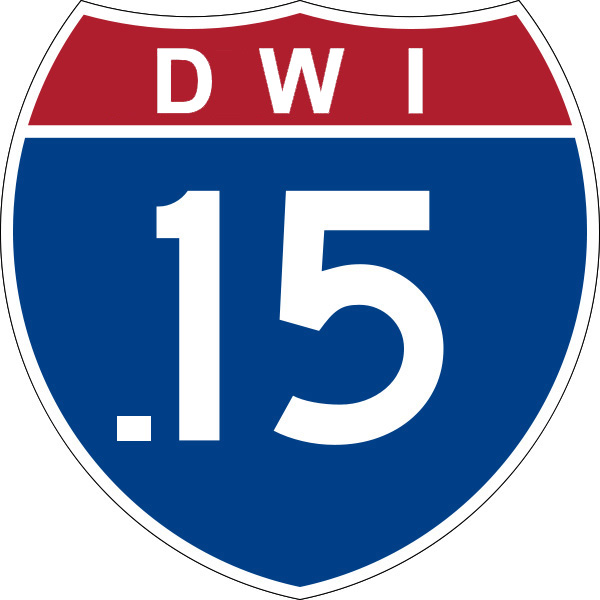
Well, there's a new law in town, and the local police and District Attorneys are already pushing it hard. Its a DWI with a breath or blood alcohol level of .15 or more.

The amended text of Penal Code 49.04 reads:

(d) If it is shown on the trial of an offense under this section that an analysis of a specimen of the person's blood, breath, or urine showed an alcohol concentration level of 0/15 or more at the time the analysis was performed, the offense is a Class A misdemeanor.

So now if you were facing a regular DWI the punishment range was 72 hrs in jail - 180 days in jail, or a term of probation not to exceed 2 years.  The new DWI +.15 punishment range is 0 days in jail - 1 year in jail, and a term of probation not to exceed 2 years.

MADD pushed hard for this, and our legislators folded as usual.  But here's the funny part....

This new crime will decrease the amount of convictions, and decrease the punishment for offenders!

What???

Here's why -- first of all, no first time offenders go to jail on a DWI 1st.  Therefore, since the length of probation is the same, the underlying jail sentence doesn't change anything.  If someone were to go to jail on a DWI 1st, it most certainly wouldn't be for a length over 6 months anyway.  

Decrease In Punishment Step ONE

Less people would be inclined to provide a breath or blood test. This is the same effect that the surcharges have had on poeple arrested for DWI.  If you do not give a breath or blood test, you cannot be charged with this "higher" level crime -- so why do it?  Refuse, Refuse, Refuse ! !

Decrease in Punishment, Step TWO

This actually LOWERS the minimum sentence for DWI.  Before, the minimum was 72 hrs in jail up to 180 days.  With this new law, the range is 0 days in jail, up to 1 year in jail.  Therefore, a prosecutor can give a $1 fine, and 0 days in jail. 

So there you go.  The new "tougher" crime effectively lowers the punishment range and decreases the chances of a conviction for the state.  Congratulations MADD.  You win again.

New DWI Statutory Warning (DIC-24) - 2011

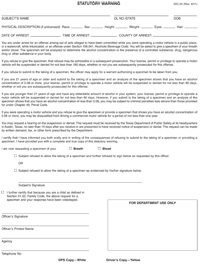
After being arrested for DWI, a police officer will read the citizen accused their "Statutory Warnings" before asking them to submit to a breath test.

This form, the DIC-24, goes through the warnings to a person discussing potential license suspension for refusal, failure, and hearing requests.  It was originally created as a "dummy proof" form so that officers weren't illegally coercing people into giving breath or blood samples.

The DIC-24 is often criticized by DWI attorneys as overly complicated, and in some cases, flat out deceiving.

I always thought it was deceiving that they tell you what happens if you provide a sample over .08, but doesn't mention that if your sample is under .08 you get charged anyway.  It is also curious that the form has a line to sign if you refuse, but not if you want to submit.

The new DIC-24 adds language regarding search warrants for blood.  The new text reads:

If you refuse to submit to the taking of a specimen, the officer may apply for a warrant authorizing a specimen to be taken from you.

I like the addition of the language, because it explains some truth's of what may happen.  However, I still think that someone giving a sample with the old, or the new form could easily be "coerced" to give a breath test in fear of the vampire police officer.

It is unclear so far, how this form will affect future DWIs.  We will be watching closely to see if officers reading the old forms could cause a breath or blood test to be inadmissible as a result of the incorrect warnings.

Crime Victim Commits Fraud on Public

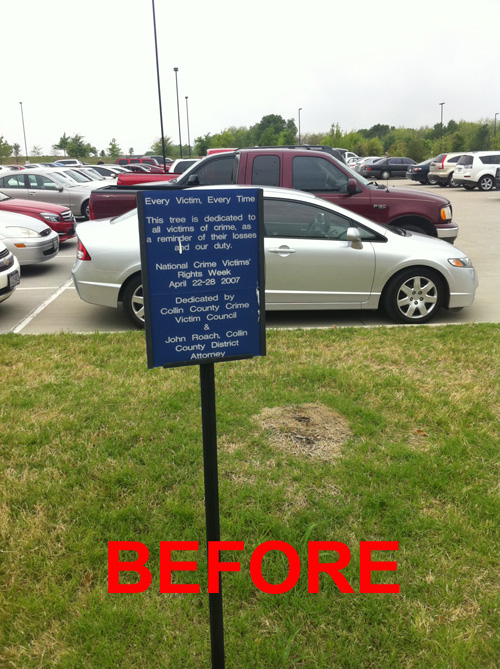
About a month ago, I wrote an article Crime Victim Dies of Complications, detailing a certain tree planted in front of the courthouse to commemorate crime victims.  I took a picture showing that the tree had apparently died and been cut down.

I also found it interesting that no one puts up wrongly accused / convicted trees around the courthouse -- that might actually cause a jury to think twice about convicting someone. 

.

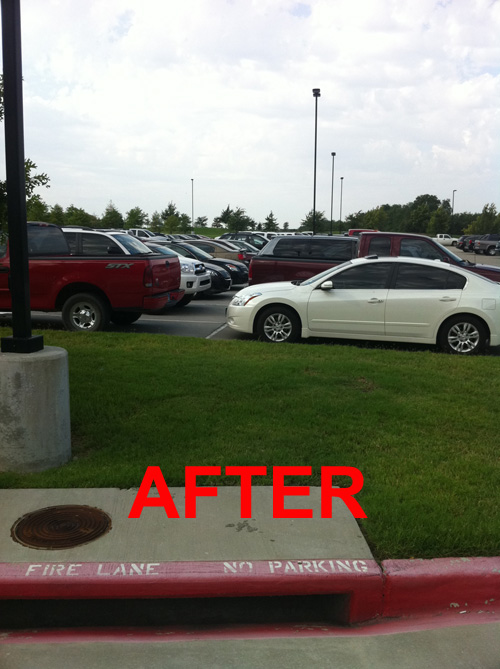
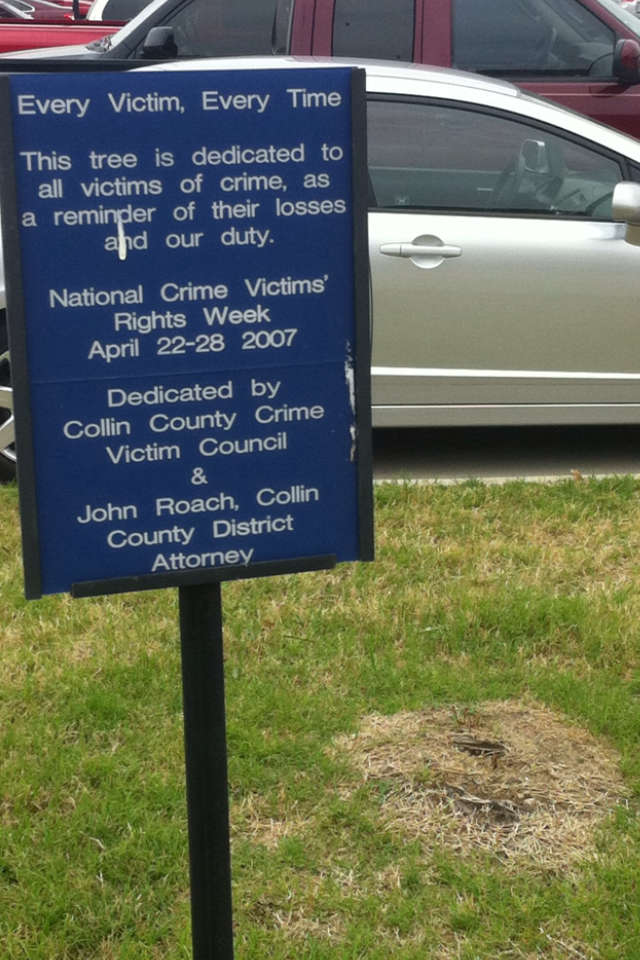
Regardless, it would seem that the tree has sparked new life after (and probably because of) my article.  Despite the tree dying and being cut down, someone moved the sign, and placed it in front of another tree instead.  This other tree is now purported to be the crime victim tree dedicated in 2007.

Based on the sign and press releases from that time, they say "this tree," (singular) although it is possible they planted two trees.  I wasn't invited to that ceremony, so I cannot be sure.  But I think there is some fraud going on here. . .

One thing is for sure:  The local bird population is not in favor of this new fake crime tree.

If anyone has any information on this coverup, please alert the authorities.  Well, I guess not, as I suspect the locals are in on the coverup. 

Crime Victim Dies of Complications

It appears a local crime victim has dies of injuries.  Reports are unclear as to whether the death is related to injuries sustained from the initial crime.

I snapped this photo recently of the "Crime Victim Tree" planted just outside of the new Collin County Courthouse.

As you can see, the tree has been removed and all that remains is a bit of the stump below.

When this sign was first erected, it was met with what I would call,  "non-vocal minority" resistance.  Why would we want potential jurors coming in from a parking lot to jury duty to walk by a sign talking about crime victims?

Maybe to poison the potential jurors?  Maybe just someone from the Government's side not being sensitive to the whole "innocent until proven guilty" premise.

I find it funny that no one seems to be jumping to put up a tree dedicated to the wrongfully accused.  How about a DNA cleared victims tree?  We could plan one, for say, each wrongfully convicted year a man spent in jail here in the DFW area.

Nah... that would take up too many parking spaces.  According to the Innocence project, Dallas alone is up to 20 wrongful convictions by men who have served a total of 250 years in prison for crimes they hadn't committed.


Former president of MADD arrested on DUI charge

From my college town of Gainesville, Florida, and their paper, the Gainesville Sun, comes this interesting piece.

Dare I say, "Go Gators!?!"

----


By Cindy Swirko
Staff writer

Debra Oberlin, 48, was arrested after she had difficulty on a field sobriety test. She registered a .234 and .239 on breath alcohol tests. Florida's legal limit for driving is .08.

Oberlin, a Realtor, had no comment when contacted Thursday by The Sun.

On Feb. 18 at 1:10 a.m., an officer spotted Oberlin driving erratically on Northwest 19th Street, swerving and crossing lanes, an arrest report states. Oberlin was pulled over in the 3600 block of Northwest 39th Avenue.

The officer wrote that Oberlin smelled of alcohol and had watery, bloodshot and dilated eyes. The report states that Oberlin told the officer she had four beers.

Gainesville's MADD chapter existed for several years in the 1990s before closing in 1996 because of lack of financial support. Oberlin was the chapter president for three years.

Tags:

Texas DWI Guide App

I'm pleased to announce the release of the Texas DWI Guide App!  This app is available free from iTunes

I created this app for the Public, Attorneys, and Peace Officers.  The Texas DWI Guide is the premier guide on all things regarding DWI / DUI charges.

The most powerful Driving While Intoxicated app on the market, it provides:

-DWI Laws
-BAC Calculator
-Taxi Locator
-Attorney Finder
-Ignition Interlock Locator
-SR-22 Insurance Locator

And much, much more...

This is the premier app for anyone needing detailed information regarding Field Sobriety Tests, Breath and Blood Tests, and the DWI / DUI process.


 It is available free from iTunes.  I look forward to your comments and suggestions on the app!


Federal Ignition Interlock Requirement on all DWIs?

It seems as if the Federal Government is now getting into the mix of deciding what the individual states should and should not be allowed to do to punish first time DWI / DUI offenders.

Today, an article in the USA today explained that the Federal Government has a pending bill that would tie in government funding for roads to the conditions of probation on a  DWI first.  According to the article, if States do not make Ignition Interlock devices a requirement as a condition of probation for DWI 1st. 

I've always heard that this is how the Government got Louisiana to up their drinking age to 21 . . by tying road funding to it.  But I don't know if that is true. 

So if this passed, what would this mean for DWI first offenders?  In my opinion, this just gives everyone even MORE of a reason to fight and go to trial.  If the only way to keep people from losing their jobs by keeping this device off, then a trial by jury is the only way to go.  We have had so many people tell us that they would lose their jobs if they have one of these installed.  Realtors, those in sales,  or any business people that have clients in their car.  What about a mom who does carpool, and the other children see mom blowing into a device to start the car?

Yet another not well thought out plan spearheaded by our friends at MADD.

New DWI Bill #5 - SB 3123

A new bill proposed in the Senate by Senator Whitmire seems to be the same as that of HB 1906.

The bill deals with lowering the surcharge for someone who successfully completes the DWI/Drug Court program.  As I stated before, this only  helps someone that completes the course, which can be 2 years or more later.  This means that the bill does not really save the person much.  It would be a better bill if the savings were upon entering the DWI court program.  I would even be in support if those savings were only temporary and became permanent after successful completion.  I think that would be a better idea.


Below is the text of the entire bill:


A BILL TO BE ENTITLED

AN ACT

relating to the amount of a surcharge assessed on conviction of certain intoxicated driver offenses on the driver's license of certain persons who complete a drug court program.

BE IT ENACTED BY THE LEGISLATURE OF THE STATE OF TEXAS:

SECTION 1.  Chapter 469, Health and Safety Code, is amended by adding Section 469.010 to read as follows:

Sec. 469.010.  REDUCTION IN AMOUNT OF ANNUAL SURCHARGE ON SUCCESSFUL COMPLETION OF DRUG COURT PROGRAM. (a) A judge or magistrate administering a drug court program under this chapter may order the Department of Public Safety to reduce the amount of the annual surcharge assessed under Section 708.102, Transportation Code, on the license of a person finally convicted of an offense relating to the operating of a motor vehicle while intoxicated to an amount that may not be less than 20 percent of the amount specified by that section, if the judge or magistrate enters a written finding in the papers in the case indicating that the person:

(1)  successfully completed a drug court program under this chapter; and

(2)  has not been arrested for an offense under Section 49.04, 49.045, 49.05, 49.06, 49.065, 49.07, or 49.08, Penal Code, during the 180 days after the date of the program completion.

(b)  On a timely request by the defendant, the judge or magistrate shall enter the written findings under Subsection (a) and promptly send a copy of those findings to the Department of Public Safety accompanied by the court's order to reduce the amount of the annual surcharge assessed under Section 708.102, Transportation Code. On receipt of a copy of the written findings under this subsection, the Department of Public Safety shall reduce the amount of the surcharge assessed to the amount specified in the court's order.

SECTION 2.  The change in law made by this Act applies to a person who, on or after the effective date of this Act, enters a drug court program under Chapter 469, Health and Safety Code, regardless of whether the person committed the offense for which the person enters the program before, on, or after the effective date of this Act.

SECTION 3.  This Act takes effect September 1, 2009.


Tags:

New DWI Bill #4- HB 3733

A new House Bill proposed by Representative Coleman affects the surcharges assessed on those convicted of DWI.  Right now, if you are convicted of DWI first, you owe the state $3,000 over 3 years just to keep your driving privledges.

The bill seems to say that the 3,000 is now a maximum surcharge, instead of it being the automatic surcharge.  It would be based now on the "seriousness of the charge, the amount necessary to deter future violations, and an amount that maximizes collection."

I like the idea of this, except it doesnt seem to really say who determines how much the amount is, and why!  Nor does it seem to give you any kind of due process, like a hearing to present to a judge or magistrate why you think your surcharge should be less.  Basically it seems like a proposal with no teeth.

The bill also makes some changes to the plea bargaining process. It provides that anyone pleaing guilty must be given notice about the surcharge.  I like this idea, but it is mostly for people who are hiring non-DWI lawyers.  Any DWI lawyer worth their salt is going to be informing their clients about the surcharge.  At our firm, we speak about it during the initial consultation along with paperwork about the potential surcharge.  And in any plea of guilty or not guilty, we ALWAYS discuss the ramifications of the potential surcharge.

Below is the entire text of the bill:

A BILL TO BE ENTITLED

AN ACT

relating to the administration of the driver responsibility program.

BE IT ENACTED BY THE LEGISLATURE OF THE STATE OF TEXAS:

SECTION 1.  Subchapter A, Chapter 708, Transportation Code, is amended by adding Section 708.004 to read as follows:

Sec. 708.004.  DEPARTMENT'S DETERMINATION OF AMOUNT OF SURCHARGE. The department by rule shall set the amount of a surcharge to be assessed under this chapter on a person's license. The amount may not exceed the maximum amount allowed by this chapter for a surcharge based on points or a conviction, as applicable. The amount shall be based on:

(1)  the seriousness of the violation, including the nature, circumstances, extent, and gravity of the violation;

(2)  the amount necessary to deter a future violation; and

(3)  the amount that maximizes the collection of surcharges by the department.

SECTION 2.  Section 708.054, Transportation Code, is amended to read as follows:

Sec. 708.054.  AMOUNT OF POINTS SURCHARGE.  The amount of a surcharge under this chapter may not exceed [is] $100 for the first six points and may not exceed $25 for each additional point.

SECTION 3.  Section 708.102(c), Transportation Code, is amended to read as follows:

(c)  The amount of a surcharge under this section may not exceed [is] $1,000 per year, except that the amount of the surcharge may not exceed [is]:

(1)  $1,500 per year for a second or subsequent conviction within a 36-month period; and

(2)  $2,000 for a first or subsequent conviction if it is shown on the trial of the offense that an analysis of a specimen of the person's blood, breath, or urine showed an alcohol concentration level of 0.16 or more at the time the analysis was performed.

SECTION 4.  Section 708.103(b), Transportation Code, is amended to read as follows:

(b)  The amount of a surcharge under this section may not exceed [is] $250 per year.

SECTION 5.  Section 708.104(b), Transportation Code, is amended to read as follows:

(b)  The amount of a surcharge under this section may not exceed [is] $100 per year.

SECTION 6.  Section 708.105, Transportation Code, is amended by adding Subsections (c) and (d) to read as follows:

(c)  Before accepting a plea other than a plea under Article 27.14(d), Code of Criminal Procedure, the court must provide a defendant charged with an offense described by Section 708.102, 708.103, or 708.104 the following statement and require the defendant to sign the statement:

"A conviction for the offense charged will result in the assessment of a surcharge that will be imposed annually for a period of 36 months under the Driver Responsibility Program."

(d)  The statement provided to a defendant under Subsection (c) must also state the maximum amount of the annual surcharge as provided by Section 708.102, 708.103, or 708.104. The copy of the statement signed by the defendant shall be retained by the court.

SECTION 7.  Section 708.157, Transportation Code, is amended by amending Subsection (c) and adding Subsection (d) to read as follows:

(c)  The department by rule shall [may] establish an indigency program to reduce the surcharge on a person's license if the department determines that the person is indigent [for holders of a driver's license on which a surcharge has been assessed for certain offenses, as determined by the department]. The department shall require a person to submit proof of indigency.

(d)  For purposes of this section, a person is indigent if the person's income is not more than 100 percent of the applicable income level established by the federal poverty guidelines.

SECTION 8.  (a) Not later than October 1, 2010, the Department of Public Safety shall adopt initial rules determining the amount of a surcharge on a person's driver's license under Chapter 708, Transportation Code, as amended by this Act. Not later than October 1 of each subsequent year, the Department of Public Safety shall review its rules and determine whether the amount of a surcharge should be increased or decreased.

(b)  A surcharge imposed under Chapter 708, Transportation Code, before the effective date of the initial rules adopted by the Department of Public Safety under Subsection (a) of this section is governed by that chapter as it existed on the date the surcharge was imposed, and the former law is continued in effect for that purpose.

SECTION 9.  This Act takes effect September 1, 2009.

Tags:

New DWI Bill #3 - HB 1906

A third new DWI bill proposed by Representative Guillen deals with the DWI surcharge for those convicted of DWI, but completed the DWI/Drug Court program.  I have spoken about the DWI/Drug Court program in the past.  In Collin County, the only DWI /Drug Court is in Judge Ray Wheless' County Court #4.

This bill would allow the surcharge to be reduced by up to 80%.  Right now, anyone convicted of DWI 1st must pay 3,000 to the state over three years.  If you are convicted of DWI 2nd, it is 4,500 over 3 years, and if you blow over .16, it is $6,000 over three years.

I think this bill is a great idea, because it gives some incentives for someone to really turn their lives around.  The Drug court is usually reserved for those on DWI 2nd, so it is an important time in those offenders' lives.

I do see some problems with this bill, though.  It only rewards those "sucessfully completing" the program.  Instead, it should reward those entering the program.  It is possible to be in the DWI court for 2  years or longer.  By then, this bill wouldn't be of much help.  

Below is the entire test of the bill:

A BILL TO BE ENTITLED

AN ACT

relating to the amount of a surcharge assessed on conviction of certain intoxicated driver offenses on the driver's license of certain persons who complete a drug court program.

BE IT ENACTED BY THE LEGISLATURE OF THE STATE OF TEXAS:

SECTION 1.  Chapter 469, Health and Safety Code, is amended by adding Section 469.010 to read as follows:

Sec. 469.010.  REDUCTION IN AMOUNT OF ANNUAL SURCHARGE ON SUCCESSFUL COMPLETION OF DRUG COURT PROGRAM. (a) A judge or magistrate administering a drug court program under this chapter may order the Department of Public Safety to reduce the amount of the annual surcharge assessed under Section 708.102, Transportation Code, on the license of a person finally convicted of an offense relating to the operating of a motor vehicle while intoxicated to an amount that may not be less than 20 percent of the amount specified by that section, if the judge or magistrate enters a written finding in the papers in the case indicating that the person:

(1)  successfully completed a drug court program under this chapter; and

(2)  has not been arrested for an offense under Section 49.04, 49.045, 49.05, 49.06, 49.065, 49.07, or 49.08, Penal Code, during the 180 days after the date of the program completion.

(b)  On a timely request by the defendant, the judge or magistrate shall enter the written findings under Subsection (a) and promptly send a copy of those findings to the Department of Public Safety accompanied by the court's order to reduce the amount of the annual surcharge assessed under Section 708.102, Transportation Code. On receipt of a copy of the written findings under this subsection, the Department of Public Safety shall reduce the amount of the surcharge assessed to the amount specified in the court's order.

SECTION 2.  The change in law made by this Act applies to a person who, on or after the effective date of this Act, enters a drug court program under Chapter 469, Health and Safety Code, regardless of whether the person committed the offense for which the person enters the program before, on, or after the effective date of this Act.

SECTION 3.  This Act takes effect September 1, 2009.


Tags:

New DWI Bill #2 - HB 591

The second bill relating to DWI Defense has been proposed by Representative Dutton.  I think it is a fantastic idea.

The crux of the bill changes Sec 42.12, which is the community supervision (probation) section of the code.  Right now, there are certain crimes that if convicted and placed on probation, you are not allowed early release off.  They are mostly major aggravated crimes involving weapons or sex offenses.  The worst of the worst.  But strangely enough, DWI was added to it.  This means if you get 2 years probation, you cannot get off early.

Not being able to get off probation early ties the hands of the judges and the prosecutors for people who have been sucessful on probation.  It takes away a lot of discretion for those in the know, that are put in their positions by the people that elect them.  This bill would remove the "DWI restriction" and allow somone on DWI probation to be released early.  It doesn't make any other changes, such as making it not a final conviction, or removing from their record -- simply letting them get off probation early.  Judges/Prosecutors usually only allow this if you have already completed all the terms and condtions of probation (commuity service, DWI classes, etc.).

Below is the entire text of the bill:


A BILL TO BE ENTITLED

AN ACT

relating to the reduction or termination of the period of community supervision imposed on a defendant convicted of certain intoxication offenses.

BE IT ENACTED BY THE LEGISLATURE OF THE STATE OF TEXAS:

SECTION 1.  Section 20(b), Article 42.12, Code of Criminal Procedure, is amended to read as follows:

(b)  This section does not apply to:

(1)  a defendant convicted of an offense [under Sections 49.04-49.08, Penal Code, a defendant convicted of an offense] for which on conviction registration as a sex offender is required under Chapter 62; [,] or

(2)  a defendant convicted of a felony described by Section 3g.

SECTION 2.  The change in law made by this Act applies to a defendant who is placed on community supervision before, on, or after the effective date of this Act.

SECTION 3.  This Act takes effect September 1, 2009.


Tags:

New DWI Bill #1 - HB 509I

I noticed that in the past few days, a few new DWI bills have been proposed.  I found 5 imparticular that may be of consequence to the DWI defense world.

The first, proposed by Texas Rep Riddle.  From what I can see, it related to who can pull blood from a person suspeced of DWI.  It amends the transportation code, which already has a list of "approved" people to pull blood.  This bill seems to add in an EMT or paramedic.  EMT's and paramedics were specifically excluded from those allowed to pull blood from suspects.

Below is the entire proposed text of the bill:


A BILL TO BE ENTITLED

AN ACT

relating to the persons authorized to draw a blood specimen from a vehicle operator to test for alcohol concentration or other intoxicating substances.

BE IT ENACTED BY THE LEGISLATURE OF THE STATE OF TEXAS:

SECTION 1.  Section 724.017, Transportation Code, is amended to read as follows:

Sec. 724.017.  TAKING OF BLOOD SPECIMEN. (a) Only the following [a physician, qualified technician, chemist, registered professional nurse, or licensed vocational nurse] may take a blood specimen at the request or order of a peace officer under this chapter:

(1)  a physician;

(2)  a qualified technician;

(3)  a registered professional nurse;

(4)  a licensed vocational nurse; or

(5)  a licensed or certified emergency medical technician-intermediate or emergency medical technician-paramedic.

(b)  A [The] blood specimen must be taken according to recognized medical procedures [in a sanitary place].

[(b)]  The person who takes a [the] blood specimen under this chapter, or a [the] hospital where a [the] blood specimen is taken, is not liable for damages arising from the request or order of the peace officer to take the blood specimen as provided by this chapter if the blood specimen was taken according to recognized medical procedures. This subsection does not relieve a person from liability for negligence in the taking of a blood specimen.

[(c) In this section, "qualified technician" does not include emergency medical services personnel.]

SECTION 2.  This Act takes effect immediately if it receives a vote of two-thirds of all the members elected to each house, as provided by Section 39, Article III, Texas Constitution. If this Act does not receive the vote necessary for immediate effect, this Act takes effect September 1, 2009.

Tags:

1310 The Ticket - Radio Publicity

Thanks to Robert Guest for pointing out to me that I was mentioned on Dallas/Ft Worth's 1310 the Ticket.  They pulled up this blog, and the entry HERE.

Apparently, they show's Gordon Keith was talking about Charles Barkley's recent DUI arrest.  They were examining the difference between DUI and DWI.  

However, I think the information from my site probably is not what they were looking for.  My site lists the difference between DUI and DWI in Texas.  What they probably wanted to know is why Charles Barkley's offense was DUI.  The answer is simple.  Each state calls this crime something different.  Acutally, most states refer to the crim of driving while intoxicated / driving under the influcence as DUI.  It is the same thing, with slightly different laws from state to state.  So, what Barkley was charged with is our equivalent of DWI.

Hope this helps, and if anyone from The Ticket is reading this, let me know if I can ever answer any questions!

Tags:

Lawmakers dont need to follow the law

I was pretty disgusted when I read an article today on chron.com.  A while back I posted about Rep. Michael Krusee, who pushed for legislation fining people between $3000-$6,000 for DWI convictions.  Of course, part of this is if you give a breath sample above .16, you are liable to the government for $6000.

Well, as do most judges and people in the know when they are arrested for DWI, they refuse the breath test.  I knew that someone that who pushed for this legislation would never take the breath test.  Not only does the test have tons of problems, but if you score high, you are fined an extra $3,000.

Apparently, today, 'ole Mike got his case dismissed.    I can't even begin to tell you how many cases have what would seem to be the same facts as described in the article:

The trooper also reported a "strong smell of alcohol" when Krusee was pulled over and Krusee failed a field sobriety test. He refused a breath and blood test, according to the affidavit. The trooper arrested him and booked him into the Williamson County Jail.


More MADDness

A recent article in the Dallas Morning News is talking about a new law passed by Texas to help nab more uninsured motorists.

The topic of this post is not whether or not it is a good law, waste of time, etc., but rather who helped champion the law.... Yup, MADD.

In the article, it tells us that:

One group that lobbied for the law was MADD [Mothers Against Drunk Driving] of Texas, which argued that the average drunken driver is less likely to have insurance than other drivers.

"The need for this law has not changed in the past three years. In fact, it has probably gotten worse," said Bill Lewis of MADD-Texas. "There are probably more uninsured people today than when the law was passed."
WHAT??

At least they aren't making up false statistics, or skewing stats, as been pointed out by other bloggers here, here, and here.

So intoxicated drivers were intoxicated at the time they were supposed to renew their insurance?

In thinking back.. with the exception of one case, every DWI case I have handled, the client had insurance at the time.  OK, so my sample group may not mean much, but there is no rhyme or reason to this thinking by MADD.

This just further shows that MADD is a political lobbying group...

So this got me to thinking.  Why would a group like MADD want a law to help nab uninsured motorists?

Maybe it is because they know that many state find DWI checkpoints to be illegal, and this is just their way of finding a way to allow police "reasonable suspicion" to stop just about anyone.

This program:

aims to create a database for police officers, state troopers and vehicle inspection stations to instantly verify whether a motorist has the minimum coverage required under state law.
Basically, this could just be another tool or rouse to allow an officer to pull you over, just to check up on you.  Obviously, this system is going to have problems... but these officers will still argue "good faith" when explaining why you were pulled over.

So, yes, I guess it makes sense that MADD would support this initiative...

Tags:

Justifying the "calling out" of Someone Being Arrested

Austin, TX DWI Lawyer Jamie Spencer recently posted about whether or not someone should "call out" of those arrested for DWI or other crimes on blogs.

He explains:
I don’t blog about so-and-so got arrested for such-and-such. It’s
-Not my style
-Seems like making fun of people in the same situation as my clients
-Not usually relevant to my ‘niche’
-Overdone by the cut-and-paste bloggers
-Not a case I think I know anything about, since all my info about it comes from the media
-There’s about a hundred more reasons I don’t ‘do’ that type of blogging.
I'd agree with him for the most part.  This was in response to my previous post, and others who constantly tell him "hey, you should blog about ________ being arrested!"

I don't normally report on people getting arrested.  I haven't once mentioned Lindsay, Brittany, Nicole, etc.  I felt this one was different for a few reasons.

1. It happened in Austin & my Collin County Readers wouldn't necessarily pick up on it.

2. I was actually kind of proud to be what I felt was the first to report on it.  At least on the blogs I normally read.  I hadn't read about it in any of the other usual suspects blogs. Posted 5/1 at 10:48pm.

3. I felt the importance of this one mainly because my understanding is that he championed the surcharge.  Also, one of the ridiculous things about the surcharge is that it doubles with a .16 reading.  That reason alone is a good one to refuse the test.

4. He decided to refuse a breath test.  I like to point out to my readers (as does several others bloggers), that Legislators, Judges, and Policeman.. when asked, all seem to refuse the breath test!

Anyway, there's my 2c on the issue.

Oh yeah, and as far as the PC affadavit you Jamie points out, I'd start with the question of

1) An officer reading a license plate exp. date at 10PM
2) I thought the expirations were on the front windshield?
(possible explanation - l/p has only 5 digits, starting with SO.  So I'm guessing this may be a special plate?)
3) Interesting how this ofc. can tell the difference between metabolized and non-metabolized alcohol.

And all the other usual garbage...

Tags:

Legislator Who Brought Us the Surcharge May Get Surcharge Himself

The Dallas Morning News has reported that the legislator that helped pass the surcharge for DWI drivers was arrested and charged with DWI himself. 

Naturally, "He refused a Breathalyzer and blood test, according to the affidavit." according to the Austin-American Statesman.

Anyone out there surprised he refused to give a sample of his breath?  I reported about judges and cops knowing about how to refuse tests in the past here and here.

Maybe because HE KNOWS that if you blow over a .16, the surcharge he came up with is DOUBLED!  This was discussed partially here.  Or perhaps he knows about the vast problems with Texas' Intoxilyzer 5000.

I would ask Jamie or Ken their opinions, but they may be getting a call very soon....

Here is the text from the DMN.

Rep. Mike Krusee Charged with DWI

State Rep. Mike Krusee, a Republican from Williamson County north of Austin, was arrested for drunk driving late Wednesday. He was released this morning. The Austin American-Statesman has the story, with mugshot.
Of note: Krusee carried and passed legislation in 2003 that created something called the "driver responsibility program" to help fund the Texas Mobility Fund. That program included a number of surcharges for driving offenses, including $1,000 for a first conviction of driving while intoxicated.

Longer Liquor Hours in Frisco?

Frisco is now voting on whether or not to allow longer alcohol serving hours for bars and restaurants.  The proposed (bill?) will allow restaurants and bars to serve until 2 AM, instead of the current Midnight.

I have been approached by many friends and colleagues about the possibility of Frisco having longer drinking hours.  The conversation usually starts, "wow, Hunter, this is something that will probably be great for your business, huh?"

So, here are my thoughts on the matter.

I don't think changing the law from midnight to 2AM is going to have any major horrible ramifications on the great City of Frisco.  Nor do I think that DWI arrests are going to skyrocket either.  (Remember, I'm commenting on my business going up... for that to happen, it is presumed there will be more arrests).  Nor do I think that alcohol related tragedies will go up.  Hey, I live here too.  If I thought it was a major danger that was going to occur, I'd be handing out fliers along side this group.


I got a ridiculous flier in the mail regarding the vote.  It is a group opposing the legislation.  It has a picture of 1) a beer+ 2) a clock = 3) Strippers and has the words "why risk it?"  The flier proclaims that if we allow alcohol sales to go two more hours, magically, a bunch of strip clubs will appear.  We will also have to have more police working longer hours......Hogwash.

Other cities have these hours and no strip clubs started opening up.  I'm pretty sure other cities are dry (or bring your own beer), and they have strip clubs.  Anyway, the entire flier was preposterous.  Ed Housewright of the Dallas Morning News recently wrote his opinions here. 

Honestly, in summary, I don't really care either way.  I don't think there is a vast negative effect that will occur.  I don't think there is a massive positive upside either.  Local businesses will probably profit, as will some of the hotels & service industries.  But either way, in answer to the questions I've been getting, I don't think my business is going to change much.

Tags:

Kudos to Freeport

In an interesting move, the city of Freeport is requiring public event organizers to offer safe rides home from events offering alcohol. 

I think this is a neat move.. they could have simply said, "lets put more police on the street," but instead decided to actually try prevention.  I've always believed that more police was never the answer to thwarting more crime.  Most Criminology courses would teach the same.  General deterrence just does not work.

I like this idea, and think Freeport is quite progressive in their thinking.  I'm not 100% sure it should be a requirement, but I like the idea of this being offered at events.

But wait, how can a DWI lawyer be for something like this?  Well, as I have always said, I do not defend Driving While Intoxicated, but rather those accused of DWI.  Big difference.  I also defend the often overzealous law enforcement agencies, and ensure those who are guilty get a fair punishment.

Here is the article.
 

Drinkers in Freeport offered safe rides home

03:23 PM CDT on Sunday, April 27, 2008

By Rosa Flores / 11 News

FREEPORT, Texas—The city of Freeport is going the extra mile to make sure partiers stay safe on the streets.

From now on, any public event in the city that sells alcohol will be required to offer drinkers a ride home.

The police chief says the decision is simple for event sponsors: Offer rides or don’t serve booze at all.

“We want them to have a successful event, but we want people to be responsible and drink responsibly and not get on the road after they are impaired,” Police Chief Jeff Pynes said.

The decision to implement the rule was natural. One out of every five DWI crashes in the state happens in Brazoria and the seven surrounding counties, making the Houston area the leader in drunk driving accidents in Texas.

At the Freeport Riverfest Festival, signs advertising the Safe Ride program were on every beer booth over the weekend.

But organizers were required to do more than that.

“We’ve got folks lined up to work from the time the alcohol sales begin to the time the sales end this evening,” festival organizer Larry Fansher said.

Some of those volunteers were charged with walking around looking for people who might need a ride and offering to call a family member or cab.

The community is so excited about the program’s potential that a local group plans to talk to state leaders about it.

“The goal is to take this to every city. We would love for every event in every city to implement this program,” Carrie Fletcher of the Brazoria County Community Coalition said.

“I think it’s a great idea,” Freeport resident Matt McDonald said.

When that happens, the usually quiet town of Freeport can say they’ve sent a loud message to drivers in Texas: Don’t drink and drive.


To Ensure DWI Convictions -- Dont let accused get good lawyers

In one of the most insane propositions I have ever seen, Lawrence Taylor reports on a bill going through the Senate in Tennessee.

The proponent of the bill wants to stop DUI (and DWI) lawyers from advertising their expertise because it is getting to hard to convict people accused of DUI.  Hmm.. so her solution is that they should not be able to get lawyers that specialize in the area?

Hey Senator, why not cut it off at the pass, and propose legislation not to allow people to have lawyers?  Or better yet, who needs jury trials anyway?

Lawrence pointed out another article where Senator XXXX explained her reasoning:  She "said she pushed for the amendment because she was tired of suspected DUI offenders not being convicted.”

Yes, people found not guilty of a crime?  How can that be?  Surely they must be guilty, right?  Those 6 idiot jurors were fooled!

Oh wait.. maybe there was another motive?  The article also explains that her move "brought criticism from her opponent who practices in DUI law"

Ahh.. politics at their best.

(P.S.  I didnt really want to put her name in here, because that might have been "advertising" that she didnt want.  But because her opponent Timothy Barnes, a Clarksville attorney, seems to support the First Amendment, I dont see the harm in mentioning him here.)
Tags:

More Interesting Plans by MADD

I read an article today on the online version of the Tyler Morning Telegraph.  It is entitled "MADD President: More To Be Done To Prevent Deaths." 

Some interesting thoughts of MADD... Here are some of the quotes of MADD's political agenda and hopes to remove all free will from our citizens...

Ms. Knox said MADD's goal is to eliminate drunken driving by separating alcohol from cars.

She talked about new, developing technology that will one day allow cars to read alcohol intake by a person's touch or breath when they get behind the wheel.

Birch said the devices will be unobtrusive, similar to air bags, because about 40 percent of Americans don't drink. The public demanded air bags for every passenger in a car and MADD wants the public to demand alcohol-detecting devices in every car, he said.
And,

Five years from now, he hopes there will be fleet vehicles with interlock devises, placed there by employers, Birch said. Ten years from now, they hope to have them on all vehicles.
And,
Now, MADD is also trying to get sobriety checkpoints in every state.
And one of my favorites,

Bingham has said trying driving while intoxicated cases can be difficult because jurors think everyone has drank and driven and no one got hurt. But, Bingham said, at any moment accidents can occur. He said the offense is committed by many people in the public but it doesn't lessen the seriousness of the offense.

He said it is his responsibility to be aggressive with the cases, but there are other district attorney's offices that reduce first-time DWI offenses because they are afraid to try the cases. He said Smith County juries are not so tolerant.

Bingham said the penalties need to fit the crime.
Here's my question about that.... If jurors think that a first time offender is someone that deserves a second chance.. how is that not the penalty fitting the crime?  Why is it that MADD believes THEIR version of punishment is the only acceptable version?

Juries are made up of a cross section of society.  Shouldn't society, and not a political Action Committee such as MADD be the decision makers?
Tags:

Oklahoma's New Scarlet Letters . . "D.W.I."

It would seem that State Rep. Scott Inman of Oklahoma came up with the perfect way to curb DWI's.  His bill would require anyone who is convicted to have it printed on their drivers license for four years.

I found the story  Inman Wants DUI, DWI Information On Licenses on the The McCarville Report Online, which follows OK political news.

Apparently Representative Inman believes that this will "alert" bartenders to the license holder's propensity to drink and drive and cause them to be cut off.

He explains:

This is a measure that I believe will help reduce the number of alcohol-related deaths by providing information to the drinking establishments that this person has a history of drinking and driving while intoxicated," said Inman, D-Del City. "Hopefully, the establishment will stop serving the customer after a few drinks. It's a way to help the industry police itself and to protect not only its customers, but also the thousands of innocent victims out there who die every year because of drunk drivers.
What about every time this person goes to use their license for non-alcohol related activities?  Does the guy you are cashing a check with really need to know this information?

I also think this is pretty dumb, considering I am 30 (and look it), and I only get carded about one out of every 10 times at the most.

Maybe if this is implemented in Texas, they can use the $3,000-$6,000 surcharge to pay for it....

Watch out Frisco Kid(s)!

Although not directly related to DWI, a new ordinance enacted by the Frisco, TX City Council could have DWI and DUI ramifications.

The City of Frisco enacted a new "curfew" for those under 17, spanning from Midnight to 6am.

In my opinion, this is just another "solution" to a problem that just does not exist.  Although I like Mayor Simpson, he explained in an article on WFAA.com, that:

"We figured we were taking a proactive step so that our kids wouldn't be put in the position of getting into trouble," he said. "And if Frisco was the only one who didn't have it, you might have teens saying, 'Hey, let's go to Frisco, they don't have a curfew.' "
Based on his quote, it would seem that this is not yet a problem, but he is reading into the future and the minds of our youth that they will exploit our city by causing mayhem after dark in Frisco, opposed to Plano, because they will realize there is no curfew in Frisco.  Of course, there is no problem now, as this is a "proactive step," as stated by the Mayor.

Like I said, I like Mayor Simpson, and he has done incredible things for the city, although I'm not too keen on this one.

I'd hate to see "he/she looked young" as an excuse to stop our citizens of Frisco.

Ignition Interlock Devices Required in Arizona

      In a new law enacted at midnight tonight, Arizona will require all first time offenders convicted of DUI to install an ignition interlock device on their vehicles.  The Arizona Republic Online reports that not only will 1st time offenders be required to install this device, but also, anyone whose BAC is over .20 will have a mandatory jail sentence of at least 45 days.

The article reports:

Hardest hit are first-time violators and a new class of "super extreme" DUI offenders whose blood-alcohol concentration registers 0.20 percent or above, which is more than double the legal limit of 0.08 percent.

Beginning Wednesday, new penalties include mandatory ignition-interlock devices for first-time offenders, increased fines and a minimum of 45 days in jail for super extreme DUI convictions.

Opponents to the bill point out that this will increase caseload on the AZ courts, requiring those that are accused to fight their cases. 

Additionally, the article reports that like myself, some feel this is a short term or knee-jerk solution to a much larger problem.

Critics say interlock devices are expensive to maintain and provide a short-term answer to a long-term problem.

 The offender pays for the device, which typically costs $100 for installation and about $80 a month to maintain. Most first-time offenders will have the device for 12 months. That cost is in addition to the more than $1,000 in fines imposed for a DUI conviction.

And studies have shown that while interlock devices are effective while in use, drivers tend to slip into old habits once the units are removed.
Texas, although not quite as extreme, has enacted many laws and statutes over time that increase the severity of DWI:

  1. Deferred Adjudication -- The legislature took out the "deferred adjudication" option to DWI cases.  This leaves a person with only two options -- plea guilty, and be convicted for the rest of your life, or plea not guilty, and contest your guilty through a trial.
  2. Ignition Interlock -- On DWI 2nds, and also DWI 1st where there is a BAC of over .15, an ignition interlock device must be installed on your vehicle.
  3. Surcharges -- DPS requires $1,000/year for three years with any conviction to keep your license.  $1,500/year for a DWI second, and $2,000/year for a BAC over .16.
I find it interesting that although on the surface some of these laws seem to crack down on "hard core" impaired drivers, you can also see that it punishes you for taking a breath test.  For Arizona, no breath test means no way you go to jail for 45 days, and no way you are required to have an ignition interlock device on your car.

In Texas, refusing a breath test means no possibility of a $6,000 FINE from DPS. and no possibility of having an ignition interlock device as a requirement on your vehicle.

The MADD influence is spreading....

Apparently some other groups are getting into the court watching program too.

Christian court watches keep tabs on judges, is the title of CNN's article on the subject.

This Kentucky group has been getting in on the action as well.  It appears that their motives are more for drug offenders when they watch the courts.

From my last article, MADD pays 40K per year for "Court Monitors," I spoke about MADD getting money from the government to "watch/influence" the courts in DUI and DWI cases.  This issue has been taken up by Mark Bennett and Robert Guest in the past as well.

Hey, at least this group isn't State funded....

The original Story can be found on CNN.com, HERE

Some interesting clips from the article...

Becknell -- a devout Christian known to many as "Brother John" -- pulls out a pen and an inch-thick docket, mostly of drug and alcohol cases. For the next three hours, he takes diligent notes on the judge's actions, the attendance of police officers, repeat offenders making another appearance, and so on.

The purpose? To make sure drug offenders in eastern Kentucky are getting what they deserve.

The Community Church of Manchester is leading the way through "Court Watch," a program in which volunteers attend court hearings to monitor judges overseeing drug-related cases.

"They know they're welcome in my court anytime I'm there," said District Judge Renee Muncy.

Yet, she added that she doesn't feel pressured by the presence of Court Watch participants.

Neither does Circuit Judge R. Cletus Maricle, who said, "Some judges probably feel they are there to intimidate him. If the judge is intimidated, that's his fault."

MADD pays 40K per year for "Court Monitors"

In another attempt to influence the Courts, the New Mexico chapter of MADD (Mothers Against Drunk Driving), has decided to pay $30,000 - $40,000 per year (per person)  in order to "monitor" DWI and DUI in the local courtroom, and the activities of judges and prosecutors.  Oh yeah.. they are hiring 5 full time people to perform this service.

Problem 1:
Political/lobbyist organizations using taxpayer money

I wouldn't be quite as much against this proposition if the funds for the "monitors" was raised independently.  In my opinion, any organization can do whatever they want with their money, and pursue the goals of their organization.  But here, they received $400,000 grant from the state Traffic Safety Bureau.  Taxpayer money going to a political organization.. I see major problems with that.

Problem 2:
The court's "biased" approach to law enforcement

"Metro Court spokeswoman Janet Blair issued a statement on July 25 saying the court has had an excellent relationship with MADD in the past. 'We look forward to their continuing observations in our courtrooms. We will welcome any constructive recommendations that come from their study that will help reduce drunk driving in our community,' Blair wrote.

The court should be an unbiased entity in an adversarial system.  Why would the court spokeswoman be looking forward to recommendations of a lobbying group?  I can't imagine the court spokeswoman taking meetings with the local criminal bar association.

-------------------
The article comes from the posting on the free republic.  See below:

New Mexico MADD chapter moves offices Downtown to better monitor DWI cases
Albuquerque Tribune ^ | 7/26/07 | Christopher Sanchez


Posted on 07/28/2007 6:00:54 PM PDT by elkfersupper

The New Mexico chapter of Mothers Against Drunk Driving has plenty to celebrate.

The organization on July 25 held a grand opening for its new headquarters Downtown and received a $400,000 grant from the state Traffic Safety Bureau to monitor DWI cases in six counties, including Bernalillo, said Terry Huertaz, executive director of MADD New Mexico.

The organization will hire five full-time court monitors to track DWI cases at random and to gather data for an annual report, Huertaz said.

"We're hoping our presence in the court will be a positive thing. We're not there to find something corrupt, but if that does happen, we will expose it to the public," she said. "We don't want to be an organization throwing rocks at the system - we want to be part of the solution."

The report doesn't have to be negative, she said.

"We might see something really awesome going on in a particular county that a district attorney, a police officer or a judge has figured out," Huertaz said, "and we should share that information with everyone."

The court monitors will track 200 to 400 cases annually in each county - Bernalillo, Santa Fe, San Juan, Rio Arriba, McKinley and Doña Ana. They were chosen because they have the highest numbers of alcohol-related arrests, crashes, deaths and injuries, Huertaz said.

The organization received the grant a week before moving into its new headquarters at 1100 Fourth St. N.W., she said.

MADD moved Downtown because it is closer to the courts, the District Attorney's Office and the Albuquerque Police Department, she said.

"We strategically moved here so we can be near all our partners," Huertaz said.

The court monitors will be paid between $30,000 and $40,000 per year, she said.

Metro Court spokeswoman Janet Blair issued a statement on July 25 saying the court has had an excellent relationship with MADD in the past.

"We look forward to their continuing observations in our courtrooms. We will welcome any constructive recommendations that come from their study that will help reduce drunk driving in our community," Blair wrote.
Tags: , ,

Drunk Driving - Over The Limit. Under Arrest

Drunk Driving - Over the Limit. Under Arrest.  Cops are cracking down. 


This is one of just many new slogans that are being used.  (I blogged previously about the Drink, Drive, Go to Jail campaign).

Although I definitely prefer this campaign to the Drink, Drive, Go to Jail campaign, but I note one big problem with this campaign.  As far as I know (and definitely in Texas), you are always arrested BEFORE there is any test to see if you are over the limit.

Let me explain....

A normal scenario for a DWI arrest goes like this:  You are pulled over for speeding, or some other minor traffic infraction.  The officer smells alcohol on your breath, and asks you to get out.  He says something along the line of, "I just need to do some tests to make sure you are O.K. to drive."  At this point, he will perform some Standardized Field Sobriety Tests.  If the officer thinks you failed, Boom -- You are under arrest.

So where does this over the limit, under arrest come in?  You are already in handcuffs.  You are then transported to jail, booked in, and taken to the "intoxilyzer room."  It is only at this point when you are even given the chance to give a sample of your breath or blood.... So how does Over the Limit, Under Arrest even come in to play?? I'd say,  It doesn't.  

Even if you blow under the legal limit, you are still already arrested, and at least in the three counties in which I practice (Collin County, Dallas County, and Denton County), you will still be charged with DWI under the other two definitions of intoxication.

Drink, Drive, Go To Jail? A lie ANY state

Drink, Drive, Go To Jail... Right?  WRONG.


One of the most popular quotes/slogans/etc. is the "Drink,Drive, Go To Jail" slogan.  The unfortunate thing is, it's flat out incorrect.

It is not against the law to have a drink and drive a car, as long as you are not impaired.  Depending on the state, each state will have a different law as to the amount of impairment before it is illegal to drive.  However, no state has a zero tolerance police regarding drinking and driving (except for minors).  In Texas, one can only be convicted of driving while intoxicated if they have lost the normal use of their mental or physical faculties by reason of the introduction of alcohol into the body, or by having an alcohol concentration of above .08 in their body.

This slogan is one of the most talked about fallacies in the blogsphere...

Recently, Austin DWI attorney Ken Gibson blogged about this issue in his post Drink, Drive, Go To Jail . . . That is not the law!  In it, Ken talked about how the Gregg County Sheriff's office has been preaching the slogan:

Gregg County Sheriff’s Department says; “We’d just like to remind people to drive responsibly. Don’t drink and drive. Enforcement will be out there and it’s not worth that chance and certainly not taking a chance of hurting yourself or others.”

Ken has not been alone in his postings.  Apparently, the police in New York have bought into the slogan as well.  Austin DWI attorney Jamie Spencer recently wrote about police in New York arresting people who have been drinking, but not going further to check and see if they are impaired.  He has posed that the police said:

"Once the driver rolls down the window, (the officer) said, it's easy to tell if he or she has been drinking.

"The first thing that hits you is the odor of alcohol -it's so obvious," he said. "I've had a few drivers who know they've been drinking and try to play it down, but the odor on their breath gives them away."

All in all, it would seem that many are buying into this slogan. . . a slogan with no basis in the law.


DWI - Enhanced Offenses and Penalties

§ 49.09. ENHANCED OFFENSES AND PENALTIES.

(a) Except as provided by Subsection (b), an offense under Section 49.04, 49.05,
49.06, or 49.065 is a Class A misdemeanor, with a minimum term of
confinement of 30 days, if it is shown on the trial of the offense
that the person has previously been convicted one time of an offense
relating to the operating of a motor vehicle while intoxicated[0], an
offense of operating an aircraft while intoxicated[0], an offense of
operating a watercraft while intoxicated[0], or an offense of
operating or assembling an amusement ride while intoxicated[0].
(b) An offense under Section 49.04, 49.05, 49.06, or 49.065
is a felony of the third degree if it is shown on the trial of the
offense that the person has previously been convicted:
(1) one time of an offense under Section 49.08 or an
offense under the laws of another state if the offense contains
elements that are substantially similar to the elements of an
offense under Section 49.08; or
(2) two times of any other offense relating to the
operating of a motor vehicle while intoxicated[0], operating an
aircraft while intoxicated[0], operating a watercraft while
intoxicated[0], or operating or assembling an amusement ride while
intoxicated[0].
(c) For the purposes of this section:
(1) "Offense relating to the operating of a motor
vehicle while intoxicated[0]" means:
(A) an offense under Section 49.04 or 49.045;
(B) an offense under Section 49.07 or 49.08, if
the vehicle operated was a motor vehicle;
(C) an offense under Article 6701l-1, Revised
Statutes, as that law existed before September 1, 1994;
(D) an offense under Article 6701l-2, Revised
Statutes, as that law existed before January 1, 1984;
(E) an offense under Section 19.05(a)(2), as that
law existed before September 1, 1994, if the vehicle operated was a
motor vehicle; or
(F) an offense under the laws of another state
that prohibit the operation of a motor vehicle while intoxicated[0].
(2) "Offense of operating an aircraft while
intoxicated[0]" means:
(A) an offense under Section 49.05;
(B) an offense under Section 49.07 or 49.08, if
the vehicle operated was an aircraft;
(C) an offense under Section 1, Chapter 46, Acts
of the 58th Legislature, Regular Session, 1963 (Article 46f-3,
Vernon's Texas Civil Statutes), as that law existed before
September 1, 1994;
(D) an offense under Section 19.05(a)(2), as that
law existed before September 1, 1994, if the vehicle operated was an
aircraft; or
(E) an offense under the laws of another state
that prohibit the operation of an aircraft while intoxicated[0].
(3) "Offense of operating a watercraft while
intoxicated[0]" means:
(A) an offense under Section 49.06;
(B) an offense under Section 49.07 or 49.08, if
the vehicle operated was a watercraft;
(C) an offense under Section 31.097, Parks and
Wildlife Code, as that law existed before September 1, 1994;
(D) an offense under Section 19.05(a)(2), as that
law existed before September 1, 1994, if the vehicle operated was a
watercraft; or
(E) an offense under the laws of another state
that prohibit the operation of a watercraft while intoxicated[0].
(4) "Offense of operating or assembling an amusement
ride while intoxicated[0]" means:
(A) an offense under Section 49.065;
(B) an offense under Section 49.07 or 49.08, if
the offense involved the operation or assembly of an amusement
ride; or
(C) an offense under the law of another state
that prohibits the operation of an amusement ride while intoxicated[0]
or the assembly of a mobile amusement ride while intoxicated[0].
(d) For the purposes of this section, a conviction for an
offense under Section 49.04, 49.045, 49.05, 49.06, 49.065, 49.07,
or 49.08 that occurs on or after September 1, 1994, is a final
conviction, whether the sentence for the conviction is imposed or
probated.
(e) Repealed by Acts 2005, 79th Leg., ch. 996, § 3.
(f) Repealed by Acts 2005, 79th Leg., ch. 996, § 3.
(g) A conviction may be used for purposes of enhancement
under this section or enhancement under Subchapter D, Chapter 12,
but not under both this section and Subchapter D.
(h) This subsection applies only to a person convicted of a
second or subsequent offense relating to the operating of a motor
vehicle while intoxicated[0] committed within five years of the date
on which the most recent preceding offense was committed. The court
shall enter an order that requires the defendant to have a device
installed, on each motor vehicle owned or operated by the
defendant, that uses a deep-lung breath analysis mechanism to make
impractical the operation of the motor vehicle if ethyl alcohol is
detected in the breath of the operator, and that requires that
before the first anniversary of the ending date of the period of
license suspension under Section 521.344, Transportation Code, the
defendant not operate any motor vehicle that is not equipped with
that device. The court shall require the defendant to obtain the
device at the defendant's own cost on or before that ending date,
require the defendant to provide evidence to the court on or before
that ending date that the device has been installed on each
appropriate vehicle, and order the device to remain installed on
each vehicle until the first anniversary of that ending date. If
the court determines the offender is unable to pay for the device,
the court may impose a reasonable payment schedule not to extend
beyond the first anniversary of the date of installation. The
Department of Public Safety shall approve devices for use under
this subsection. Section 521.247, Transportation Code, applies to
the approval of a device under this subsection and the consequences
of that approval. Failure to comply with an order entered under
this subsection is punishable by contempt. For the purpose of
enforcing this subsection, the court that enters an order under
this subsection retains jurisdiction over the defendant until the
date on which the device is no longer required to remain installed.
To the extent of a conflict between this subsection and Section
13(i), Article 42.12, Code of Criminal Procedure, this subsection
controls.
Tags:

Driving While Intoxiated with a Child - Law in Texas

§ 49.045. DRIVING WHILE INTOXICATED[0] WITH CHILD
PASSENGER.

(a) A person commits an offense if:

(1) the person is intoxicated[0] while operating a motor
vehicle in a public place; and

(2) the vehicle being operated by the person is
occupied by a passenger who is younger than 15 years of age.

(b) An offense under this section is a state jail felony.
Tags:

Driving While Intoxiated - Law in Texas

§ 49.04. DRIVING WHILE INTOXICATED. (a) A person commits
an offense if the person is intoxicated while operating a motor
vehicle in a public place.

(b) Except as provided by Subsection (c) and Section 49.09,
an offense under this section is a Class B misdemeanor, with a
minimum term of confinement of 72 hours.

(c) If it is shown on the trial of an offense under this
section that at the time of the offense the person operating the
motor vehicle had an open container of alcohol in the person's
immediate possession, the offense is a Class B misdemeanor, with a
minimum term of confinement of six days.
Tags:

Definition of Intoxication

Penal Code - Chapter 49

(2) "Intoxicated" means:

(A) not having the normal use of mental or
physical faculties by reason of the introduction of alcohol, a
controlled substance, a drug, a dangerous drug, a combination of
two or more of those substances, or any other substance into the
body; or

(B) having an alcohol concentration of 0.08 or
more.
Tags:

Radio Station believes Guilty until proven Innocent

In yet another instance of the "guilty until proven innocent mentality," an Indianapolis radio station has decided to do their part and read off a list of people arrested for drunken driving (DUI in Indiana). 

I wonder if anyone at the station even though, just for a second about what they were doing?  How about TAINTING a potential jury pool of people who would be instructed to presume the person on trial innocent until proven guilty?

Although I wouldnt be for it, I would think that reading a list of those CONVICTED of DWI / DUI that week would be more appropriate.  At least it wouldnt taint future jurors, or compound the problem of further humiliating innocent people that were arrested.  Below is the article.

Radio station to read names of DUI arrestees


WNOU-FM (93.1) is taking a unique stand against drunken driving in Indianapolis -- by reading the names of the previous week's offenders every Monday during its morning radio show.

"You don't want to hear your name on this list, do you?" co-host Marco Anselmo asked listeners during the premier segment Monday.
To the tune of Inner Circle's "Bad Boys" song, hosts of "The Morning Mess" highlighted a handful of drivers charged with DUI last week and quoted details from incident reports.
The segment promises to feature "prominent guest commentators."
On Monday, Sgt. Ray Poole of the Indiana State Police offered anecdotes about DUI arrests he has made.
Upcoming speakers include members of Mothers Against Drunk Driving, and Gov. Mitch Daniels.

Humilated from a DWI? Ask this guy...

In a recent case in New Mexico, a citizen was arrested, tired, and acquitted of DWI.  Despite his being found not guilty by a jury of his peers, and after a clerk "checked the wrong box" saying guilty, his picture and name was published in the newspaper.

Oh yes, a retraction was printed, but I'm quite sure it was too little too late for him.  The interesting thing is, I found this article online, on an NBC news site, which not only published his name, but also published his PICTURE as well!   Apparently they don't care about his privacy either....

Here is the story, but in order to not perpetuate the wrong that was done to this man, I have removed his name and his picture.


Man mistakenly published on DWI offender list

A man who was never found guilty for DWI had his picture published in the local paper saying he was guilty of drunk driving.

XXXXXXXXXXXXXXX, was arrested last August and blew at or above the legal limit, according to court records. XXXXXXXXXXX fought the case and was found "not guilty," in February.

A Metropolitan Court clerk made a mistake and marked guilty next to the DWI charge days after XXXXX was acquitted.

XXXXXXXXX works for the Federal Government on Kirtland Air Force Base and has been trying to get higher security clearance.

XXXXXXXXXXXXXX said, "I'm gonna have to do a lot of explaining I shouldn't have never had to do."

For two months XXXXX was officially a convict, until the mistake was found and fixed.

During the time XXXXXXXXXXXXX was mistakenly labeled "guilty" his name was put into the mix of guilty faces to be published by Albuquerque police.

Metropolitan Court spokeswoman Janet Blair said, "We really regret Mr. XXXXXXXXXXXX had to go through this...and we don't understand why such outdated information was used when correct information has been available for three months."

The Albuquerque Police Department plans to issue a retraction in the next few months.