CCO: CSI Frisco: The Mark Lyle Bell episode

Bill over at the CCO is keeping us up to date on the Mark Bell case.  The case involves missing evidence, a search of an attorney's private office, and a murder case.  What's not to be interested in??

Interestingly enough, the attorney's office who was searched is Keith Gore, currently running for judge of the 296th judical district court.  His private office was searched after Judge Rusch issued a search warrant allowing the search despite a hearing already being set in another court.


CSI Frisco: The Mark Lyle Bell episode

By Bill Baumbach of the Collin County Observer
Posted 2/28/2010

It was the day after Christmas in 2007 when police were called to a house just south of downtown Frisco.

A woman who had been shot had run to a neighbor's house and called for help. Upstairs in the house next door, the police found the body of 36 year old Craig Nail. He died of gunshot wounds before the police arrived. The woman who was shot was his girlfriend, Therisa Hofman. She was Care Flighted to a hospital, and later recovered.

Mark Lyle Bell
 
Vera Elizabeth Guthrie-Nail
 

Thomas Edward Grace

Two weeks later, the Frisco police announced they had made an arrest in the murder/shooting case. Arrested was Craig Nail's ex-wife, Vera Elizabeth Guthrie-Nail.

Later a Collin County Grand Jury indicted Guthrie-Nail, Thomas Edward Grace, and Mark Lyle Bell -- all on charges of capital murder. Guthrie-Nail was accused of using Thomas Grace as an intermediary to contract a murder for hire with Mark Bell, the triggerman.

During the grand jury investigation, prosecutors learned that Mark Bell's wife had given his attorney, Keith Gore, some letters and a sealed shoe box, which she told Gore contained evidence crucial to his defense, but which prosecutors allege contained evidence that would tie Bell to the murder.

The District Attorney's office then went to Judge Robert Dry, who was supervising the Grand Jury and asked for a subpoena for the box, letters and a pair of boots they believed were also given to Gore by Mrs. Bell. Dry scheduled a hearing on the request for 5 days later.

However later that same day, the DA and a Frisco police detective also filed a request for a search warrant on Keith Gore's office with a different judge. Judge Mark Rusch issued the warrant, and detectives seized some letters, a multi-page, stapled document, and a sealed shoe box. No boots were found.

The seized items were taken by police to Judge Rusch, who was at home at the time, and later to the Frisco police evidence room.

What happened next is in dispute.

The Collin County District Attorney's office and the Frisco police allege that Judge Rusch used a knife to open the seals of the shoe box and inspect its contents. Judge Rusch denies this and says he gave the box back to the prosecution team still sealed.

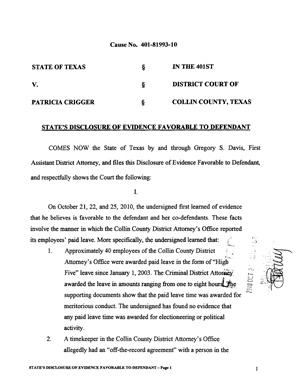
According to a motion filed with the appeals court by the defense, at a later court hearing officers involved in the search stated that the contents of the box had been switched out. They said the box originally contained a Wal Mart receipt, but later the receipt was missing and a business card from a Wal Mart security officer was substituted. The defense claims that the receipt was exculpatory evidence - that it would prove that the boots sought by police were purchased after the murder.

But the receipt is gone. Who done it?

Claiming that by inspecting the seized evidence, Judge Mark Rusch became a material witness, the defense team sought to have Judge Rusch recused. A hearing was held before an assigned judge who ordered that Rusch recuse himself from the case -- to be replaced by Judge Chris Oldner.

The defense also accused the Collin County District Attorney's office of prosecutorial misconduct and sought to question the First Assistant District Attorney, Greg Davis. Judge Oldner denied the request.

Oldner also denied a defense motion to disqualify the District Attorney's Office from the case.

Bell's attorneys appealed Oldner's decisions to the 5th Court of Appeals in Dallas, which also refused to force the DA off the case. Bell has now appealed again, this time to the Texas Court of Criminal Appeals, which earlier this month agreed to hear the case and has ordered that arguments be submitted.

So who is lying - The judge? The DA? The police?

Perhaps we'll never know who opened the shoe box, and what happened to the evidence. It does seem possible that misconduct and mishandling of evidence could make prosecution of Mr. Bell difficult if not impossible.

This 2 year old case is starting to look like something from a television detective story plot. Unfortunately it's unlikely that a super detective is going to come on the scene with his scientific tool kit and tell us who done it.

CSI:Frisco? Not hardly.

Bill


District Attorney Candidate "Best Answers"

     Recently, a collaborative effort was made to get a questionnaire answered by the candidates for Collin County District Attorney.  All candidates in the Republican contested primary returned our questionnaire.  (The Democratic candidate has not responded).

     I thought one way for me to add my commentary is to take what I see as the best answer from each question (sometimes shortened), and post them here.  As was promised to the candidates, the full text of their answers appears at the bottom of this article.

     I hope none of the candidates take my comments too personally.  I consider all three friends.  This is a great race because it is not about who is qualified versus who is not, but rather which is the best from three qualified candidates.  _______________________________________________________________________

BACKGROUND For #1– Right now there are 3 attorneys per misdemeanor court (1
chief, 2 others), and 1 Misdemeanor chief over it all. There are 3 “teams” of
attorneys for District Courts. I believe there are 3 attorneys staffing 3 courts on
one team, and 2 attorneys staffing 2 courts on the other team. Additionally, there
are 4 attorneys in the crimes against children section, 6 in “special crimes” (civil
and criminal), 5 in appeals, and 3 in Juvenile. (These numbers might be slightly
off, but are generally correct.)

1. What do you think about the current structure/staffing of the ADAs? Would
you shift attorneys around?

Best Answer: Greg Willis

     I believe the present District Attorney’s Office staffing matrix lacks a sufficient
number of prosecutors in the individual courts. There are currently seven district
courts hearing criminal cases. Staffing these courts with two permanently
assigned assistant district attorneys will increase efficiency. A felony chief
prosecutor will supervise two or three of these court teams depending on the
respective caseloads for the individual courts. These changes will provide law
enforcement and defense attorneys more access to prosecutors, as well as for
more consistency in handling cases without the need for additional staff and
connected growth in the budget. Additionally, I plan to implement a program of
rotating misdemeanor prosecutors into the felony division before they are
promoted to a chief’s position within the Misdemeanor Division. These
assignments will not only provide these prosecutors with felony trial experience,
but also give them practical experience within the intake and grand jury sections.
The benefits for implementing this specific program are many, not the least of
which is providing better qualified and more experienced misdemeanor court
chiefs to supervise and train new prosecutors who are responsible to handle
misdemeanor cases in the Collin County Courts at Law.

Why This Is The Best Answerr: All candidates addressed the problems with the "team method" of prosecutors currently implemented. However, Mr. Willis' answer addresses the misdemeanor chiefs. One of the things I envied about the Dallas DA's office is that they will make an attorney a felony prosecutor before becoming a misdemeanor chief. This helps the prosecutor gain perspective on what cases are important, and what cases are not. It also allows them to be better prepared when training new attorneys -- a crucial aspect of the office.

2. What do you think about the criminal special crimes section? Would you make changes in that section, and if so, specifically how?

Best Answer: Jeff Bray

     In addition to taking over the Special Crimes division, I will change it's
orientation and responsibilities. It is supposed to be a white collar crime section, but it
seems to have drifted over the years to a major fraud/catch-all division. It has also
caused quite a bit of controversy. The Specialized Crime division of the Dallas County
D.A.'s office handles all felony white collar crime cases, starting with a loss value of
$1500. These cases, and these victims, need an experienced white collar prosecutor just
as much as the large cases, but the Collin County Special Crimes division only handles
cases with a loss of at least $20,000, and even then sends many eligible cases to the trial
teams for prosecution after they are indicted. Unless a case goes through the standard
intake process, it should be tried by the prosecutor that prepared it. I believe this division
will be able to handle the cases that need special crimes attention even though we would
be giving up a prosecutor to the new trial team. The section may also handle the same
type of "special" cases it has handled in the past, including investigations of local
attorneys and officials, but these will either be handled by me or under my direct
supervision. If there is any negative impact from one of these investigations or
prosecutions, I will be directly responsible and answerable to the involved parties, the
press, and the voters.
Further, as a former special prosecutor for a neighboring county, I will not
hesitate to call in a prosecutor from another office to take over an investigation if my
office could be perceived as having an improper bias.

Why This Is The Best Answer: Mr. Bray has the edge in experience in complex special crimes investigations.  I like the fact that his face will be part of the investigations and keep him motivated to do the right thing.  Jeff also knows of some cases starting out in that division, then transferring out, and has vowed to stop that practice.

3. Will you get in the courtroom and actually try cases? Why or Why Not?

Best Answer: Jimmy Angelino

     Anyone who knows me knows that I am not a politician who will just sit behind a
desk drawing a paycheck. I am the only candidate in this race who has extensive jury
trial experience, with over 190 jury trials taken to a verdict as a prosecutor. Of the cases
I took to trial, I had a 98% conviction rate. I am a skilled prosecutor and I don’t think I
should just shelve those skills, but I have to balance that with the time commitment
managing and training will take up.
Because of that, especially at the beginning, I do not expect to be in the
courtroom trying cases on a daily basis. Not to mention there are plenty of excellent
prosecutors who need to be left to do their jobs. I do however expect to second-chair
trials occasionally in order to help our junior prosecutors develop their trial skills,
especially in the misdemeanor courts. Training and mentoring the Assistant District
Attorneys will be a priority for me.

Why This Is The Best Answer: Conviction rate doesn't mean much to me.  Any attorney can win all of their cases if they pick the right one.  Plus, there are many cases that you shouldn't be winning in the  interest of of justice.  However, I like the fact that he singles out the misdemeanor division to sit in on cases and help out.  Mr. Angelino's background with trial and DWI prosecution would be helpful to new attorneys.

4. In general, what changes would you be making if you became District Attorney?

Best Answer: Greg Willis

     First is my commitment to make the just prosecution of criminal cases the number
one priority of the Collin County District Attorney’s Office. I will permanently
assign prosecutors to the individual courts. Assistant district attorneys will take
ownership of their cases as I implement a new protocol that not only gives each
prosecutor more discretion over their individual cases, but also broadens the
authority of chief prosecutors. My administration will work hard to build interagency
relationships with law enforcement throughout Collin County to increase
our investigative and prosecution effectiveness. My administration will also
create an on-call system, making veteran prosecutors available to Collin County
law enforcement officers on a 24 hour / 7 days a week basis as we strive to make
the pursuit of just results the guiding principle of the District Attorney’s Office.

Why This Is The Best Answer: Both Bray and Willis discuss giving individual prosecutors more discretion by making cases their own.  I have thought and blogged about that being a major problem within the office.  However, Willis also writes about the implementation of an "on call" prosecutor to assist law enforcement.  I think this would be a welcome addition by local law enforcement agencies.

5. Right now, only three people in the District Attorney’s office have authority to dismiss a case. The misdemeanor division chief for misdemeanor cases, the first assistant for felony cases, and of course, the elected District Attorney. What do you think of this policy? Would you allow misdemeanor court chiefs and or felony court chiefs to dismiss cases they feel should be dismissed?

Best Answer: Greg Willis

     I believe those individual assistant district attorneys assigned as court chiefs
should have my support in the day-to-day operations of their courts. Those
individuals must demonstrate integrity, professionalism and wisdom in order to
justify occupying this very important role. Any prosecutor working with me in
that capacity will have the ability, when justice requires, to reduce charges, reduce
sentence recommendations and in appropriate cases, dismiss charges.

Why This Is The Best Answer: Both Willis and Angelino propose allowing misdemeanor prosecutors to dismiss or reduce charges.  However Angelino prefaces it by saying that there is less of a need when proper screening of cases occurs.  I think that is a myth.  No office (on a misdemeanor level), can ever "properly screen"  all the misdemeanors that come in.  Unless Mr. Angelino is proposing that all DWI cases that come in will come in with videos that are watched before the filing of the case (what can show a rightful on non-rightful arrest), there can never be "proper screening" of cases.  Mr. Willis gets the nod on this question by unequivocally stating his answer. It also shows the benefit from #1, allowing misdemeanor chiefs to first gain experience felony prosecutions before starting that  position.

6. Current DA John Roach recently proposed using funds to purchase weapons and body armor for the Investigators in the office. What do you plan on doing with these weapons, and will your investigators continue to train to be a emergency security staff for the court?

Best Answer: Jimmy Angelino & Greg Willis & Jeff Bray

    You can read all the full answers linked at the bottom to this question.  I didn't find this questions to be a major differentiator of candidates.

Why This Is The Best Answer: All three answered pretty similarly.  That they aren't going to create a SWAT team out of investigators.  They would seek out the advice of local law enforcement to see how they could best be utilized.

7. Do you have any plans to expand or develop alternative/deferred sentencing programs? What programs have you seen or heard of that you would implement?

Best Answer: Greg Willis

     Yes. The current system is bloated with criminal cases that would be more
appropriately handled by diversion out of the courts and into an alternative
program of rehabilitation. I would favor diversion for youthful, non-violent
offenders
with a demonstrated desire to change their behavior in exchange for
keeping their record clear. This means I will expand the current divert program
within the misdemeanor division and create a felony diversion program.

Why This Is The Best Answer: Mr. Willis goes the furthest in saying he'd like to expand to felonies.  I give Mr. Angelino a close second on this one.  I'm not sure if Mr. Angelino agrees, although he stated he wanted to expand the current diversionary system.  I would have liked to hear the candidates opinion on the current system (which is rarely used, and riddled with problems in my humble opinion).  Mr. Bray wont commit to saying what if any programs he'd use until he learns more which makes sense. However, I think that all candidates running for DA should have already researched or experienced programs that worked.

8. What lessons should the Collin County District Attorney learn (if any) from Dallas County’s experience with their Innocence Commission?

 Best Answer:  Greg Willis

     When the Dallas County District Attorney became aware that innocent individuals
had been convicted and incarcerated, he moved swiftly to rectify these injustices.
Such actions are completely consistent with Texas law -- a district attorney’s
paramount duty is to seek justice. As District Attorney it will be one of my
priorities to make sure that Collin County prosecutors and all of our law
enforcement agencies take full advantage of the important lessons we have
learned from uncovering and studying the kinds of problems that led to those
wrongful prosecutions and convictions of all those innocent individuals, who have
now finally been exonerated.

     Beyond the grave injustice to the wrongfully convicted, a credible criminal justice
system simply cannot tolerate the number of violent criminals who (as a result of
charging and convicting innocent citizens) were never prosecuted, but rather were
allowed to remain at large to commit additional crimes against our citizens.
After meeting with the various law enforcement agencies these past few months, I
am confident that the professionals at all levels of the Collin County criminal
justice system sincerely want to be respected by their peers and by the public for
performing their duties aggressively by zealously investigating and prosecuting
criminal offenses, while at the same time diligently protecting the rights of our
citizens.

Why This Is The Best Answer: All candidates give good answers to this question.  I don't know that there is a "right answer" to this question.  I think that good hiring and creating an atmosphere of it being OK to do the right thing is key.  Through Mr. Willis' answer, I get the feeling that this would be accomplished. 

9. Do you believe our indigents are well served and fairly treated in our “Indigent Defense Plans”? What changes to the plans might you recommend to the Board of Judges?

 Mr. Willis gave a REALLY long answer with links to studies, etc. -- You can read the entire text below. However, one line struck me as the most telling:

"I believe an emphasis should be placed on working to keep well qualified defense attorneys involved with the programs and removing those with records of inadequate representation."

Why This Is The Best Answer: Truth is, this question was designed more to get at the core of the candidates ideals than to find real answers to the problem (if any).  The judges are the ones in charge of the Indigent Defense Plan, however the DA certainly sees what works and what doesn't.  I think quality of court appointed lawyers is always an issue, and some attorneys don't treat it with the respect it deserves.  Mr. Willis being a judge and seeing a plethora of court appointed and retained attorneys in court and trial gives him some insight that others may not have. 

10. Would you bar defendants from open pleas before a judge if a plea agreement can not be reached, or would you reserve the right to object if you thought the judge might be more lenient than your plea offer was? Which level of prosecutors in the office would be allowed to make this decision?

Best Answer: Greg Willis & Jimmy Angelino

WILLIS (partial answer): "The decision to waive a jury trial on behalf of the State is not a decision that can be lightly made and must be evaluated on a case by case basis. Certainly, it is not my intention to universally bar defendants from open guilty pleas to the Court but every case must be independently evaluated on its particular merits. . . If the question asked is whether I will predicate a decision to request a jury trial solely on whether or not I believe we can obtain a greater sentence from a jury, my answer to this question is no.

ANGELINO (full answer): In general, I believe defendants who want to plead guilty to the charge against them, should be allowed to enter a guilty plea. This is because guilty pleas avoid the necessity of a trial which takes up the time of the jury members and extra cost to the taxpayers. The DA’s office should generally not bar defendants from entering open guilty pleas, except for extraordinary circumstances.

Why This Is The Best Answer: I thinks these two answers explain for themselves why they are the best answers.  Judges are also elected, and sometimes we need to allow the elected judges to make the decisions on punishment.  It is also a GROSS waste of money and time to have a "sham" trial, just to allow the prosecutor to get another win at trial, when a person wanted to plea guilty in the first place.

Jimmy Angelino's full responses are here

Jeff Bray's full responses are here

Greg Willis' full responses are here

Full Disclosure: I have been a supporter of Greg Willis' campaign. Although I haven't "campaigned" for him, I have sent in a donation to his campaign.

PAST ARTICLES ON COUNTY RACES

 Hunter Biederman is a DWI / Criminal Defense Attorney in Collin County. He publishes his blog (www.friscodwilawyer.com) which focuses on the Collin County and Texas legal system. He can be reached at friscolaw@gmail.com or (888) DWI-FRISCO.


Collin County District Attorney Q&A

Recently, we sent out 10 questions to the DA candidates. I will go back and analyze some of the answers soon.
Unfortunately, my blog platform is having problems, and I am not able to edit these post very well right now. As soon as it's back up, I'll add more. Below is the first article by the Collin County Observer publishing those answers. ---


District Attorney candidate questionnaire responses

The Collin County Observer, in a collaboration with the Frisco DWI Lawyer's Blog recently sent all four District Attorney candidates a 10 question form designed to give the voters an insight both into the plans each candidate has for operating the DAs office and their approach to criminal justice.

The Collin County District Attorney is responsible for prosecution of all criminal cases in the county. The DA runs a large operation, divided into ten divisions. These divisions are: Intake/Grand Jury, Misdemeanor Trial, Felony Trial, Family Justice (crimes against children section, domestic violence section), Special Crimes, Appellate, Hot Checks, Investigations, Operations and Victim/Witness Assistance. The DA also may represent the County in civil cases.

The DA's office has 116 employees and its 2010 budget is $10,775,827.

The questionnaire contained 10 questions. The first 5 involved the organization and operation of the department:

1. What do you think about the current structure/staffing of the ADAs? Would you shift attorneys around?

2. What do you think about the criminal special crimes section? Would you make changes in that section, and if so, specifically how?

3. Will you get in the courtroom and actually try cases? Why or Why Not?

4. In general, what changes would you be making if you became District Attorney?

5. Right now, only three people in the District Attorney’s office have authority to dismiss a case. The misdemeanor division chief for misdemeanor cases, the first assistant for felony cases, and of course, the elected District Attorney. What do you think of this policy? Would you allow misdemeanor court chiefs and or felony court chiefs to dismiss cases they feel should be dismissed?

The next question addressed the recent attempt by DA John Roach to arm a "Rapid Response Team" with automatic weapons and riot gear:

6. Current DA John Roach recently proposed using funds to purchase weapons and body armor for the Investigators in the office. What do you plan on doing with these weapons, and will your investigators continue to train to be a emergency security staff for the court?

And the last 4 questions with policies affecting the administration of justice:

7. Do you have any plans to expand or develop alternative/deferred sentencing programs? What programs have you seen or heard of that you would implement?

8. What lessons should the Collin County District Attorney learn (if any) from Dallas County’s experience with their Innocence Commission?

9. Do you believe our indigents are well served and fairly treated in our “Indigent Defense Plans”? What changes to the plans might you recommend to the Board of Judges?

10. Would you bar defendants from open pleas before a judge if a plea agreement can not be reached, or would you reserve the right to object if you thought the judge might be more lenient than your plea offer was? Which level of prosecutors in the office would be allowed to make this decision?

As of the deadline at midnight on Sunday 3 of the candidates had returned their completed questionnaires:

James Angelino's responses are here

Jeff Bray's responses are here

Greg Willis' responses are here

The questions are specific and so the responses are long. The Observer offers this in-depth look at each of these candidates in the hope that the discerning voter will gain valuable insight into the plans and philosophy of each of these well qualified candidates.

The Observer thanks each of these gentlemen for taking the time to submit thoughtful answers to our questions. Our readers can look forward to further analysis and discussion of these issues in both The Collin County Observer and the Frisco DWI Lawyer's Blog.

Bill

Collin County District Attorney Race Q&A

Coming Soon!  A 10 Question and Answer session with the candidates for Collin County District Attorney.  This Q&A is a collaborative effort between myself and the Collin County Observer (CCO).

In the next couple of days, we will be sending out 10 questions to the candidates for DA.  I think it will be helpful to see where the candidates stand on several of these issues.  Because I am a criminal defense attorney who practices in the county, I have tailored some of the questions to reflect important issues to practicing attorneys.  The other questions, with the help of the CCO are more geared towards the average voter who will not have much direct contact with the Judicial System.

The candidates will be given the questions in writing, and have several days to respond.  I will post their answers here on the blog.

Collin County District Attorney Race - Videos

Recently, several candidates for the Republican primary came to the Allen Area Patriots club to discuss the race for Collin County District Attorney.  Videos of the candidates were uploaded to youtube, and I have added them here to the blog.  A big thank you to "mopenshaw" whoever you are.You can read bios of the candidates on my previous post HERE.

JEFF BRAY

GREG WILLIS


JAMES ANGELINO


PAST ARTICLES ON COUNTY RACES

 Hunter Biederman is a DWI / Criminal Defense Attorney in Collin County. He publishes his blog (www.friscodwilawyer.com) which focuses on the Collin County and Texas legal system. He can be reached at friscolaw@gmail.com or (888) DWI-FRISCO.

Collin County DA Denies Citizen From Pleading Guilty

A couple of weeks ago, I happened to be present in the 429th District Court and saw an individual, Mr. Robert Blackburn trying to plea guilty, but was barred in doing so by the Assistant District Attorney.  I didn't think too much of it at the time, because I have seen the DA do this many times -- including to my clients.

What happened differently on this occasion, is that the (visiting) Judge John McCraw stood up to this ridiculous practice. I was pleased to read a great article by the Collin County Observer reporting the incident and subsequent appeal by the DA.

The Law

First, lets go through how a criminal case is disposed.

A person accused of a crime may either plea guilty or plea not guilty regarding criminal charges against them.

Plea Not Guilty

Texas has a bifurcated trial system, meaning "two parts."  The first phase is to determine whether or not a person is guilty, the second phase is to determine punishment (if found guilty).  Obviously if found not guilty, there is no punishment phase.  As far as the second phase goes, one must choose before the trial begins as to whether or not to have the judge or jury handle sentencing if found guilty.

1. Plea Not Guilty, Judge Punishment:  A citizen requests a jury to determine if they are guilty or not guilty, and if  found guilty, elect the judge to impose punishment.  This is the most common, as most attorneys know that judges get to see lots of cases and can understand the seriousness/non-seriousness of the particular crime.  Additionally, it is easier for an attorney to advise a client on the likely punishment if you know who will be doing the sentencing opposed to jurors you have never met.

2. Plea Not Guilty, Jury Punishment: A citizen requests a jury to determine if they are guilty or not guilty, and if found guilty, elect the jury to impose punishment.  If in front of a tough, unreasonable, or unknown judge, one might elect a jury of their peers to decide their fate. 

Plea Guilty

1. Negotiated Plea:  This is the most common plea.  The DA and the citizen (often with the help of their attorney), negotiate a punishment, and they plea and receive punishment.

2. Non-Negotiated "Slow" Plea: If a citizen accused wants to plea, but cannot agree with the DA on punishment, they can enter a "slow plea."  This means the accused will plea guilty, but allow the jury to assess the punishment.

2. Non-Negotiated "Open" Plea: If a citizen accused wants to plea, but cannot agree with the DA on punishment, they can enter an "open plea."  This means the accused will plea guilty, but allow the judge to asses the punishment.

The Case

In this case, the defendant, Robert Lee Blackburn was charged with 4 felonies after he bit a Plano Police officer while being arrested for possession of cocaine. It seemed that everyone agreed as to his guilt, but there was no agreement on what the punishment would be.

Mr. Blackburn and his attorney agreed he should plea guilty, and wanted the presiding Judge (in this case, Judge Jill Willis) to assess punishment.  Mr. Blackburn wanted to plea guilty in an "open plea," but the District Attorney refused to allow him to do so.  They did this by invoking the State's right to a Jury Trial. 

In Texas, the State has a right to a jury trial.  It's a bit silly in my opinion, but too complicated to debate in this article the legality of the whole issue.  I'll save that for another article.

By invoking the right to a jury trial, it means that a defendant CANNOT enter an "open plea."  This means that if Mr. Blackburn wants a judge to assess his punishment, he must plea not guilty, go through the farce of a jury trial, and elect the judge to impose the sentence. 

That is exactly what the Assistant District Attorney, Gary Knapp forced upon Mr. Blackburn's.  I do not know if this was his personal decision, or if someone higher up in the office instructed him to do this. (The Observer reported and provided a transcript showing Appellate Chief John Rolater who was arguing the case -- which is accurate at the second hearing.  Originally it was Knapp barring the plea of guilty, and calling  the Appellate department for assistance).  In this case, the Judge did not allow the State to invoke their right to a jury trial, and ordered the plea be accepted.  The State has since appealed, and the case is in limbo until the appellate court reaches a decision.

Why would the DA force a "sham" trial on a defendant when everyone agrees on their guilt?

There can be several possible reasons, none of which seem justified to me:

1. Forum Shopping - Forum shopping is an attorney (on either side of the case) attempting to pick what judge is going to hear a case.  Defendant's cases are randomly assigned to courts, so one cannot pick a judge.  However, visiting judges are often called in when judges are out of town, or want to run a "double-docket," to help clear out some cases. 

I am almost positive I heard the DA that if Mr. Blackburn wanted to plea to a visiting judge, they would allow it, but not to the presiding judge.  I cannot remember for sure, and am not willing to make this claim positively.  I wish that a transcript available of the hearing that took place before the appellate department got involved.  That is where the true hearing took place.  I personally believe forum shopping was part of the reason why the DA did not allow the plea.

2. Padding Statistics - This is political gamesmanship. If a DA wants to boast about their conviction rate, they can pad the stats.  I have seen Collin County DA literature boasting about conviction rates in the past. Additionally, if a prosecutor wants to look good to their superiors, they will try to win as many cases as possible.

The DA can offer really tough plea bargains to a defendant.  This will bar someone from pleading guilty in a negotiated plea.  In a court where the defendant chooses to allow the judge to accept punishment, this will force a trial if the state invokes their right to a jury trial.  The DA will have a slam dunk case of guilt, and get to put it down as a win.

They will additionally get to put it up on the "Board" which is at the DA's office.  The "Board" is where attorneys write down their trials they are having that week, along with the results.  It was there when I was an assistant district attorney, and assume it is still there.

3. Practice for young prosecutors:  I guess if someone wants some experience in a trial, they could force a sham trial just to get some experience.  This is not what happened in this case, because these are felony prosecutors with plenty of trials under their belts already. 

4. Manipulating the Punishment Range: The entire range of punishment is available to either a judge or a jury.  With one exception: Deferred Adjudication.  A citizen accused can only get deferred adjudication from a judge after a guilty plea (negotiated, or not negotiated).  By barring a person from pleading guilty, the DA is barring the possibility of them getting Deferred Adjudication.  Basically usurping the elected Judge's powers.  The DA in this case says this is the reason for their behavior, however I have personally seen them do this in cases where the client is not even deferred eligible.  I don't see why the DA would stop an elected presiding Judge (or in this case, a judge appointed by Governor Rick Perry) from doing the job they were put there to do.

My hope is that with this article, one of the new candidates for District Attorney will stop this archaic practice of barring a person from pleading guilty to an elected Judge thus forcing a sham trial.  In the end, it is about the difference of what should be done, versus what can be done.  After about seven years of the same elected District Attorney, I think a new DA will be the only factor that change this practice.

DOCUMENTS


Petition for Writ of Mandamus, In re John Roach, Fifth COA case number 05-09-01451-cv

Reporters Record, December 3, 2009 Texas vs Robert Lee Blackburn

Order granting Emergency Motion for Temporary Relief, In re John Roach, Court of Appeals, Fifth District.

Link to Court of Appeals case 05-09-014510-CV, In re John Roach

Link to Collin County cases 199-80283-08, 199-80284-08, 199-80285-08, 199-80286-08, State vs. Robert Lee Blackburn

Hunter Biederman is a DWI / Criminal Defense Attorney in Collin County. He publishes his blog (www.friscodwilawyer.com) which focuses on the Collin County and Texas legal system. He can be reached at friscolaw@gmail.com or (888) DWI-FRISCO

Craig Watkins (Dallas DA) on Stephen Colbert

The Colbert Report

Mon - Thurs 11:30pm / 10:30c
Craig Watkins
www.colbertnation.com

Colbert Report Full Episodes Political Humor U.S. Speedskating

Saw this recently, and thought I'd share it.  Although I love what Craig is doing down in Dallas, I really think he could have been a bit funnier. . . .

Comment Explosion on the Collin County DA's "Investigation"

I recently showcased an article, "Two Local Judges Investigated in Grand Jury Investigation"  by the Collin County Observer.

In general, I don't like just grabbing an entire article and posting in on our blog.  I instead try to post and show my take on the matter.  But his article was too good on the matter to do anything but post the entire article.

What I have found interesting, is not just the article itself, but the massive amounts of comments about the article.  As of today, there are 64 comments on the article.  I think that is the new story of the day.

I am posting the responses to the article below.  It is interesting the progression from anonymous comments, to non-anonymous comments.  Specifically with local attorney who often are the targets of these investigations.

Below are the comments from the site:


Comment from: FM Voter [Visitor] Email
Mr. Willis has served the citizens of Collin County with the utmost integrity and he will continue to do so if elected as our next DA. What happened to our secretive grand jury process? What a shame that this information is out in the public. This entire situation smells of political intimidation
 
PermalinkPermalink 11/19/09 @ 09:43
 
Comment from: Christobell [Visitor] Email
Bill, thank you for tracking down this story. Both Jill and Greg Willis are honorable public servants. This certainly sounds like a political witch hunt.
In regards to Judge Wooten, wouldn't the Ethics Commission be the one filing charges, or am I mistaken.
I hope Judge Willis is our next District Attorney.
 
PermalinkPermalink 11/19/09 @ 10:21
Continue Reading...

CC Observer -Two local judges targets of grand jury investigations

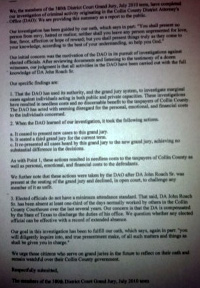
Bill at the Collin County Observer is back again with a commentary & article on the DA's office going after local officials. I will not be commenting.  Below is his unedited article. You may also want see a very active discussion on his "comments page."

Two local judges targets of grand jury investigations


The Collin County Observer has learned that two Collin County judges are currently the targets of seperate grand jury investigations. Court house observers I have spoken with suspect that both investigations are politically motivated.

Judge Suzanne Wooten, of the 380th District Court has recused herself from all criminal trials for several months now after, my sources tell me, the former judge she defeated brought forth charges of illegal campaign finance transactions.

And Judge Greg Willis, who recently resigned as judge of the County Court at Law #6 is, according to court house insiders, the target of an investigation alleging possible irregular authorization of payments to defense attorneys representing indigent defendants.

Judge Willis is generally considered the front runner in the GOP primary race for District Attorney.

Grand Jury proceedings are, by law, secret. The particulars of both cases can not be known unless and until the grand jury hands down indictments.

The Observer can not and does not know what testimony has been given or exactly what the allegations are. What this author does know is that the Collin County court house is abuzz with rumors.

However, sources close to both judges have confirmed that they are indeed targets of grand jury investigations.

Rumors abound.

According to court house insiders, it is likely that former judge Robert Sandoval filed his charges against Judge Wooten directly with the grand jury. Sandoval is said to still bear a grudge against Wooten who beat him handily in the 2008 election.

The most popular explanation I've heard for the investigation against Willis is that the DA and his chief assistants do not want Judge Willis to become the next District Attorney - they believe that if he is elected, he will "clean house" by replacing many of the lead prosecutors.

Local attorneys point to what they say is a history of using grand juries for intimidation by DA Roach and Chris Milner, the Chief of the District Attorney's Special Crimes Division.

Milner has, in the past, been accused of using grand juries to "go after people with vague offenses". They bring up Milner's indictment of local attorneys Deric Walpole and James Vasilas who were indicted by Milner for "tampering with government records" for making an error on a legal pleading. Both indictments were eventually thrown out.

Milner also investigated the allegations of fraud between Dallas County Sheriff Bowles and jail contractor Jack Madera. All indictments were later tossed out because the charges in the indictment were not criminal offenses, but not before Bowles lost his primary bid for nomination as sheriff. In yet another big case, Milner secured indictments against Denton County Sheriff Weldon Lucas. Less than a week later, a judge dismissed all charges against him.

Special prosecuter is needed.

Regardless of the merits of either case, the prosecution of a judge by the DA, who on a daily basis pleads before that same judge, opens the door to charges of political intimidation.

When Dallas and Denton Counties needed to investigate their sheriffs, their DAs asked for an outside prosecutor. When the Rockwall county DA was accused of wrong doing, again an outside prosecutor was brought in.

Every day, members of the district attorney's staff appear before our judges and make motions, ask for pleas, and argue cases. Every day, our judges make decisions to accept or reject those motions and pleas. Every day they hold trials where they try to remain fair to both the defendant and the DA.

It is insane for a county district attorney to prosecute the county's own judges. If John Roach believes there may have been wrong doing by either judge, then justice requires that he ask an outsider, with no vested interest in the outcome, to investigate and prosecute if warranted.

It is wrong for the Collin County District Attorney to proffer charges against a jurist who seeks to use the ballot box to replace him.

The fact that these two cases have proceded this far smacks of arrogance on the part of the Collin County District Attorney. His actions look like cheap and brutal political stunts. If justice is to be served, Roach and his staff must either drop their investigations, or turn over their evidence to a special prosecutor and let him convene a new grand jury to hear the charges.

Bill


And Now For the Rest of the Story. . .

I have not written about a recent DWI incident because I didn’t want to soil the names of  prosecutors accused of wrongdoing.  Those accused have now found their names in print and put on TV.  I have chosen not to add their names to this article.

WFAA & the Collin County Observer have published stories, so I guess on a small scale, the cat is now out of the bag about the “story.”  Which in my opinion is not much of a story at all.

The truth is, if these reporters personally knew the stellar reputations of the two prosecutors accused and the great reputation of the defense attorney accused versus the young prosecutor accuser, they wouldn’t have been so quick to believe what they heard from the accuser.

The 30 second recap of the story is that an “iron-clad” DWI case was effectively dismissed by a Collin County prosecutor by holding a trial and not putting on any evidence.

Brett Shipp from WFAA and the Collin County Observer got this one way wrong.  At the very least, they made a premature jump to conclusions:

The first conclusions asserted are that the citizen accused is definitely guilty and there would be plenty of evidence to prove his guilt in court.

The second conclusion was that the actions of the prosecutor was motivated by some ulterior motive.

Assuming the citizen is guilty and there is enough evidence to prove his guilt can often be a big leap in a DWI case.  I do not know the facts of the case.  But from courthouse talk, I am told that the citizen burped seconds before the breath test.  Anyone who regularly practices in the area knows that this would invalidate the breath test.  Additionally, the state’s own experts who are required to certify the test will not do so if someone burps within the required 15 minute observation period.  This is because the machine would be testing the mouth alcohol instead of the alcohol from the lungs.  No jury would ever hear the results of the test. 

If a prosecutor has this knowledge, they may a) try to put on the evidence anyway, knowing it is no good, or b) self-regulate and not offer the breath test evidence.  Apparently the prosecutor chose the latter.  So then, what is left is the facts of the case without the breath test.

Without going into too much detail, often young, just out of school prosecutors think cases are “iron-clad” when they are anything but that.  As a DWI attorney, I could give a list of DWI not guilty verdicts in cases with seemingly significantly worse facts where prosecutors thought the case was a slam dunk.  Especially in cases where there are no chemical tests.  There is a reason why the State is pushing so hard for blood tests when people refuse breath tests – because it is difficult to obtain convictions on opinion testimony alone of some police officers.

I have heard that the citizen accused in this case looked stellar on the tape.  Just because a person is weaving and cant stand on one leg doesn’t mean they are guilty of DWI.  So again, the prosecutor may have had doubts about the guilt of the person, who is by law required to "seek justice" can then either, a) put on the evidence anyway, or b) do what apparently was done in this case – not put on the shaky evidence.

I believe the WFAA report deceives the audience in what I gather is an attempt to shield the true source of his story – a young prosecutor accuser.  The report purports to display two citizen callers as the people who are upset about the trial results.  And they very well may be upset, but certainly they did not bring this story to the attention of the reporter.  You see, this “story” was known for a while by many local attorneys.  The young prosecutor accuser sent a long email to a law professor about his views on the indigent’s representation in local courts.  In the email, he blasts his fellow prosecutors for effectively dumping the DWI case for their own personal gain.  His email did not mention the names of the prosecutors, but gave enough personal information about them to make them easily identifiable to anyone in the tight knit Collin County legal community.

WFAA’s story relates and shows that the “incident report spells out what happened next.” Smelling of alcohol and stepping off line during a walk and turn test.  So the reporter has the incident report of the event.  Where did the reporter get it?  Witnesses aren’t given police reports and never went to court.  The case is expunged and you cannot get the paperwork from the court or from open records.  So it would seem that maybe young prosecutor gave it to the reporter?  This prosecutor proclaimed in his email to the professor that he “got the file from the ‘disposed’ files and made sure that none of it was attributed to me.  I made copies of the file.”

Under the law, the reporter of the story didn’t do anything wrong, but our hero young prosecutor accuser might want to study up on expunction laws:

55.04. Violation of Expunction Order

1. A person who acquires knowledge of an arrest while an officer or employee of the state or of any agency or other entity of the state or any political subdivision of the state and who knows of an order expunging the records and files relating to that arrest commits an offense if he knowingly releases, disseminates, or otherwise uses the records or files.

2. A person who knowingly fails to return or to obliterate identifying portions of a record or file ordered expunged under this chapter commits an offense.

Violation of an Expunction order is a Class B misdemeanor.  Ironically enough, it the same level crime as the DWI in question.  It would appear likely that the accusing young prosecutor may have committed the same level crime that he is complaining was not effectively prosecuted.  I wonder if he would object if someone prosecuting him were to drop the case if they felt the evidence against him was shaky?

Hunter Biederman is a DWI / Criminal Defense Attorney in Collin County. He publishes his blog (www.friscodwilawyer.com) which focuses on the Collin County and Texas legal system. He can be reached at friscolaw@gmail.com or (888) DWI-FRISCO.

A Wrong Way of Thinking - How Innocent People Get Railroaded

Today I had an experience with the Collin County District Attorney's office that gives some great insight into the minds of some (not all) prosecutors.  The "Win At All Costs" mindset.

In general, I have seen this win at all costs mindset from prosecutors locally, and in articles around the country.  Arguments that get away from the merits of why we have the judicial system at all.  Consider a case where an inmate is requesting DNA to prove their innocence.  A prosecutor would argue not about whether or not that person is guilty, but whether or not he should be allowed to test the DNA sample. This gets away from the primary concern - is he guilty or not?  It moves into the realm of, should we test to see if he is guilty or not.

The illogical win at all costs argument is what I saw from the Collin County DA today, and it was shameful.

A while back we requested a hearing for a new trial for a client.  He had a different attorney for a trial, was convicted, and felt like he didn't get a fair shake at things.  We agreed and offered to represent him.  We requested, and were granted a hearing on the motion for new trial.  At this hearing, the judge would decide for himself whether or not the client gets a new trial.

We prepared for the hearing, and headed into court today. The judge asked if we were ready, we said "yes," but the prosecutors said "we just have a quick issue to take up first."

Instead of having the hearing today, and deciding whether or not the client got a fair trial, the DA decided to argue procedural issues.  Their arguments are not whether or not he got a fair trial, but whether or not he should even get a hearing to determine if he got a fair trial.

They proceeded to argue for quite some time that we were not entitled to even have a hearing to determine if the client had a fair trial. (I'll leave the post about whether or not they are right for later)

The Code of criminal procedure states that "It shall be the primary duty of all prosecuting attorneys . . . . not to convict, but to see that justice is done."

Can the argument of whether or not to even have a hearing be done? Sure.  Does it seem to me like this is a way to see that justice is done?  No way.

Collin County District Attorney Not Seeking Re-Election

I have been told today from several sources that Collin County District Attorney John Roach will not be seeking re-election. I haven't seen an official press release, but believe it is true.

His campaign website says it is being readied for the 2010 re-election campaign, but hasn't been updated in a while.

You heard it here first.

Let the rumors fly of who will be the next Collin County District Attorney. . . .