Collin County DA Recuses Self From District Clerk Case

Immediately after filing Brady Material - Favorable Evidence to the Defense, the Collin County District Attorney's office joined in the Defense's prior motion to recuse the District Attorney.

In the filing today, Gregory Davis, the First Assistant District Attorney explains that "[a]s a result of newly discovered evidence set forth in the State's Disclosure of Evidence Favorable to Defendant, the State of Texas now agrees that the Criminal District Attorney of Collin County and the Collin County's District Attorney's Office is disqualified in this case."

Both of these filings follow my past article, "How To Gut Your Own Case: Collin County District Clerks Case." which outlined the similarities in the District Attorney's High-Five paid time off program, and the District Clerk's "Blue Book" time.

It would seem that the District Attorney's Office employees, and or their policies have the potential to come into play in the District Clerk's case.

After originally refusing to move the case, the case was subsequently moved to Dallas County and postponed until 2011.  But it was originally planned to still be prosecuted by the Collin County District Attorney's office.  Instead, an "Attorney Pro Tem" must be substituted to act as the prosecuting attorney.

The judge has not ruled on the motion to recuse, but generally when both sides agree to a motion, it is granted.

Oh yes, and let's not forget what our friends at the Collin County Observer discovered... an AG opinion discussing elected officials roles in setting schedules.

The Texas General Attorney Opinion : Opinion No. GA-0778
Re: Whether a commissioners court may amend the county budget to reduce salaries for the county clerk's office because the clerk closed her office temporarily for a weather-related emergency (RQ-0834-GA)

In the resulting opinion, the AG states: "Elected county officers have a 'sphere of authority' within which they may manage their offices without interference.

District Clerks Case - Brady Material Filing

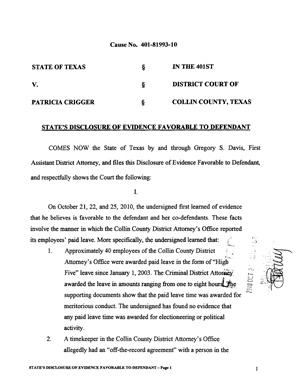
Today, Gregory Davis, Collin County's First Assistant District Attorney filed a "State's Disclosure of Evidence Favorable to the Defendant."  This is commonly known as a "Brady Material." Brady material, in short, refers evidence favorable to the defense that is known by the State. The State is required to turn this evidence over.  Brady material is often the source of heated debates including what is, and is not, Brady material.  Brady material requirements stem from the US Supreme Court case of Brady  v. Maryland

Today's filing goes on to detail some specifics regarding the State's High-Five program.  I previously reported on this program and detailed the shocking similarities to behavior alleged in the District Clerk's case. This stemmed from the District Attorney requesting a new way to code this time off which was denied by the County Commissioners.

The filing states:

1. Approximately 40 employees of the Collin County District ~
Attorney's Office were awarded paid leave in the form of"High Five" leave since January 1, 2003. The Criminal District Attorney awarded the leave in amounts ranging from one to eight hours.  The supporting documents show that the paid leave time was awarded for meritorious conduct. The undersigned has found no evidence that any paid leave time was awarded for electioneering or political activity.

2. A timekeeper in the Collin County District Attorney's Office allegedly had an "off-the-record agreement" with a person in the Collin County Human Resources Department to alter employees' time records.

3. At least two timekeepers in the Collin County District Attorney's Office altered employees' time records to reflect that employees were at work when they were actually on "High Five" leave.

4. A timekeeper in the Collin County District Attorney's Office believes that "everyone" in the county was altering employees' time records, including persons in the Collin County Human Resources Department.

5. Per a department spokesperson, the Collin County Human Resources Department had no knowledge of the "High Five" leave program prior to June 2,2010.

6. Per a department spokesperson, the Collin County Human Resources Department instructed all timekeepers to accurately report county employees' times.

7. An undetermined number of scheduling requests for investigators in the Collin County District Attorney's Office were destroyed without the knowledge of the Criminal District Attorney or the undersigned.

Mr. Davis further states, "While the undersigned believes that much of this newly discovered evidence will be held to be inadmissible at trial, he believes disclosure of this evidence should be made to ensure full compliance with Brady v. Maryland."

Analysis:

This certainly seems to lend credibility to my previous article of the similarities in the High-Five program and what the District Clerks were doing.

So this begs the heated question, "What is the question?"  What must the state prove?  Not just the behavior, but that behavior must actually be a crime.

Mr. Davis' filing seems to suggest the reason for the time off is what is in question.   (I think if this question was posed months ago, that wouldn't be the issue).

It would seem that the State planning on arguing it IS ok for an elected official to give time off on their own made up program.  It IS ALSO OK to lie about that to human resources and say those workers were there when they were not.  But apparently it is a Felony if during their time off they decide to campaign.

The filing seems to make this distinction by the line, ""[t]he undersigned has found no evidence that any paid leave time was awarded for electioneering or political activity."

How To Gut Your Own Case: Collin County District Clerks Case

The Short Answer? Admit to doing the exact same thing the people charged did.

I have never had a case where a prosecutor has stood in front of a large group and admitted to driving while intoxicated -- or any other crime for that matter. 

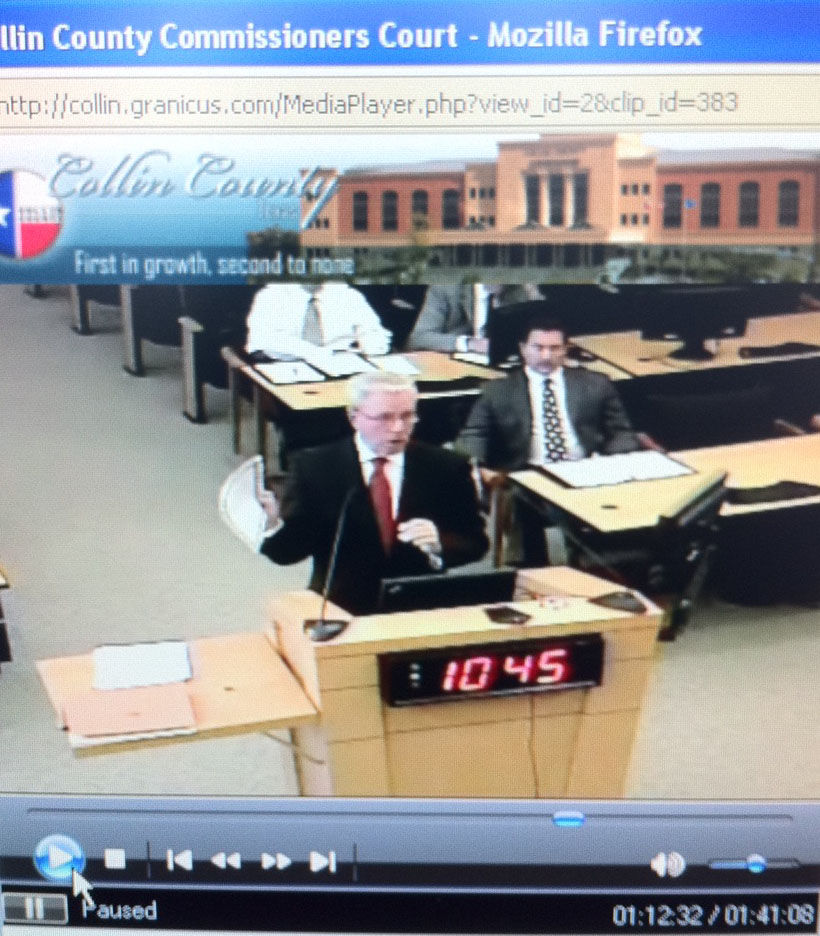
But that seems to be exactly what the elected District Attorney in Collin County recently did. No, he did not admit driving while intoxicated, but instead stood in front of the county commissioners and asked for assistance on properly "coding" his Hi-Five Paid Time Off program.  A program that on its face seems to be doing the same thing he accuses Six Collin County District Clerks of doing. Taking time off from work with the permission of their supervisors, but putting in with the county that they were actually present so they can be paid.

From the Commissioners Agenda below:

The request started off innocently enough. DA John Roach was asking for was a way to change the computer coding of employees time off.  Apparently he had already asked HR to do this, but they refused to make the change.

DA Roach explained the program: A supervisor or manager recommends an employee for a certificate that allows some time off. The recommendation is reviewed by manager, division chief and ultimately by me personally (John Roach).  The employee "might get an hour off or two hours off "and they must take it within a certain amount of time, usually 30 days. They must get their managers approval, then fill out a scheduling request. That lets us (The DA) know when they’ll take the time off.

Cynthia Jacobson (HR's appointed official) told the Court Commissioners that they only make the change with these programs are approved by the Court.  And this program has not been approved by the court.

The meeting then took on a much different tone.  The commissioners seemed very disturbed by the elected DA coming up with his own time off compensation program.

One Commissioner asked, "The application should reflect our policies. Do we have policy where people get time off for rewards?"  The question seemed rhetorical, because from the way the meeting went, it was clear that no such program exists within the county.  There are policies in place that dictate time off, and this isn't one of them.

The commissioners not only refused to change the computer coding, but refused to accept that it was OK for the elected DA to start his own paid time off program.

In response to the District Attorney's statement, "if I have someone doing a really good job, I should have the discretion to reward them for it," the commissioner responded with a resounding, "I disagree."

So if the elected District Attorney feels it is OK to come up with his own paid time off program, why is it not OK for the clerks office to do the same?  He charged six clerks with felonies for doing just that.

Here is the major problem I see with the State's case against the clerks.  Even if they did exactly what the District Attorney alleges (and they might very well have), do those actions constitute a crime?  The clerks supposedly padded their time in the office when they were not actually in the office.

According to the District Attorney paying someone for time off when they are not in the office is legal. But apparently only if they are his employees, not employees of the District Clerk's office.  Perhaps it is because the clerks didn't first come up with a name as cool as the "High Five" program.

If you would like to view the video, click on the video picture above.  You can click on the agenda item below the video to jump to that portion of the commissioner's meeting.

Also, for those not normally dealing with Collin Courts, this is the District Clerks office that was accused of wrongdoing -- a different office than the County Clerks office.

Hunter Biederman is a DWI / Criminal Defense Attorney in Collin County. He publishes his blog (www.friscodwilawyer.com) which focuses on the Collin County and Texas legal system. He can be reached at friscolaw@gmail.com or (888) DWI-FRISCO.

Targeting Judges?

Yesterday, our firm found ourselves in an odd position.  A case of ours was set for trial, and we were ready to go. (That's not the odd part).  The odd part is that although we were willing to waive the jury and allow the judge to make the determination of guilt, the state wouldn't allow it.

In general, the only reason the state would oppose this is because  they think they would have a better chance of a guilty verdict with a jury rather than the judge.  Conversely, a defense attorney would do this if they think they have a better (or equal) chance with the judge.  In this case, we knew the facts of the case, and were very confident of a not guilty no matter who was looking at it.

So we attempted to save our citizens some time, and let the judge decide.  But as has recently been pointed out by the front page article in the Dallas Morning News (just one day earlier), the State has a right to a jury trial.

A quote from the article was running through my mind when the prosecutor said that they wouldn't waive a jury.  Although we asked why, they refused to say why, except to proclaim "we have a right to a jury." Transcript Page I, Transcript Page II.  (Sound like a recent appellate attorney for the State?)

From the DMN article:

Roach said his office does not target specific judges as some allege. "That's an ignorant statement," he said. The law says prosecutors are entitled to demand a jury trial "and it doesn't make any difference what our motives are."

Yet avoiding specific judges seemed to be exactly what was going on in our case.

It needs to be pointed out, that this specific case, the issue was not about who was going to be doing the punishing in the case (as the DMN article was about).  This case was about having a judge or a jury decide the verdict of guilty or not guilty.  So although the quote is telling about the mindset of the District Attorney's office -- it's not directly on point.

So, instead of having the one judge decide, the State insisted on the jury.  About 25 jurors were brought in for the day.  Of those 25 jurors, 6 were selected for the jury and sat through a day and a half of trial.

Oh yeah, the verdict? Not Guilty. I'm sure the jurors were glad to have to take off work.


The State's "Biederman & Burleson" Motion in Limine

Recently, we had a trial set in which the prosecutors filed some pretrial motions.  While not uncommon for the prosecutors to file such motions, one of the items they requested I found quite interesting. 

The prosecutors filed a "Motion in Limine." A Motion in Limine is the attorney asking the judge to make the opposing attorney ask permission in advance of doing something.  Some common requests are for an attorney to request the opposing attorney to ask permission during trial in advance of offering expert testimony, or something else they think might be inadmissible and don't want the jury to hear.

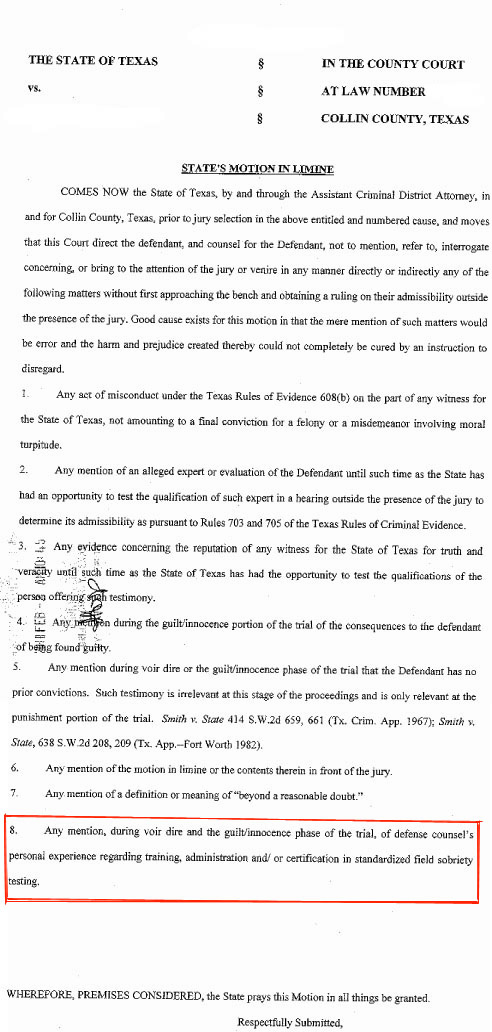
Well, the State's Motion in Liminie starts out pretty normal, but they then add in the "Biederman & Burleson" Clause.  Both my partner Troy Burleson and myself are both certified to administer Standardized Field Sobriety Tests. This is the same certification the police officer's have.  I am an instruction in Standardized Field Sobriety Testing (I can teach the course that certifies the students). I guess they State doesn't like the jury know we have more specialized knowledge than most of the officers.

#8 of their motion reads that we cannot make:

"Any mention, during voir dire and the guilt/innocence phase  of the trial, of defense counsel's personal experience regarding training, administration and/or certification in standardized field sobriety testing."

As you can see on their motion, #8 is lower than the others numbers, because it was added on a form motion. 

So from now on, I hope future law books refer to this motion as the "Biederman & Burleson Motion in Limine."  I know we at the office do.

Collin County DA Denies Citizen From Pleading Guilty

A couple of weeks ago, I happened to be present in the 429th District Court and saw an individual, Mr. Robert Blackburn trying to plea guilty, but was barred in doing so by the Assistant District Attorney.  I didn't think too much of it at the time, because I have seen the DA do this many times -- including to my clients.

What happened differently on this occasion, is that the (visiting) Judge John McCraw stood up to this ridiculous practice. I was pleased to read a great article by the Collin County Observer reporting the incident and subsequent appeal by the DA.

The Law

First, lets go through how a criminal case is disposed.

A person accused of a crime may either plea guilty or plea not guilty regarding criminal charges against them.

Plea Not Guilty

Texas has a bifurcated trial system, meaning "two parts."  The first phase is to determine whether or not a person is guilty, the second phase is to determine punishment (if found guilty).  Obviously if found not guilty, there is no punishment phase.  As far as the second phase goes, one must choose before the trial begins as to whether or not to have the judge or jury handle sentencing if found guilty.

1. Plea Not Guilty, Judge Punishment:  A citizen requests a jury to determine if they are guilty or not guilty, and if  found guilty, elect the judge to impose punishment.  This is the most common, as most attorneys know that judges get to see lots of cases and can understand the seriousness/non-seriousness of the particular crime.  Additionally, it is easier for an attorney to advise a client on the likely punishment if you know who will be doing the sentencing opposed to jurors you have never met.

2. Plea Not Guilty, Jury Punishment: A citizen requests a jury to determine if they are guilty or not guilty, and if found guilty, elect the jury to impose punishment.  If in front of a tough, unreasonable, or unknown judge, one might elect a jury of their peers to decide their fate. 

Plea Guilty

1. Negotiated Plea:  This is the most common plea.  The DA and the citizen (often with the help of their attorney), negotiate a punishment, and they plea and receive punishment.

2. Non-Negotiated "Slow" Plea: If a citizen accused wants to plea, but cannot agree with the DA on punishment, they can enter a "slow plea."  This means the accused will plea guilty, but allow the jury to assess the punishment.

2. Non-Negotiated "Open" Plea: If a citizen accused wants to plea, but cannot agree with the DA on punishment, they can enter an "open plea."  This means the accused will plea guilty, but allow the judge to asses the punishment.

The Case

In this case, the defendant, Robert Lee Blackburn was charged with 4 felonies after he bit a Plano Police officer while being arrested for possession of cocaine. It seemed that everyone agreed as to his guilt, but there was no agreement on what the punishment would be.

Mr. Blackburn and his attorney agreed he should plea guilty, and wanted the presiding Judge (in this case, Judge Jill Willis) to assess punishment.  Mr. Blackburn wanted to plea guilty in an "open plea," but the District Attorney refused to allow him to do so.  They did this by invoking the State's right to a Jury Trial. 

In Texas, the State has a right to a jury trial.  It's a bit silly in my opinion, but too complicated to debate in this article the legality of the whole issue.  I'll save that for another article.

By invoking the right to a jury trial, it means that a defendant CANNOT enter an "open plea."  This means that if Mr. Blackburn wants a judge to assess his punishment, he must plea not guilty, go through the farce of a jury trial, and elect the judge to impose the sentence. 

That is exactly what the Assistant District Attorney, Gary Knapp forced upon Mr. Blackburn's.  I do not know if this was his personal decision, or if someone higher up in the office instructed him to do this. (The Observer reported and provided a transcript showing Appellate Chief John Rolater who was arguing the case -- which is accurate at the second hearing.  Originally it was Knapp barring the plea of guilty, and calling  the Appellate department for assistance).  In this case, the Judge did not allow the State to invoke their right to a jury trial, and ordered the plea be accepted.  The State has since appealed, and the case is in limbo until the appellate court reaches a decision.

Why would the DA force a "sham" trial on a defendant when everyone agrees on their guilt?

There can be several possible reasons, none of which seem justified to me:

1. Forum Shopping - Forum shopping is an attorney (on either side of the case) attempting to pick what judge is going to hear a case.  Defendant's cases are randomly assigned to courts, so one cannot pick a judge.  However, visiting judges are often called in when judges are out of town, or want to run a "double-docket," to help clear out some cases. 

I am almost positive I heard the DA that if Mr. Blackburn wanted to plea to a visiting judge, they would allow it, but not to the presiding judge.  I cannot remember for sure, and am not willing to make this claim positively.  I wish that a transcript available of the hearing that took place before the appellate department got involved.  That is where the true hearing took place.  I personally believe forum shopping was part of the reason why the DA did not allow the plea.

2. Padding Statistics - This is political gamesmanship. If a DA wants to boast about their conviction rate, they can pad the stats.  I have seen Collin County DA literature boasting about conviction rates in the past. Additionally, if a prosecutor wants to look good to their superiors, they will try to win as many cases as possible.

The DA can offer really tough plea bargains to a defendant.  This will bar someone from pleading guilty in a negotiated plea.  In a court where the defendant chooses to allow the judge to accept punishment, this will force a trial if the state invokes their right to a jury trial.  The DA will have a slam dunk case of guilt, and get to put it down as a win.

They will additionally get to put it up on the "Board" which is at the DA's office.  The "Board" is where attorneys write down their trials they are having that week, along with the results.  It was there when I was an assistant district attorney, and assume it is still there.

3. Practice for young prosecutors:  I guess if someone wants some experience in a trial, they could force a sham trial just to get some experience.  This is not what happened in this case, because these are felony prosecutors with plenty of trials under their belts already. 

4. Manipulating the Punishment Range: The entire range of punishment is available to either a judge or a jury.  With one exception: Deferred Adjudication.  A citizen accused can only get deferred adjudication from a judge after a guilty plea (negotiated, or not negotiated).  By barring a person from pleading guilty, the DA is barring the possibility of them getting Deferred Adjudication.  Basically usurping the elected Judge's powers.  The DA in this case says this is the reason for their behavior, however I have personally seen them do this in cases where the client is not even deferred eligible.  I don't see why the DA would stop an elected presiding Judge (or in this case, a judge appointed by Governor Rick Perry) from doing the job they were put there to do.

My hope is that with this article, one of the new candidates for District Attorney will stop this archaic practice of barring a person from pleading guilty to an elected Judge thus forcing a sham trial.  In the end, it is about the difference of what should be done, versus what can be done.  After about seven years of the same elected District Attorney, I think a new DA will be the only factor that change this practice.

DOCUMENTS


Petition for Writ of Mandamus, In re John Roach, Fifth COA case number 05-09-01451-cv

Reporters Record, December 3, 2009 Texas vs Robert Lee Blackburn

Order granting Emergency Motion for Temporary Relief, In re John Roach, Court of Appeals, Fifth District.

Link to Court of Appeals case 05-09-014510-CV, In re John Roach

Link to Collin County cases 199-80283-08, 199-80284-08, 199-80285-08, 199-80286-08, State vs. Robert Lee Blackburn

Hunter Biederman is a DWI / Criminal Defense Attorney in Collin County. He publishes his blog (www.friscodwilawyer.com) which focuses on the Collin County and Texas legal system. He can be reached at friscolaw@gmail.com or (888) DWI-FRISCO

More examples of "relative" wins

I recently posted here of why a DWI "win" is all relative.   Especially in light of a  tough plea bargain offer that is not much of a "bargain" at all. 

Shawn Matlock of The Matlock Blog (no, not Andy Griffith with a blue suit), gave another great example of a relative win.  In the past, he spoke about relative wins here.  His more recent post, Life in a Box, explains how he was lucky enough to see some great lawyers, Mark Daniel and Tim Moore, fighting a death penalty case.  In the end, the client was given a life in prison sentence instead of the death penalty.  And while life in prison might not seem like a win to most --- when looking at the alternative, it can certainly look O.K.  Especially when the reason you are on trial is for killing a police officer.  No one is saying it is O.K. to kill anyone, especially not a police officer.  But apparently 12 people felt that life in prison was a just punishment.

In the end, it is always important to ask your clients what their goal is.  For some, it is being found not guilty.  For others, it is to receive a fair punishment for the crime.  Either way, we as lawyers must do our best to achieve fair and just results for our clients.

Plea Bargains Aren't Just for Pre-Trial

Many of my clients come into my office knowing that they want to fight their DWI case.  I'm OK with that.   In fact, as I have stated in past blogs, in general, there is very little to lose by going to trial on a DWI 1st case.

Despite knowing we are going to trial, the plea bargaining process is still an important one. . . even in counties, such as Collin County or Dallas County, where pleaing to a non-DWI offense will almost never happen.

Here is why it is important to get the best offer you can from the state, even if you never plan on pleaing to it.  If you go to trial, and are not successful, often the first thing done by the prosecutor is to look at the last recommendation given to the attorney in the case.  The point being, usually they will be seeking a tougher punishment after trial. 

Often times, you can come to an agreement with the prosecutor on the case... maybe a slightly larger fine, or a few months extra probation if your client is found guilty after trial.  If you did not actively pursue a good plea bargain pre-trial, your negotiating position after trial will diminished.

It is for this reason (and also so the client can weigh all options before deciding whether or not a trial is in their best interest), that I always actively pursue the best plea bargain possible pre-trial, even if the client has their heart set on a trial.

Pitfalls of Testifying in DWI cases

In a recent blog post by blogger Robert Guest, he posts about some of the techniques taught to prosecutors when cross examining a defendant in a DWI case.  These are the same techniques taught to me while working as a prosecutor.  He reports from old manuals that he has:

Today's subchapter is called "Crossing the Defendant", it should have been called "guilty until proven innocent." Prosecutors are taught to spin or ignore evidence of innocence.

- ADA's are taught to work out a "time line" of that day's events with the defendant. Why? Because there is "no credible way the defendant could have kept track of that, so you will either succeed in showing their no memory of times, or he has an overdeveloped memory."

- What should a prosecutor do if the defendant does not look intoxicated on the video? Drop the charge? Of course not. Argue that the defendant only looks good because of the adrenaline brought on by arrest.

- If the defendant claims the officer was abusive ask the defendant why he/she did not file a complaint with the police department.

- Ask the defendant how often he usually drinks. For regular drinkers argue that the defendant has a high tolerance and would not know if he is drunk. If he is not a regular drinker then argue he would not know his own limits.
There are others too, of course.  Other "damned if you do, damned if you dont" ways to further humiliate someone testifying in their own behalf.  Sometimes they will try and trip up a defendant on whether or not they felt they were intoxicated, and what that definition is... If they report the "falling over drunk" type definition, then during arguments, the State can argue that "we agree.. he wasnt intoxicated according to his definition.. but he was intoxicated according to the legal definition."

And how often have we heard it argued "witness credibility" of our clients??  Because he testifies, he AUTOMATICALLY must be lying, because he has something to gain?  Of course he does.. everyone on trial does.  Does that mean a citizen accused, who was sworn to tell the truth always lies?

These are just some of the arguments that an attorney and a client must be prepared to face when deciding whether or not to testify.

Intoxilyzer 5000 Source Code --- I thought not...

I last posted regarding CMI's refusal to reveal their source code here.  Apparently, court orders do not seem to phase this "government contracting" juggernaut.  CNET now reports that CMI has missed their deadline for turning over the source code. According to CNET:

The next step is a court hearing scheduled for September 19, Underdahl's attorney, Jeffrey Sheridan, told CNET News.com in a phone interview on Tuesday. At the hearing, Sheridan is expected to ask the judge to throw out any evidence the state had obtained using the the Intoxilyzer 5000EN. If the judge agrees, at least one charge--that his client was driving with a blood alcohol concentration above the legal limit of .08--would likely be dismissed.

Sheridan had predicted in an interview with CNET News.com last month that the Minnesota state public safety commissioner would not supply him with the source code to the device, as ordered by the Minnesota Supreme Court, by the August 17 deadline.
I understand their arguments, "proprietary information, and all" but I don't buy it.   This is a device that is used to convict people.  Take away their freedom.  Restrict future jobs and earnings.  Gets people fired from existing jobs.  Takes away MILLIONS of dollars from people through fines, court costs, and attorney's fees. 

In a recent post by fellow DUI/DWI blogger Lawrence Taylor, he reports that another Breathalyzer, the Draeger AlcoTest 7110, was forced to turn over their soucecode.  In his blog, he reports several problems with the code, including:

1. The Alcotest Software Would Not Pass U.S. Industry Standards for Software Development and Testing
2. Catastrophic Error Detection Is Disabled
3. Error Detection Logic problems.

Quite honestly, I don't fault CMI for the way they were acting.  If most people/corporations could get away with this type of behavior, they would.  Why do you think Enron or other large corporations didn't want to turn over their books???  What is most disappointing to me is that State agencies continue to contract with this company. That is where I place the fault in this "secret convicting machine" fiasco.