NHTSA Manuals and Other Guides

Thought I'd share some great links to .pdf's of many of the NHTSA guides and manuals.  They come from the Washington State Patrol - Breath Testing Program


Advanced Roadside Impaired Driving Enforcement (ARIDE):
Instructor Manual - October 2007.pdf
Student Manual - November 2007.pdf

 
Forms :


Publications:


2008 DRE In-Service Presentations:


2007 DRE In-Service Presentations:


MOU Reimbursements:


Resource Links:

The International Drug Evaluation & Classification Program
CJTC Regional Training Map
The International Association of Chiefs of Police

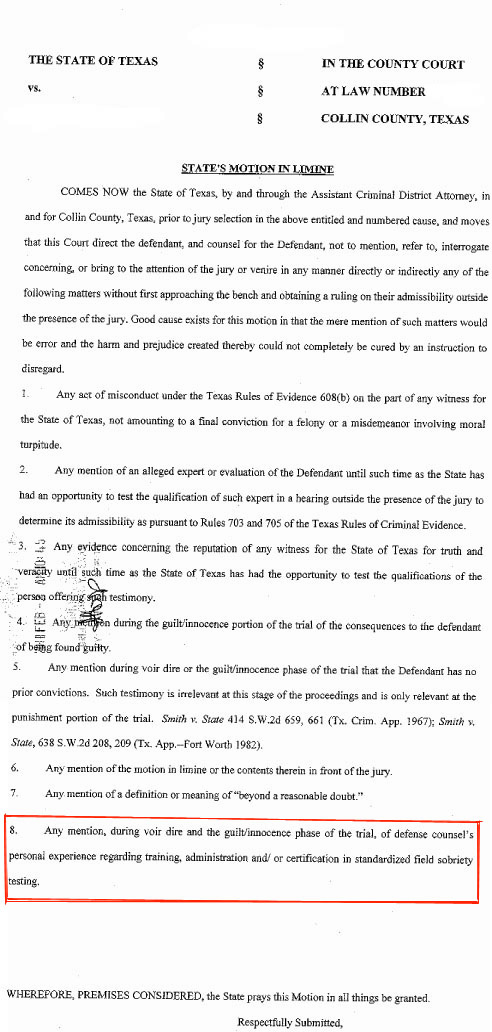
The State's "Biederman & Burleson" Motion in Limine

Recently, we had a trial set in which the prosecutors filed some pretrial motions.  While not uncommon for the prosecutors to file such motions, one of the items they requested I found quite interesting. 

The prosecutors filed a "Motion in Limine." A Motion in Limine is the attorney asking the judge to make the opposing attorney ask permission in advance of doing something.  Some common requests are for an attorney to request the opposing attorney to ask permission during trial in advance of offering expert testimony, or something else they think might be inadmissible and don't want the jury to hear.

Well, the State's Motion in Liminie starts out pretty normal, but they then add in the "Biederman & Burleson" Clause.  Both my partner Troy Burleson and myself are both certified to administer Standardized Field Sobriety Tests. This is the same certification the police officer's have.  I am an instruction in Standardized Field Sobriety Testing (I can teach the course that certifies the students). I guess they State doesn't like the jury know we have more specialized knowledge than most of the officers.

#8 of their motion reads that we cannot make:

"Any mention, during voir dire and the guilt/innocence phase  of the trial, of defense counsel's personal experience regarding training, administration and/or certification in standardized field sobriety testing."

As you can see on their motion, #8 is lower than the others numbers, because it was added on a form motion. 

So from now on, I hope future law books refer to this motion as the "Biederman & Burleson Motion in Limine."  I know we at the office do.

Damn Your Drunk Tests Are Hard!

I dont usually post video clips.  Especially because every time I see one posted, I've seen it 50 times already.  But here is an old one, that I have just never seen before.  From the 1983 Steve Martin movie, "The Man With Two Brains."  Enjoy.


HGN (Horizontal Gaze Nystagmus) Cross Examination

A great point was made recently by Jamie Spencer (through George Scharmen at the Rusty Duncan Criminal Defense Seminar put on by TCDLA) regarding the cross examination of an officer about HGN.

Jamie points out in "Nystagmus, Mostly Leave it Alone" that not a lot of cross examination is necessary.  Mark Bennett agrees in his comment that "juries are duly unimpressed with the 'pen voodoo' as one juror called it post-trial."

Here is my take on it:

I almost never spend a lot of time on the issue.  Spending a lot of time just makes it seem like you care about it.  I feel that a trial is about whatever you decide it is about.  If I spend an hour talking about how many passes it takes for the Lack of Smooth Pursuit, it only shows how worried I am about that testimony.

This especially holds true on a refusal case.  In a refusal case (no breath test, and no vampire blood draw), the only issue is if the citizen accused lost the normal use of their mental or physical faculties.

Question 1.  If someone has HGN, do they even know it is there? -- Officer answer, "No"
Question 2.  Does HGN affect the vision?  -- Officer answer, "No"

Statement to the jury -- Well then, who the heck cares?  It doesn't affect your faculties!  So what difference does it make?

I have found that most juries could care less about the HGN test, and the testimony that follows from it.  Conversely, though, almost every offcer I have spoken with feels like it is the most important indicator of intoxication.  Go figure.

DWI Attorneys certifited in SFST's (Standardized Field Sobriety Tests)

I spent this past weekend at a certification course to gain the same certification the police officers have in Standardized Field Sobriety Testing.  I was going to attempt a daily blog about the course, but I ended up too tired with with too  much to do each day I went home.

This course certifies the participant as a practitioner in Standardized Field Sobriety Testing.  It was put on by Lance Platt.  This is the same course that the police go through.  It also provides the students with the latest edition of the SFST manual (August 2008.)

All in all, it was a fantastic course.  Nice to learn some new information, but also particularly nice to know the exact training the officers go through... or lack thereof.  That is some of the stuff I plan on writing about.  How, although this 2.5 day course is good, it is no where near enough information I would like a police officer to have when taking away someones liberty.

I'll put up some new blog posts soon of some of the tidbits I learned, and how they can help in trial.

It was nice to see some of the other local DFW attorneys at the course.  Fellow blogger Troy Burleson was there, along with Deandra Grant of Plano, Kim Tucker of Pllano, Chris Hoover of Plano, Douglas Wilder of Dallas, and Denver McCarty of Denton.  I was actually a little surprised not to see more local attorneys there.