
How To Gut Your Own Case: Collin County District Clerks Case

The Short Answer? Admit to doing the exact same thing the people charged did.
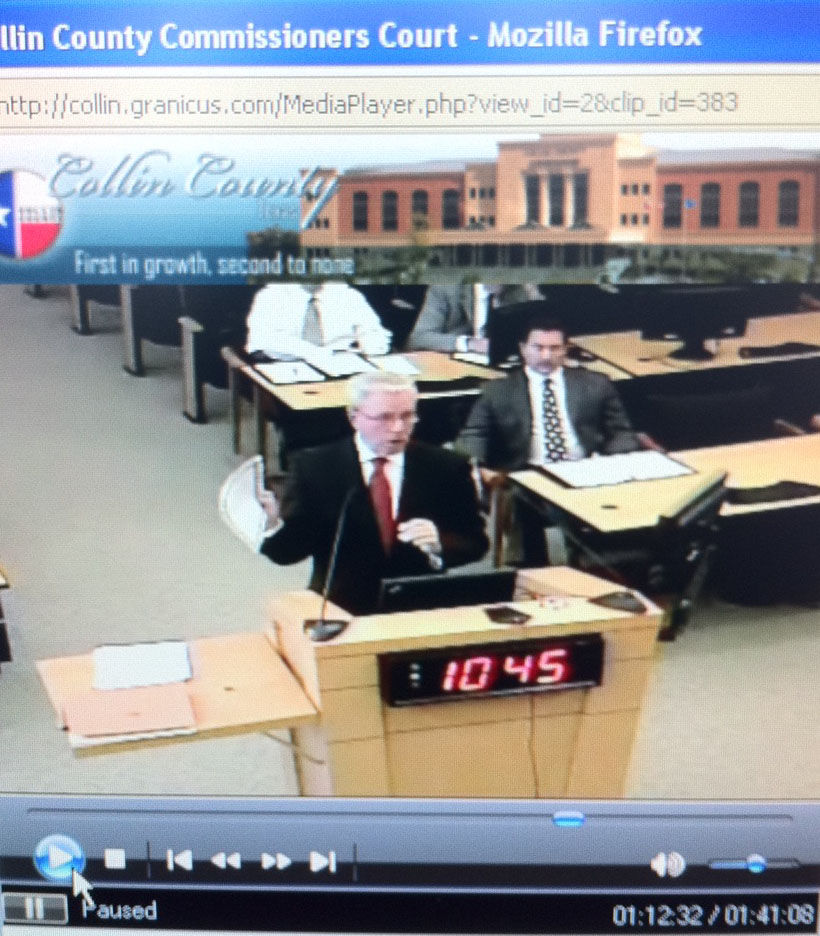
I have never had a case where a prosecutor has stood in front of a large group and admitted to driving while intoxicated -- or any other crime for that matter. 

But that seems to be exactly what the elected District Attorney in Collin County recently did. No, he did not admit driving while intoxicated, but instead stood in front of the county commissioners and asked for assistance on properly "coding" his Hi-Five Paid Time Off program.  A program that on its face seems to be doing the same thing he accuses Six Collin County District Clerks of doing. Taking time off from work with the permission of their supervisors, but putting in with the county that they were actually present so they can be paid.

From the Commissioners Agenda below:

The request started off innocently enough. DA John Roach was asking for was a way to change the computer coding of employees time off.  Apparently he had already asked HR to do this, but they refused to make the change.

DA Roach explained the program: A supervisor or manager recommends an employee for a certificate that allows some time off. The recommendation is reviewed by manager, division chief and ultimately by me personally (John Roach).  The employee "might get an hour off or two hours off "and they must take it within a certain amount of time, usually 30 days. They must get their managers approval, then fill out a scheduling request. That lets us (The DA) know when they’ll take the time off.

Cynthia Jacobson (HR's appointed official) told the Court Commissioners that they only make the change with these programs are approved by the Court.  And this program has not been approved by the court.

The meeting then took on a much different tone.  The commissioners seemed very disturbed by the elected DA coming up with his own time off compensation program.

One Commissioner asked, "The application should reflect our policies. Do we have policy where people get time off for rewards?"  The question seemed rhetorical, because from the way the meeting went, it was clear that no such program exists within the county.  There are policies in place that dictate time off, and this isn't one of them.

The commissioners not only refused to change the computer coding, but refused to accept that it was OK for the elected DA to start his own paid time off program.

In response to the District Attorney's statement, "if I have someone doing a really good job, I should have the discretion to reward them for it," the commissioner responded with a resounding, "I disagree."

So if the elected District Attorney feels it is OK to come up with his own paid time off program, why is it not OK for the clerks office to do the same?  He charged six clerks with felonies for doing just that.

Here is the major problem I see with the State's case against the clerks.  Even if they did exactly what the District Attorney alleges (and they might very well have), do those actions constitute a crime?  The clerks supposedly padded their time in the office when they were not actually in the office.

According to the District Attorney paying someone for time off when they are not in the office is legal. But apparently only if they are his employees, not employees of the District Clerk's office.  Perhaps it is because the clerks didn't first come up with a name as cool as the "High Five" program.

If you would like to view the video, click on the video picture above.  You can click on the agenda item below the video to jump to that portion of the commissioner's meeting.

Also, for those not normally dealing with Collin Courts, this is the District Clerks office that was accused of wrongdoing -- a different office than the County Clerks office.

Hunter Biederman is a DWI / Criminal Defense Attorney in Collin County. He publishes his blog (www.friscodwilawyer.com) which focuses on the Collin County and Texas legal system. He can be reached at friscolaw@gmail.com or (888) DWI-FRISCO.

Pitfalls of Testifying in DWI cases

In a recent blog post by blogger Robert Guest, he posts about some of the techniques taught to prosecutors when cross examining a defendant in a DWI case.  These are the same techniques taught to me while working as a prosecutor.  He reports from old manuals that he has:

Today's subchapter is called "Crossing the Defendant", it should have been called "guilty until proven innocent." Prosecutors are taught to spin or ignore evidence of innocence.

- ADA's are taught to work out a "time line" of that day's events with the defendant. Why? Because there is "no credible way the defendant could have kept track of that, so you will either succeed in showing their no memory of times, or he has an overdeveloped memory."

- What should a prosecutor do if the defendant does not look intoxicated on the video? Drop the charge? Of course not. Argue that the defendant only looks good because of the adrenaline brought on by arrest.

- If the defendant claims the officer was abusive ask the defendant why he/she did not file a complaint with the police department.

- Ask the defendant how often he usually drinks. For regular drinkers argue that the defendant has a high tolerance and would not know if he is drunk. If he is not a regular drinker then argue he would not know his own limits.
There are others too, of course.  Other "damned if you do, damned if you dont" ways to further humiliate someone testifying in their own behalf.  Sometimes they will try and trip up a defendant on whether or not they felt they were intoxicated, and what that definition is... If they report the "falling over drunk" type definition, then during arguments, the State can argue that "we agree.. he wasnt intoxicated according to his definition.. but he was intoxicated according to the legal definition."

And how often have we heard it argued "witness credibility" of our clients??  Because he testifies, he AUTOMATICALLY must be lying, because he has something to gain?  Of course he does.. everyone on trial does.  Does that mean a citizen accused, who was sworn to tell the truth always lies?

These are just some of the arguments that an attorney and a client must be prepared to face when deciding whether or not to testify.

Humilated from a DWI? Ask this guy...

In a recent case in New Mexico, a citizen was arrested, tired, and acquitted of DWI.  Despite his being found not guilty by a jury of his peers, and after a clerk "checked the wrong box" saying guilty, his picture and name was published in the newspaper.

Oh yes, a retraction was printed, but I'm quite sure it was too little too late for him.  The interesting thing is, I found this article online, on an NBC news site, which not only published his name, but also published his PICTURE as well!   Apparently they don't care about his privacy either....

Here is the story, but in order to not perpetuate the wrong that was done to this man, I have removed his name and his picture.


Man mistakenly published on DWI offender list

A man who was never found guilty for DWI had his picture published in the local paper saying he was guilty of drunk driving.

XXXXXXXXXXXXXXX, was arrested last August and blew at or above the legal limit, according to court records. XXXXXXXXXXX fought the case and was found "not guilty," in February.

A Metropolitan Court clerk made a mistake and marked guilty next to the DWI charge days after XXXXX was acquitted.

XXXXXXXXX works for the Federal Government on Kirtland Air Force Base and has been trying to get higher security clearance.

XXXXXXXXXXXXXX said, "I'm gonna have to do a lot of explaining I shouldn't have never had to do."

For two months XXXXX was officially a convict, until the mistake was found and fixed.

During the time XXXXXXXXXXXXX was mistakenly labeled "guilty" his name was put into the mix of guilty faces to be published by Albuquerque police.

Metropolitan Court spokeswoman Janet Blair said, "We really regret Mr. XXXXXXXXXXXX had to go through this...and we don't understand why such outdated information was used when correct information has been available for three months."

The Albuquerque Police Department plans to issue a retraction in the next few months.