
The State's "Biederman & Burleson" Motion in Limine

Recently, we had a trial set in which the prosecutors filed some pretrial motions.  While not uncommon for the prosecutors to file such motions, one of the items they requested I found quite interesting. 
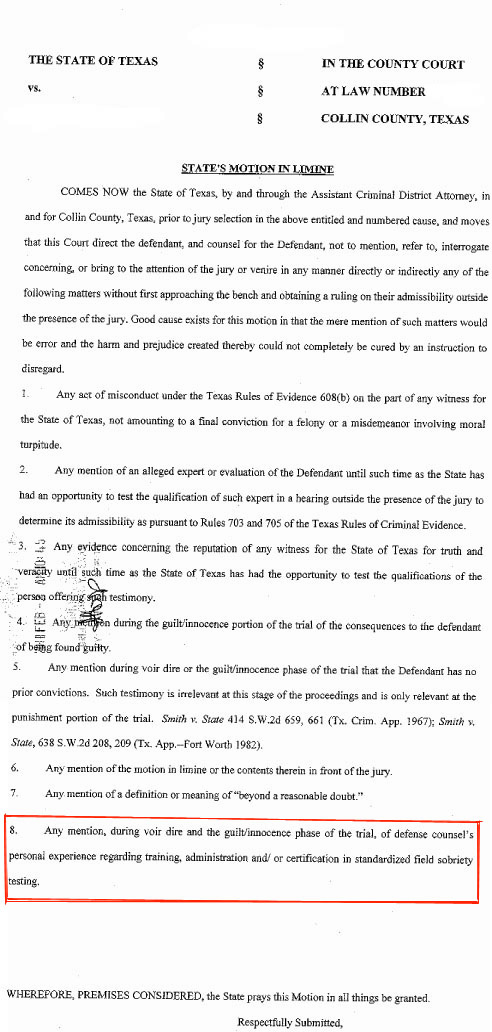
The prosecutors filed a "Motion in Limine." A Motion in Limine is the attorney asking the judge to make the opposing attorney ask permission in advance of doing something.  Some common requests are for an attorney to request the opposing attorney to ask permission during trial in advance of offering expert testimony, or something else they think might be inadmissible and don't want the jury to hear.

Well, the State's Motion in Liminie starts out pretty normal, but they then add in the "Biederman & Burleson" Clause.  Both my partner Troy Burleson and myself are both certified to administer Standardized Field Sobriety Tests. This is the same certification the police officer's have.  I am an instruction in Standardized Field Sobriety Testing (I can teach the course that certifies the students). I guess they State doesn't like the jury know we have more specialized knowledge than most of the officers.

#8 of their motion reads that we cannot make:

"Any mention, during voir dire and the guilt/innocence phase  of the trial, of defense counsel's personal experience regarding training, administration and/or certification in standardized field sobriety testing."

As you can see on their motion, #8 is lower than the others numbers, because it was added on a form motion. 

So from now on, I hope future law books refer to this motion as the "Biederman & Burleson Motion in Limine."  I know we at the office do.

State Does Not Need to Charge How Someone Is Intoxicated in DWI Cases

In a brand new case out by the Court of Criminal Appeals, the Court has declared that the state does not need to be specific on which theory or theories of intoxication they need to prove.

In order to find someone guilty of DWI, the State must prove that person was intoxicated.  Intoxicated means not having the normal use of your mental faculties, not having the normal use of your physical faculties, or having an alcohol concentration of above .08 at the time of driving.  (this is my simplified definition -- so attorneys, don't jump on me about it!)

In the past, the state would have to add into the charging document (information for misdemeanors, indictment for felonies), which of those three definitions of intoxication they wanted to prove. 

The new case that came out says they no longer need to do this.  Therefore, as someone defending themselves on a DWI charge, you will not know how the State plans to prove you were intoxicated until the trial begins.  In reality, though, most cases a good attorney will have an idea.  Always mental and physical faculties, and only .08 where breath tests are involved.  Where it gets tricky is if someone blows under .08, but the state tries to use "retrograde extrapolation," to prove you were higher at the time of driving.

Here is the opinion:

Court of Criminal Appeals of Texas.
The STATE of Texas
v.
Stephen Gregory BARBERNELL, Appellee.
No. PD-0867-07.
July 2, 2008.

On State's Petition for Discretionary Review from the Ninth Court of Appeals Montgomery County.
Joseph Salhab, for Stephen Gregory Barbernell.

Marc Brumberger, for The State of Texas.


OPINION


KEASLER, J., delivered the opinion for a unanimous Court.
*1 Stephen Gregory Barbernell was charged with DWI. The court of appeals affirmed the trial judge's decision to grant Barbernell's motion to quash due to the State's failure to allege which definition of “intoxicated” that it intended to prove at trial.FN1 The court reasoned that intoxication is an act or omission and that the definitions of “intoxicated” provide for different means of commission.FN2 Because we hold that the definitions of “intoxicated” do not describe an act or omission, we reverse and vacate the judgment of the court of appeals and remand this case to the trial court.

FN1. Barbernell v. State, 221 S.W.3d 914, 917-18 (Tex.App.-Beaumont 2007).
FN2. Id. at 917.

I. Procedural History

Barbernell was charged by information with the misdemeanor offense of driving while intoxicated under Texas Penal Code, Section 49.04.Section 49.04 defines the offense of DWI and reads, in part, as follows: “A person commits an offense if the person is intoxicated while operating a motor vehicle in a public place.” FN3 Section 49.01(2), Texas Penal Code, sets out two definitions of “intoxicated.” FN4

FN3. TEX. PENAL CODE ANN. § 49.04 (Vernon 2003).
FN4. TEX. PENAL CODE ANN. § 49.01(2)(A)-(B) (Vernon 2003).
“Intoxicated” means:

(A) not having the normal use of mental or physical faculties by reason of the introduction of alcohol, a controlled substance, a drug, a dangerous drug, a combination of two or more of those substances, or any other substance into the body; or

(B) having an alcohol concentration of 0.08 or more.FN5

FN5. Id.
The information charging Barbernell alleged: “on or about April 30, 2005, in Montgomery County, Texas, Stephen Gregory Barbernell ..., while operating a motor vehicle in a public place, was then and there intoxicated[.]”

Barbernell moved to quash the information because the State failed to allege the definition of “intoxicated” set out in Section 49.01(2) that it intended to prove at trial. In support of his motion, Barbernell relied on our 1991 decision in Carter v. State,FN6 which held that the State must allege which definition of intoxicated-“loss of faculties” or “per se” intoxication (i.e., alcohol concentration) FN7-that the State intends to prove at trial.FN8 Barbernell claimed that the information failed to provide him with adequate notice of the manner and means (i.e., the definition of “intoxicated” that the State intended to prove) in which he committed the offense. In response, the State argued that our 2004 opinion in Gray v. StateFN9 establishes that the definitions of “intoxicated” are not elements of DWI. After a brief hearing, the trial judge granted Barbernell's motion to quash. The State then timely filed a notice of appeal.FN10

FN6. 810 S.W.2d 197 (Tex.Crim.App.1991).
FN7. TEX. PENAL CODE ANN. § 49.01(2) (previously codified at TEX. REV. CIVIL STAT. art. 6701 l-(a)(2)).
FN8. Id.
FN9. 152 S.W.3d 125 (Tex.Crim.App.2004).
FN10. See TEX.CODE CRIM. PROC. art. 44.01(a)(1) (Vernon Supp.2005).

II. Court of Appeals

In the Beaumont Court of Appeals, the State argued that the judge erred in granting Barbernell's motion to quash.FN11 In doing so, the State reasserted its reliance on our decision in Gray, while Barbernell continued to rely on Carter.FN12 Finding that Gray did not address Carter's holding, the court of appeals, after reviewing our analysis of the elements of DWI in Gray, held that the element of “intoxicated” is an act or omission and that the definitions of “intoxicated” provide different manner or means to commit intoxication.FN13 Due to the State's failure to allege the definition of “intoxicated” that it intended to prove at trial, the court held that the information did not sufficiently notify Barbernell of the charged offense.FN14 As a result, the court affirmed the trial judge's decision to grant Barbernell's motion to quash.FN15

FN11. Barbernell, 221 S.W.3d at 916.
FN12. Id.
FN13. Id. at 917.
FN14. Id.
FN15. Id. at 917-18.
*2 In a concurring opinion, Justice Horton noted that Carter is controlling authority.FN16 However, Justice Horton stated that he believed that the State was correct in asserting that the definitions of “intoxicated” are evidentiary matters, as opposed to manner and means of commission, and therefore do not need to be alleged in the charging instrument.FN17

FN16. 221 S.W.3d at 918 (Horton, J., concurring).
FN17. Id.
We granted the State's petition for discretionary review to address the following issue: “Whether the manner of intoxication, either ‘loss of faculties' or ‘alcohol concentration,’ is an element of the offense of driving while intoxicated which must be alleged in the charging instrument[.]”

Before we address this particular issue, we provide a general overview of the law concerning notice and our most recent cases addressing notice in relation to the offense of DWI. And because the State's ground for review comes to us in light of our decision in Gray, we will also examine Gray'sdiscussion of the DWI statute.


III. Law


A. Notice
The Texas and United States Constitutions grant a criminal defendant the right to fair notice of the specific charged offense.FN18 “The charging instrument must convey sufficient notice to allow the accused to prepare a defense.” FN19 Toward that end, Chapter 21 of the Texas Code of Criminal Procedure governs charging instruments and provides legislative guidance concerning the requirements and adequacy of notice.FN20 With respect to informations, Article 21.21 sets out what facts must be included in an information and states, in part, “[t]hat the offense [must] be set forth in plain and intelligible words[.]” FN21 Additionally, an information must include everything that is necessary to be proved.FN22 An information is sufficient if it

FN18. Lawrence v. State, 240 S.W.3d 912, 916 (Tex.Crim.App.2007) (citing U.S. CONST. amend. VITEX. CONST. art. I, § 10;Ferguson v. State, 622 S.W.2d 846, 849 (Tex.Crim.App.1981) (opinion on reh'g)); TEX. CONST. art. V, § 12(b)see also Cole v. Arkansas, 333 U.S. 196, 201 (1948).
FN19. Curry v. State, 30 S.W.3d 394, 398 (Tex.Crim.App.2000) (citing State v. Mays, 967 S.W.2d 404, 406 (Tex.Crim.App.1998)).
FN20. Moff v. State, 154 S.W.3d 599, 601 (Tex.Crim.App.2004)Ferguson, 622 S.W.2d at 849-50.
FN21. TEX.CODE CRIM. PROC. ANN. art. 21.21(7).
FN22. TEX.CODE CRIM. PROC. ANN. art. 21.03TEX.CODE CRIM. PROC. ANN. art. 21.23.
charges the commission of the offense in ordinary and concise language in such a manner as to enable a person of common understanding to know what is meant, and with that degree of certainty that will give the defendant notice of the particular offense with which he is charged, and enable the court, on conviction, to pronounce the proper judgment[.] FN23
FN23. TEX.CODE CRIM. PROC. ANN. art. 21.11TEX.CODE CRIM. PROC. ANN. art. 21.23.
We have recognized that in most cases a charging instrument that tracks the statutory text of an offense is sufficient to provide a defendant with adequate notice.FN24 When a statutory term or element is defined by statute, the charging instrument does not need to allege the definition of the term or element.FN25 Typically the definitions of terms and elements are regarded as evidentiary matters.FN26 But in some cases, a charging instrument that tracks the statutory language may be insufficient to provide a defendant with adequate notice.FN27 This is so when the statutory language fails to be completely descriptive.FN28 The statutory language is not completely descriptive “when the statutes define a term in such a way as to create several means of committing an offense, and the definition specifically concerns an act or omission on the part of the defendant.” FN29 In such cases, “more particularity is required to provide notice.” FN30 Thus, “if the prohibited conduct is statutorily defined to include more than one manner or means of commission, the State must, upon timely request, allege the particular manner or means it seeks to establish.” FN31

FN24. Lawrence, 240 S.W.3d at 916 (citing State v. Mays, 967 S.W.2d 404, 406 (Tex.Crim.App.1998)); Curry, 30 S.W.3d at 398 (citingOlurebi v. State, 870 S.W.2d 58, 62 (Tex.Crim.App.1994)); Phillips v. State, 597 S.W.2d 929, 934 (Tex.Crim.App.1980) (citing Parr v. State, 575 S.W.2d 522, 526 (Tex.Crim.App.1978)Boney v. State, 572 S.W.2d 529, 532 (Tex.Crim.App.1978)).
FN25. Geter v. State, 779 S.W.2d 403, 405 (Tex.Crim.App.1989) (citing Thomas v. State, 621 S.W.2d 158, 161 (Tex.Crim.App.1981);May v. State, 618 S.W.2d 333, 341 (Tex.Crim . App.1981)).
FN26. Marrs v. State, 647 S.W.2d 286, 289 (Tex.Crim.App.1983) (citing Thomas, 621 S.W.2d at 162); see also Curry, 30 S.W.3d at 398.
FN27. Curry, 30 S.W.3d at 398.
FN28. Id.
FN29. Solis v. State, 787 S.W.2d 388, 390 (Tex.Crim.App.1990)Geter, 779 S.W.2d at 405 (citing Ferguson, 622 S.W.2d at 851).
FN30. Id.
FN31. Saathoff v. State, 891 S.W.2d 264, 266 (Tex.Crim.App.1994) (citing Ferguson, 622 S.W.2d at 851).
*3 On appeal, because the sufficiency of a charging instrument presents a question of law, an appellate court reviews a trial judge's decision to quash a charging instrument for failure to provide adequate notice de novo.FN32

FN32. Moff, 154 S.W.3d at 601.

B. Notice and DWI
Garcia and Carter are our two most recent cases addressing the issue of adequate notice under the DWI statute. In our 1988 decision in Garcia,we held that when a defendant is charged with DWI, in order to provide adequate notice, the State must allege the specific type of intoxicant(s) that the defendant allegedly used to become intoxicated.FN33 In charging Garcia with DWI, the State alleged that Garcia “ ‘did then and there drive and operate a motor vehicle in a public place ... while intoxicated, when [he] did not have the normal use of his mental and physical faculties.’ “ FN34

FN33. 747 S.W.2d at 381.
FN34. Id. at 380.
In deciding that the specific type of intoxicant must be included in the charging instrument, we reasoned that the prohibited conduct of becoming intoxicated depends on an act or omission of the defendant and that such conduct, under the first definition for “intoxication,” “can be accomplished in several different ways.” FN35 Continuing, we said that the type of intoxicant “becomes an element of the offense and critically necessary to the State's proof .” FN36 Concluding, we held that, because the State failed to allege the type of intoxicant, the charging instrument did not provide Garcia with adequate notice.FN37

FN35. Id. at 381.
FN36. Id.
FN37. Id.
Approximately three years later, examining the same statute in Carter, we built on Garcia's holding and stated that, in addition to alleging the specific type of intoxicant, the State must also allege the definition of “intoxicated” that it intends to prove at trial to provide adequate notice. FN38 In making this determination, we concluded that the definitions of “intoxicated” describe two types of DWI offenses, a “loss of faculties” offense and a “per se offense.” FN39 The “loss of faculties” offense, we said,

FN38. 810 S.W.2d at 200.
FN39. Id.
may be established by proving the defendant drove or operated a motor vehicle in a public place while not having the normal use of his mental faculties, or while not having the normal use of his physical faculties, because of the introduction into his body of (1) alcohol; (2) a controlled substance; (3) a drug; or (4) a combination of two or more of those substances.FN40
FN40. Id.
In contrast, we said that the “per se” offense “may be established by proving the defendant drove or operated a motor vehicle in a public place while having an alcohol concentration of 0 .10 or more in his blood, breath, or urine.” FN41

FN41. Id.
Finally, recognizing Garcia and another case discussing notice, we then said that “given the fundamentally different natures” of the two offenses “and the different behaviors necessary to commit the two offenses,” the State must allege the definition(s) of “intoxicated” that it intends to prove at trial. FN42 We then held that the information, which did not specify the type of intoxicant Carter allegedly used or the definition of “intoxicated” that the State would rely on at trial, did not provide Carter with adequate notice so he could prepare his defense.FN43

FN42. Id. (citing Garcia, 747 S.W.2d at 381; Solis, 787 S.W.2d at 391).
FN43. Id.

C. Gray v. State
*4 In Gray, in 2004, we repudiated our statement in Garcia that the specific type of intoxicant is an element of DWI. In that case, the State charged Gray with DWI, and the information alleged, in part, that Gray did not have the normal use of his mental and physical faculties due to the introduction of alcohol.FN44 At trial, evidence was admitted establishing that Gray was taking several anti-depressant medications at the time of the offense.FN45 A chemist testifying on behalf of the State stated that alcohol and anti-depressant drugs have the same depressant effect on the central nervous system and that when the two are used in combination with one another, it can result in what has been described as a “synergistic effect.”FN46 According to the chemist, the two medications can interact inappropriately: when used together either one may “accelerate the action of one medication.” FN47

FN44. 152 S.W.3d at 126.
FN45. Id.
FN46. Id.
FN47. Id. at 127.
The trial judge's proposed charge instructed the jury that if the defendant indulges in the use of the anti-depressant medications and “thereby makes himself more susceptible to the influence of alcohol than he otherwise would have been, and by reason thereof becomes intoxicated from recent use of alcohol, he would be in the same position as though his intoxication was produced by the alcohol alone.” FN48 The judge's proposed application paragraph also instructed the jury to convict if it found that Gray was driving while intoxicated by reason of the introduction of alcohol into his body, either alone or in combination with anti-depressant medications.FN49 Gray objected to the charge, arguing that it improperly expanded the scope of the of the State's allegation in the information because, under our decision in Garcia, the specific type of intoxicant alleged to have been used by the defendant is an element of the offense of DWI.FN50 The trial judge overruled the objection, and Gray was subsequently found guilty and sentenced. FN51

FN48. Id.
FN49. Id.
FN50. Gray, 152 S.W.3d at 131.
FN51. Id. at 127.
Gray appealed, arguing that the jury charge, which instructed the jury on the “synergistic effect,” was not part of the law applicable to the case.FN52 The First Court of Appeals in Houston disagreed and affirmed the judgment of the trial court.FN53 We granted review to decide whether the court of appeals “erred in holding that the instruction constituted the law applicable to the case when Gray was not charged with intoxication by a combination of drugs and alcohol.” FN54

FN52. Id.
FN53. Id.
FN54. Id.
We began by examining the DWI statute and, in particular, Garcia's statement that the type of intoxicant is an element of DWI.FN55 We observed that this statement was dicta because the issue in Garcia involved pleading notice requirements and was therefore unnecessary to the resolution of the case.FN56 We then noted three “problems with the statement.” FN57

FN55. Id. at 131.
FN56. Id. at 132.
FN57. Id.
“First, it contradicts the statutory definitions of what constitutes an element of the offense.” FN58 Section 1.07 defines the elements of the offense as “the forbidden conduct, the required culpability, the required result, and the negation of any exception to the offense.” FN59 The type of intoxicant does not constitute any of these, and “[t]he mere fact that the DWI statute separately defines intoxication does not automatically elevate the intoxicant to the status of an element of the offense.” FN60 Second, the statement conflicts with our caselaw; specifically, Ex parte Luna,FN61 which addressed the essential elements of the theft statute.FN62 There, we held that the definitions of “unlawfully” are not elements of the offense of theft but are evidentiary matters that do not need to be alleged in the charging instrument.FN63 Comparing Ex parte Luna, we said that even though the DWI statute defines “intoxicated,” this fact does not mean that the types of intoxicants are elements of DWI.FN64 Third, it would be bad public policy to hold that the specific type of intoxicant is an element of DWI because a defendant could obtain an acquittal if the State, at trial, ultimately proves that the defendant used another type of intoxicant than the one alleged in the charging instrument.FN65 The DWI statute, we observed, does not focus on the act of becoming intoxicated; it focuses on the act of the defendant while intoxicated.FN66 Based on these considerations, we held that the type of intoxicant used by the defendant is not an element of DWI and “disavow[ed] the dicta in Garcia to the contrary.” FN67

FN58. Id.
FN59. Id. (citing TEX. PENAL CODE ANN. § 1.07(a)(22)).
FN60. Id.
FN61. 784 S.W.2d 369 (Tex.Crim.App.1990).
FN62. Gray, 152 S.W.3d at 132.
FN63. Ex parte Luna, 784 S.W.2d at 371.
FN64. Gray, 152 S.W.3d at 132.
FN65. Id.
FN66. Id.
FN67. Id.
*5 Examining the jury charge in Gray's case, we held that the “synergistic effect” instructions in the charge did not expand on the allegation in the information and therefore properly applied the law to the facts of the case. FN68 We reasoned that the instructions “permitted the jury to convict if Gray's drug made him more susceptible to alcohol, but it still required intoxication due to alcohol.” FN69

FN68. Id. at 133.
FN69. Id.

IV. Analysis

Reiterating the arguments it made before the trial judge and the court of appeals, the State contends that by explicitly disavowing Garcia'sreasoning in Gray, we necessarily undermined Carter's holding that the State is required to allege the definition of “intoxicated” that it intends to rely on at trial. The State asserts that a person's state of intoxication is not an act or omission; instead, it is the defendant's condition and a circumstance that accompanies the defendant's act of operating a motor vehicle. In response, Barbernell argues that our decision in Carter is sound and has not been undermined by Gray. Citing Carter as controlling precedent, Barbernell asserts that the court of appeals was correct in affirming the trial judge's ruling.

At the outset, we must make clear that our discussion about the elements of DWI in Gray had no impact on Garcia's holding concerning the adequacy of notice. We expressly made this point at the end of our opinion in Gray when responding to the State's request that we overrule Garcia'snotice holding: “Reaching out to address the validity of Garcia's notice holding would be dicta. And we have rejected this argument before. We decline to consider it today.” FN70 Consequently, contrary to the State's argument, Gray's discussion of the elements of DWI and renunciation ofGarcia's statement that the type of intoxicant is an additional element of the offense, while authoritative with respect to the elements of DWI, does not directly control the pleading notice issue before us.

FN70. 152 S.W.3d at 134 (majority opinion), 136 (Cochran, J., dissenting).
In analyzing whether a charging instrument provides adequate notice, our notice jurisprudence makes clear that courts must engage in a two-step analysis. First, a court must identify the elements of an offense. As recognized in Gray, the elements, defined by the Legislature, include: the forbidden conduct, the required culpability, if any, any required result, and the negation of any exception to the offense.FN71 Next, as to the second inquiry, when the Legislature has defined an element of the offense that describes an act or omission, a court must ask whether the definitions provide alternative manners or means in which the act or omission can be committed. If this second inquiry is answered in the affirmative, a charging instrument will supply adequate notice only if, in addition to setting out the elements of an offense, it also alleges the specific manner and means of commission that the State intends to rely on at trial. With these principles in mind, we find that it is necessary to revisit our analysis inCarter.

FN71. TEX. PENAL CODE ANN. § 1.07(22).
*6 A careful review of our decision in Carter reveals that the Court's analysis was incorrect. First, although the Court, consistent with Gray, began by citing the elements of DWI as those set out in Article 6701 l-1(b) of the Texas Revised Civil Statutes, now codified in Section 49.04(a), Texas Penal Code, the Court ultimately held that by virtue of the definitions of the element “intoxicated,” that there two separate DWI offenses-“loss of faculties” and “per se.” The Court reached this conclusion based on its determination that the definitions of “intoxicated” permit the offense of DWI to be proven in two ways. Our reevaluation of this analysis exposes a serious defect in the Court's reasoning: After identifying the elements of DWI, the Court neglected to ask whether the definitions of “intoxicated” concern an act or omission so as to create more than one manner and means of committing an offense. Instead, without explanation, the Court decided that the two definitions of “intoxicated” each constitute separate acts or forbidden conduct. In doing so, the Court failed to reconcile this conclusion with its previous statement that the definitions of “intoxicated” involve only matters of proof. Then, expanding on its faulty determination, the Carter Court held that, because the two types of forbidden conduct involve “fundamentally different natures” and “different behaviors,” a charging instrument must allege the definition of “intoxicated” that the State will seek to prove at trial.

The shortcomings of Carter's constitutional analysis have not gone unnoticed by legal scholars. Criminal law experts Professors Dix and Dawson have criticized this opinion, stating that the Court “took considerable liberties with the concept of ‘behavior’ or conduct constituting an offense.” FN72In their view,

FN72. DIX & DAWSON, 41 TEXAS PRACTICE AND PROCEDURE § 20.314 (2nd ed.2001).
[t]he State's choice between the methods of proving intoxication does not in any sense determine what acts, conduct or ‘behavior’ of the accused that the State will rely on. Rather, the choice concerns the type of evidence the State will rely upon to show particular conduct by the accused-‘driving’ or ‘operating’ a vehicle-performed while a particular circumstance-intoxication-existed.FN73
FN73. Id.
Having determined that Carter's holding evolved from a flawed analysis, we now reevaluate the notice issue according to the dictates of our precedent. With the understanding that “intoxicated” is an element of DWI FN74 and that Section 49.01(2) sets out two definitions for “intoxicated,” we ask whether the definitions of “intoxicated” concern an act or omission and create two different manners and means of committing DWI. Our recent examination of the definitions of “intoxicated” in Bagheri v. StateFN75 leads us to conclude that the answer to this question is “no.” Echoing the sentiments of Professors Dix and Dawson, in Bagheri, we held that the definitions “set forth alternative means by which the State may proveintoxication, rather than alternate means of committing the offense.” FN76 We then explained, “The conduct proscribed by the Penal Code is the act of driving while in a state of intoxication. That does not change whether the State uses the per se definition or the impairment definition to prove the offense.” FN77 These statements make clear that the definitions of “intoxicated” are purely evidentiary matters; therefore, they do not need to be alleged in a charging instrument to provide a defendant with sufficient notice. As a result, we overrule Carter's holding that the State must allege the definition of “intoxicated” that it intends to rely on at trial in the charging instrument to provide adequate notice. A charging instrument that pleads the offense of DWI provides adequate notice when it sets out the elements of the offense as provided in Section 49.04.

FN74. Gray, 152 S.W.3d at 131.
FN75. 119 S.W.3d 755 (Tex.Crim.App.2003)
FN76. Id. at 762 (emphasis in original).
FN77. Id.
*7 Thus, in this case, the information, though it did not allege either definition of “intoxicated,” provided Barbernell with adequate notice, and the court of appeals erred to conclude otherwise.


V. Conclusion

After reevaluating our analysis in Carter, we hold that the definitions of “intoxicated” in Section 49.01(2) are evidentiary and therefore do not need to be alleged in a charging instrument. Therefore, a trial court should not quash a DWI information charging a defendant with DWI due to the State's failure to allege the definition of “intoxicated” that it intends to prove at trial. The judgment of the court of appeals is reversed and vacated, and the cause is remanded to the trial court.

Tex.Crim.App.,2008.
State v. Barbernell 
--- S.W.3d ----, 2008 WL 2596934 (Tex.Crim.App.)

DWI Jury Selection

I occasionally handle criminal appeals.  DWI criminal appeals are usually pretty rare, and even more rarely successful.

Handling an appeal is a little like Monday morning quarterbacking... A lot of "why didn't they say XXX or XXX?" is running through my head.  The appeal I am reading now has an attorney making a challenge for cause improperly, and because he does so improperly, I cannot raise that point of error on my appeal.

Instead of complaining, I thought I would blog here on the correct way to challenge a juror for cause.  This would be in case you you are in trial, and end up wanting or needing to appeal a case.  Truth is, you never know until after the case is over if you need or want to appeal your case.  Therefore, it is good practice to preserve all possible points of appeal during your case.

During jury selection, (for a misdemeanor case), both sides get 3 juror challenges.  Generally speaking, you can strike any 3 people for whatever reason you want, (peremptory challenges) so long as it is not race, gender, etc. related. 

You may also challenge (ask the Judge to strike) jurors for "cause."  This is when a juror indicated they can not be fair to either your side or the opposing side.  One example (in caselaw I'm reading) is where someone cannot be fair because they always believe the police are telling the truth.  Even before hearing from them.

How to properly challenge the juror for cause:

First,  you must make your challenge to the court and present to the court why you believe that juror is "challengable" (Is that a real word?). 

If your objection is sustained, the juror is removed (no need to appeal).  If your objection is wrongly overruled, there are more steps you must take.

You must first off, use all of your peremptory challenges. 

Second, you must request from the court additional strikes (which is always denied) to use.

Third, after the panel is selected, you must object to an "identifiable" juror that you were forced to take that you would not otherwise have accepted but for the court's overruling of your challenge for cause.

That's it!  But unfortunately, I almost never see attorneys properly handling these challenges for cause.  By following these procedures, you are showing that your client was harmed by the erroneous ruling of the court.

If you do not follow this procedure, the opinion of the appeal will read "Accordingly, appellant failed to properly preserve this point of error for appeal, and we overrule his point of error."  That means you lose.

You Are A Much Different Person In Trial

Yesterday I was told by a prosecutor (after setting a case for Jury Trial), "I hear you are a much different person in trial."

I questioned what that meant ... but the prosecutor started back-peddling, saying, "I don't know," and "I don't remember where I heard that from."

So, what does that mean??

The only other time I heard something like that, was from the boss of a prosecutor after I had won a pretty high breath test case. (I think it was a .12 or .13).  Anyway, that comment was something along the lines of, "I heard you pulled some crap in that trial the other day."  I didn't really think I did.  My response to that one was much easier:

Do you really think a) I was unethical, or b) the prosecutor is trying to explain to their boss why they lost a case that they easily should have won?  I think the latter is the more obvious answer.

So, anyway, I don't know if these two are related or not.  Heck, I don't even know for sure what the prosecutor this time meant?  Aggressive?  Unethical?  Mean?  Oh well...

A DWI trial "win" is all relative

I've often said that the reason I do not post a list of trial "wins" on my website is because I feel that to do so is deceiving to potential clients.  Simply saying "DWI case - Not Guilty" is not fair because EVERY case is different.  Some cases, quite honestly, you SHOULD be winning.  Some cases, are significantly harder.  And in every case, the client's idea of what a "win" is, is different.

My trial this week truly brings this point home.  I represented a client accused of DWI 2nd.  He provided a breath sample of .210, and .220.  Close to 3 times the legal limit.  The offer pre-trial was to be convicted of DWI second, $2000 fine, court costs, 2 years probation, an ignition interlock device on his car, a S.C.R.A.M. device (ankle monitor that checks for alcohol -- very expensive), and 30 days in jail as a term and condition of his sentence.

We decided to take the case to trial, knowing that it was going to be a very tough battle.  The jury ended up finding my client guilty.  After a VERY hard fought trial, the  judge assessed the punishment.  the punishment ended up being a lower fine ($1000 instead of $2000), and only 5 days in jail instead of 30 days in jail.

(5 days in jail, keep in mind, is the statutory minimum jail term if you are convicted of DWI 2nd, and your first conviction was within 5 years.  3 days in jail is required for a DWI 2nd if the conviction was over 5 years ago).

So basically, he was granted the minimum amount of jail time.  For him, it is a win.  Of course, our goal was to be found not guilty, but we still achieved a better result than pleading guilty.  You must factor in, though, that he had to pay his attorney to try the case.  But I suspect if he was asked before trial, if he was willing to pay a little more to spend 25 less days in jail, he would have happily agreed.

Plea Bargains Aren't Just for Pre-Trial

Many of my clients come into my office knowing that they want to fight their DWI case.  I'm OK with that.   In fact, as I have stated in past blogs, in general, there is very little to lose by going to trial on a DWI 1st case.

Despite knowing we are going to trial, the plea bargaining process is still an important one. . . even in counties, such as Collin County or Dallas County, where pleaing to a non-DWI offense will almost never happen.

Here is why it is important to get the best offer you can from the state, even if you never plan on pleaing to it.  If you go to trial, and are not successful, often the first thing done by the prosecutor is to look at the last recommendation given to the attorney in the case.  The point being, usually they will be seeking a tougher punishment after trial. 

Often times, you can come to an agreement with the prosecutor on the case... maybe a slightly larger fine, or a few months extra probation if your client is found guilty after trial.  If you did not actively pursue a good plea bargain pre-trial, your negotiating position after trial will diminished.

It is for this reason (and also so the client can weigh all options before deciding whether or not a trial is in their best interest), that I always actively pursue the best plea bargain possible pre-trial, even if the client has their heart set on a trial.

Pitfalls of Testifying in DWI cases

In a recent blog post by blogger Robert Guest, he posts about some of the techniques taught to prosecutors when cross examining a defendant in a DWI case.  These are the same techniques taught to me while working as a prosecutor.  He reports from old manuals that he has:

Today's subchapter is called "Crossing the Defendant", it should have been called "guilty until proven innocent." Prosecutors are taught to spin or ignore evidence of innocence.

- ADA's are taught to work out a "time line" of that day's events with the defendant. Why? Because there is "no credible way the defendant could have kept track of that, so you will either succeed in showing their no memory of times, or he has an overdeveloped memory."

- What should a prosecutor do if the defendant does not look intoxicated on the video? Drop the charge? Of course not. Argue that the defendant only looks good because of the adrenaline brought on by arrest.

- If the defendant claims the officer was abusive ask the defendant why he/she did not file a complaint with the police department.

- Ask the defendant how often he usually drinks. For regular drinkers argue that the defendant has a high tolerance and would not know if he is drunk. If he is not a regular drinker then argue he would not know his own limits.
There are others too, of course.  Other "damned if you do, damned if you dont" ways to further humiliate someone testifying in their own behalf.  Sometimes they will try and trip up a defendant on whether or not they felt they were intoxicated, and what that definition is... If they report the "falling over drunk" type definition, then during arguments, the State can argue that "we agree.. he wasnt intoxicated according to his definition.. but he was intoxicated according to the legal definition."

And how often have we heard it argued "witness credibility" of our clients??  Because he testifies, he AUTOMATICALLY must be lying, because he has something to gain?  Of course he does.. everyone on trial does.  Does that mean a citizen accused, who was sworn to tell the truth always lies?

These are just some of the arguments that an attorney and a client must be prepared to face when deciding whether or not to testify.